Website Fundamentals Explained
Introduction to Web Development
What's in a Web Address?
Every website you visit has a unique address, just like a house. In the digital world, this is called a domain name. It’s the memorable name you type into your browser, like google.com or wikipedia.org.
Without domain names, we'd have to remember long strings of numbers called IP addresses for every site. An IP address is the computer's true address on the internet, something like 142.250.191.78. It's not very friendly for humans.
Think of it this way: a domain name is like saving 'Mom' in your phone's contacts. You don't have to remember her actual phone number; you just tap the name.
A system called the Domain Name System, or DNS, acts as the internet's phonebook. When you type a domain name into your browser, the DNS looks up the corresponding IP address so your browser can find the right computer on the internet to connect to.
Where Websites Live
Once your browser knows the site's IP address, it knows where to send a request. But what is it requesting? And where does that content live?
A website is a collection of files—code, text, images, videos. These files need to be stored on a computer that's connected to the internet 24/7. This computer is called a server, and the service of storing your website's files on a server is called web hosting.
If a domain name is the address of a house, web hosting is the plot of land and the house itself, where all the furniture (your website's files) is kept.
When you pay for web hosting, you're essentially renting space on a powerful, reliable computer. This ensures that whenever someone types in your domain name, your website is available for them to visit, day or night.
How You Get the Page
The process of your browser retrieving a website from a server is a great example of the client-server model. It's the fundamental way the web works.
In this relationship:
- The Client is the device you're using to browse the web (your phone or laptop) and the software on it (your web browser, like Chrome or Safari). The client requests information.
- The Server is the computer where the website is hosted. It serves information in response to requests.
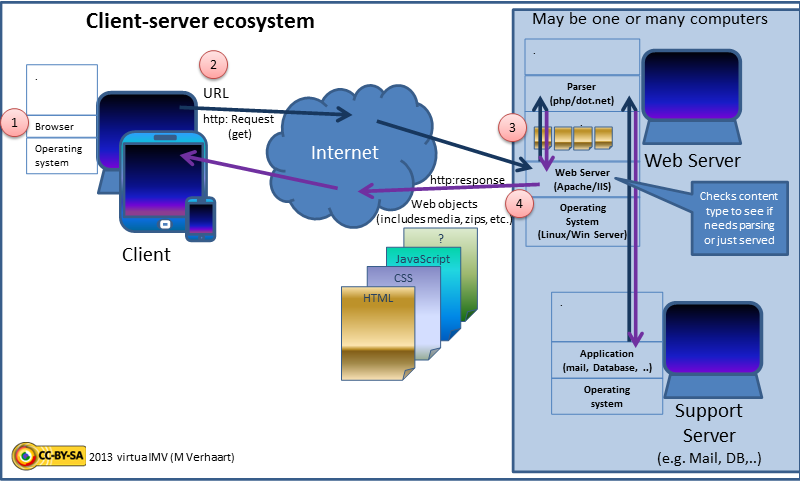
The whole interaction is a simple conversation:
- Request: Your browser (the client) sends an HTTP request to the server's IP address, asking for the files for a specific page.
- Response: The server finds the requested files (the HTML, CSS, JavaScript, and images) and sends them back to your browser as an HTTP response.
- Render: Your browser receives the files, pieces them together like a puzzle, and displays the fully-formed webpage on your screen.
This back-and-forth happens every time you click a link, load a new page, or watch a video online. It's a constant cycle of requests and responses between your client and countless servers across the globe.
Let's check your understanding of these core concepts.
What is the primary role of the Domain Name System (DNS)?
In the client-server model, your web browser (like Chrome or Safari) is considered the client.
And that's the basic blueprint of how the web works. It's a simple but powerful system that connects billions of clients and servers together.