Website Creation Fundamentals
Understanding Web Fundamentals
How the Web Works
When you type a website address into your browser and hit Enter, you kick off a lightning-fast chain of events. It feels instant, but behind the scenes, your computer is having a conversation with another computer, possibly thousands of miles away. Understanding this conversation is the first step in understanding the web.
The internet itself is just a giant network connecting billions of computers around the world. Think of it like a global postal system, but for digital information. Instead of sending physical letters, this system sends tiny pieces of data called packets. Everything you do online, from loading a webpage to sending an email, involves breaking down information into these packets, sending them across the network, and reassembling them at their destination.
The Client and the Server
Web traffic relies on a simple but powerful relationship called the client-server model. It’s like ordering food at a restaurant. You, the customer, are the client. You make a request for something specific, like a hamburger. The restaurant's kitchen, which has all the ingredients and cooks to prepare your meal, is the server.
In the digital world, your web browser (like Chrome, Firefox, or Safari) is the client. When you want to visit a website, your browser sends a request out over the internet. That request travels to a powerful, specialized computer called a server. The server's job is to store all the files, data, and code that make up a website. When it receives a request, it finds the correct files and sends them back to your browser.
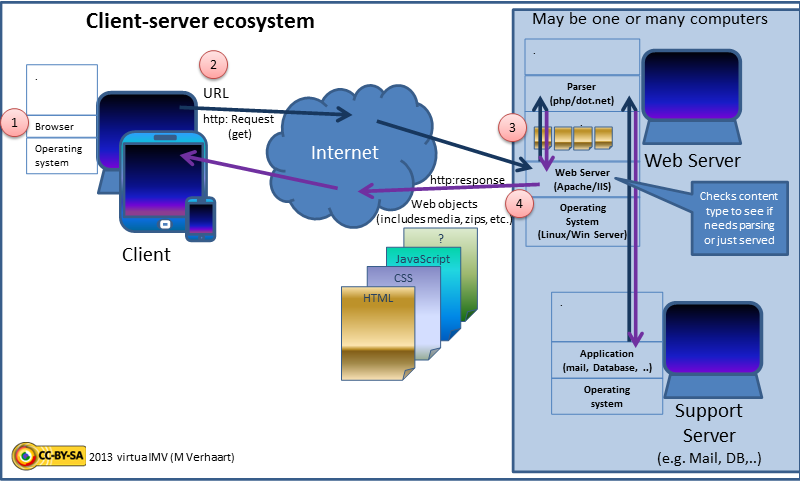
This model is efficient because servers are designed to handle thousands of requests at once, serving up websites to clients all over the world. Your personal computer doesn't need to store the entire internet, it just needs to know how to ask for the piece it wants.
Your Browser's Role
So, the server sends back a bunch of files, usually written in languages like HTML, CSS, and JavaScript. But those files are just code. They don't look like a website. This is where your browser does its most important job: it acts as an interpreter.
A web browser reads the code it receives from the server and renders it into the visual page you see on your screen. It follows the HTML instructions to structure the content, applies the CSS rules to style it with colors and layouts, and runs the JavaScript code to add interactive features like animations or forms.
Without a browser, a website is just a collection of text files. The browser is what turns that code into a functional, visual experience.
The Language of the Web
For clients and servers to communicate reliably, they need to follow a strict set of rules, or a protocol. The protocol of the web is called the Hypertext Transfer Protocol, or HTTP.
HTTP defines how requests and responses are structured. When your browser sends a request, it uses an HTTP command, like GET, to ask for a webpage. The server then sends back the files along with an HTTP status code to let the browser know if the request was successful.
| Method | Purpose | Common Status Code | Meaning |
|---|---|---|---|
GET | Requests data from a server. | 200 OK | The request succeeded. |
POST | Submits data to a server. | 404 Not Found | The server couldn't find the requested page. |
You've probably also seen HTTPS in website addresses. The 'S' stands for 'Secure'. HTTPS is simply a version of HTTP that encrypts the conversation between your browser and the server. This is like sending your request in a sealed, tamper-proof envelope instead of on a postcard. It ensures that sensitive information, like passwords or credit card numbers, can't be intercepted and read by others. Today, almost all legitimate websites use HTTPS to protect their users.
In the client-server model, what role does your web browser (like Chrome or Firefox) play when you request a webpage?
What is the primary job of a web browser after it receives files like HTML, CSS, and JavaScript from a server?
This fundamental back-and-forth between clients and servers, all guided by the rules of HTTP, is what makes the entire web run.