Web SaaS Tech Stack Fundamentals
Introduction to SaaS Architecture
The SaaS Blueprint
Software as a Service, or SaaS, is a way of delivering applications over the internet. Instead of installing and maintaining software on your own computer, you access it through a web browser. Think of it like streaming a movie instead of owning the DVD. You get all the benefits of the movie without having to store or manage the physical disc.
Software as a Service (SaaS) represents a cloud computing model where software applications are hosted and provided to users over the internet on a subscription basis.
This model has some major advantages. For one, it usually means lower upfront costs. You're subscribing, not buying expensive licenses. It also makes software accessible from anywhere with an internet connection. Plus, the provider handles all the updates and maintenance, so you're always using the latest version without any extra effort.
By outsourcing software management and infrastructure maintenance to SaaS providers, organizations can focus on their core competencies and strategic initiatives.
Core Components
Every SaaS application, from a simple project management tool to a complex financial platform, is built from a few fundamental components. Together, they form the application's architecture. A simple way to think about it is the classic client-server model. A user (the client) makes a request, and a powerful computer (the server) processes that request and sends a response back.
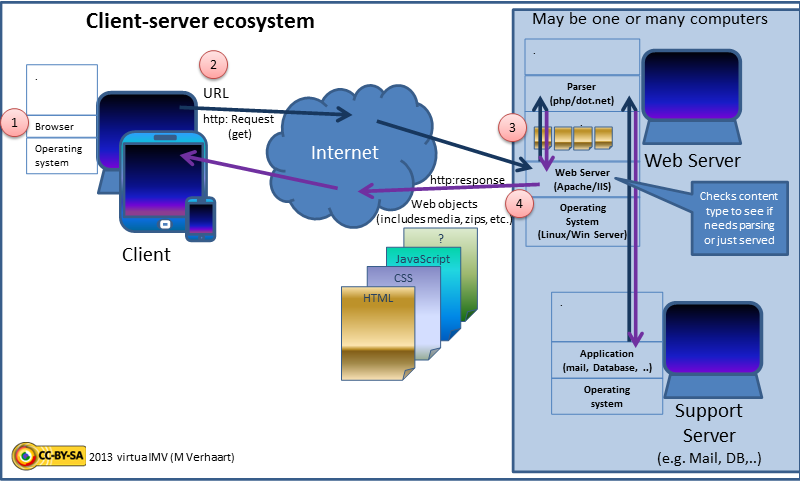
Let's break down the key parts of this structure:
-
Frontend (The Client): This is everything you see and interact with in your browser. It's the user interface, the buttons you click, and the forms you fill out. The frontend's main job is to present data and capture your input.
-
Backend (The Server): This is the engine of the application. It runs on remote servers and handles the business logic, data processing, user authentication, and all the other heavy lifting. When you click a button on the frontend, the backend is what does the work.
-
Database: This is where all the application's data is stored, organized, and retrieved. User profiles, settings, content—it all lives in the database. The backend communicates with the database to save and fetch information.
Key Design Considerations
Building a successful SaaS application isn't just about connecting these components. It requires careful planning around a few key principles. These aren't technical details, but high-level goals that shape the entire architecture.
| Consideration | Why It Matters |
|---|---|
| Scalability | The architecture must handle growth. Can it support 10 users as well as 10,000? |
| Security | Protecting user data is non-negotiable. Security must be built-in at every level. |
| Reliability | The application needs to be available and performant. Users depend on it to be online and fast. |
| Maintainability | The system should be easy to update and debug. A clean, organized architecture saves time and headaches later. |
These considerations influence every decision, from choosing a programming language to designing the database. A system that can't scale will fail under success. An unreliable one will drive users away. Getting the architecture right from the start is crucial for long-term success.
A thorough understanding of these elements will enable teams to create scalable, secure, and resilient cloud architectures that satisfy their particular business requirements as more and more organisations move to the cloud.
With these fundamentals in mind, we can start to explore each component in more detail.