Web Application Development Fundamentals
Introduction to Web Development
How the Web Works
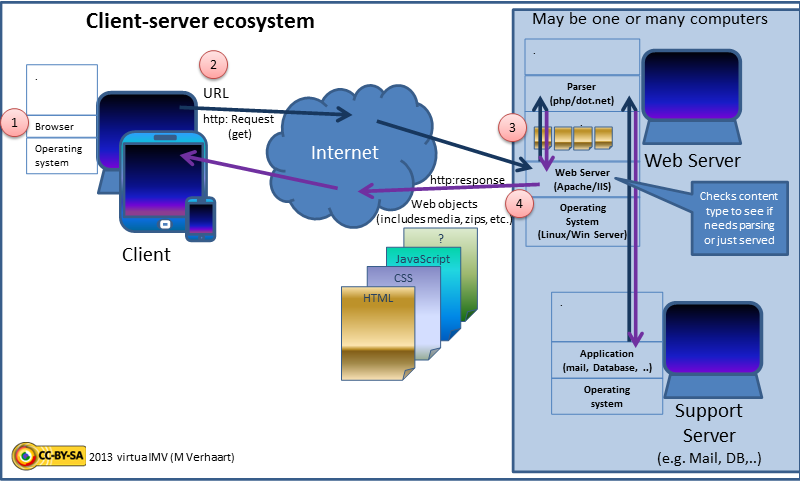
At its heart, a website is just a collection of files stored on a computer called a server. This isn't some magical, complex machine—it's just a computer that's always on and connected to the internet, waiting for people to ask for its files.
Your web browser, like Chrome, Firefox, or Safari, is the program you use to ask for those files. When you type a web address, your browser sends a request across the internet to the correct server. The server finds the requested files (like text, images, and code) and sends them back to your browser. Your browser then reads these files and displays them as a complete webpage. This whole conversation is called the request-response cycle.
The Building Blocks
Webpages are built using three core technologies that work together. Think of them like the components of a house.
HTML provides the structure, CSS handles the style, and JavaScript adds interactivity.
HTML (HyperText Markup Language) is the skeleton of a webpage. It defines the structure and content, like headings, paragraphs, and images. It tells the browser what each piece of content is.
<!-- This is the basic structure of an HTML page -->
<!DOCTYPE html>
<html>
<head>
    <title>My First Page</title>
</head>
<body>
    <h1>Hello, World!</h1>
    <p>This is a paragraph.</p>
</body>
</html>
CSS (Cascading Style Sheets) is the clothing. It tells the browser how to display the HTML elements. This includes colors, fonts, spacing, and the overall layout. CSS makes the web look good.
/* This CSS rule makes all h1 headings red */
h1 {
    color: red;
}
JavaScript (JS) provides the brains and interactivity. It's a programming language that lets you create dynamic content, control multimedia, animate images, and much more. If something on a webpage moves, changes, or responds to you without reloading the page, it's probably JavaScript at work.
// This JavaScript code shows a popup when a button is clicked
button.onclick = function() {
  alert('Button was clicked!');
};
Two Sides of the Coin
Web development is often split into two areas: client-side and server-side.
Client-side refers to everything that happens in your web browser. When a server sends files to your browser, the browser (the client) executes the code and displays the page. HTML, CSS, and JavaScript are all client-side technologies because they are interpreted by the browser.
Server-side refers to everything that happens on the server before the page is sent to your browser. This often involves tasks like pulling information from a database, processing a payment, or logging a user in. The server runs some code, prepares a custom HTML page based on the results, and then sends that finished page to the client.
| Client-Side | Server-Side | |
|---|---|---|
| Where it runs | In the user's web browser | On the web server |
| Core Technologies | HTML, CSS, JavaScript | Languages like Python, Node.js, PHP |
| Primary Job | Displaying content and handling user interaction | Processing data, database operations, user authentication |
Ready to check your understanding?
What is the primary role of a web server in the request-response cycle?
If a webpage were a house, which technology defines its fundamental structure, like the walls, rooms, and roof?
Understanding these core concepts—the roles of servers and browsers, the HTML/CSS/JS trio, and the client/server split—is the first step in learning web development.