Web Application Development Basics
Introduction to Web Development
The Two Sides of the Web
Think of a website like a restaurant. When you sit down, you see the dining area: the tables, the decor, the menu. This is the front-end. It’s everything you, the user, can see and interact with. It's designed to be pleasant and easy to use.
But behind the scenes, there's a kitchen. This is the back-end. It’s where your order is received, the food is cooked, and all the complex work happens. You don't see the kitchen, but it's essential for the restaurant to function. Web development is split the same way.
Front-End
noun
The part of a website or application that the user interacts with directly. It includes visual elements like layout, colors, and buttons.
Front-end development is also called client-side programming. The “client” is simply the web browser (like Chrome, Firefox, or Safari) on your computer or phone. This code runs on your device, not on a distant server.
Back-End
noun
The server-side of a website or application. It's responsible for storing and organizing data, and ensuring everything on the client-side works.
Back-end development is called server-side programming. The “server” is a powerful computer that stores the website's data and code. When you do things like log in to an account or post a comment, the back-end processes that information on the server.
How Websites Talk
So how do the client (your browser) and the server talk to each other? They communicate using a simple, constant cycle of requests and responses. This is the fundamental process that makes the web work.
Every time you click a link, submit a form, or type a web address, your browser sends a request to a server. The server then processes that request and sends a response back to your browser.
Let’s break it down:
- Request: You type
www.example.cominto your browser and hit Enter. Your browser sends an HTTP request to the server whereexample.comis hosted. This request essentially asks, "Please give me the content for your homepage." - Processing: The web server receives the request. It finds the necessary files (HTML for structure, CSS for style, JavaScript for interactivity) and assembles the page. If the page needs to show personalized information, like your username, the server might pull that from a database.
- Response: The server bundles everything up and sends it back to your browser as an HTTP response.
- Rendering: Your browser receives the files and renders them, displaying the complete webpage on your screen.
This whole conversation, the request-response cycle, happens in seconds.
The Web Server's Job
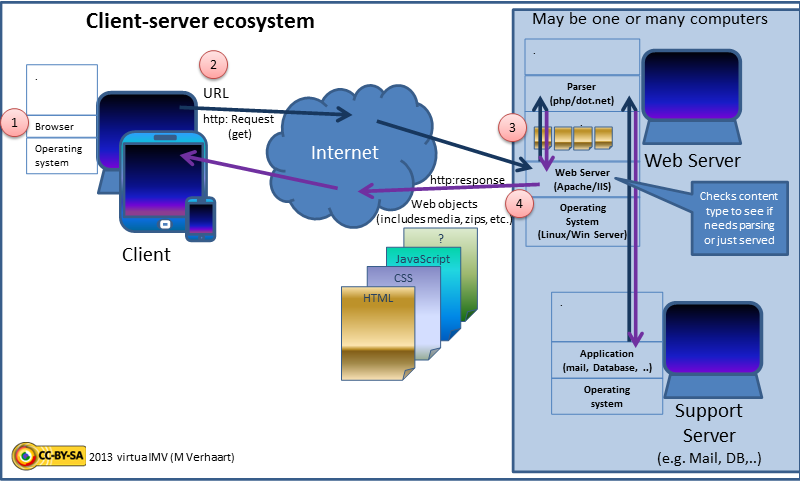
A web server is a combination of hardware and software that delivers web content. At its most basic, when a request for a specific file comes in, the server finds it and sends it back. Think of it as a librarian for the internet. You ask for a specific book (a webpage), and the librarian finds it and gives it to you.
But modern web servers are more than just file clerks. They host applications, run complex scripts, interact with databases, and handle security. They are the engines that power dynamic websites, from social media platforms to online stores. Without servers, the internet would just be a collection of disconnected files on individual computers.
The building blocks of front-end development are HTML, CSS, and JavaScript.
Every web application, no matter how complex, is built on this client-server architecture. The front-end handles the presentation, and the back-end manages the data and logic. Understanding this separation is the first step to understanding how the web works.
Time to check your understanding.
Using the restaurant analogy, what part of a website is comparable to the kitchen where the main work is done?
Front-end development is also known as _______-side programming.
Let's review the key terms from this section.
Now you know the basic structure of all websites and web applications. It's a constant conversation between your device and a server, all happening behind the scenes to bring the web to your screen.