Wazuh Security Monitoring
Introduction to Wazuh
Meet Wazuh
In the world of cybersecurity, teams are often buried in data from countless logs, alerts, and systems. It's a constant challenge to separate the real threats from the noise. This is where a tool like Wazuh comes in. At its core, Wazuh is an open-source security platform designed to protect your digital environments, from individual laptops to complex cloud infrastructures.
Think of it as a centralized security hub. Instead of using a dozen different tools that don't talk to each other, Wazuh provides a single, unified view of your security posture. It achieves this by combining two powerful cybersecurity concepts: SIEM and XDR.
SIEM and XDR Explained
To understand what makes Wazuh effective, we first need to break down these two acronyms. They represent different, but related, approaches to security.
SIEM
noun
Stands for Security Information and Event Management. A SIEM system collects, aggregates, and analyzes log data from numerous sources across an organization's IT infrastructure. Its primary goal is to spot trends, detect threats, and provide a comprehensive audit trail.
A SIEM is like a security camera system for your entire network. It records everything happening on your servers, firewalls, and applications. It then analyzes this footage to find suspicious patterns or specific events that might indicate a security breach. It gives you the full story of what happened.
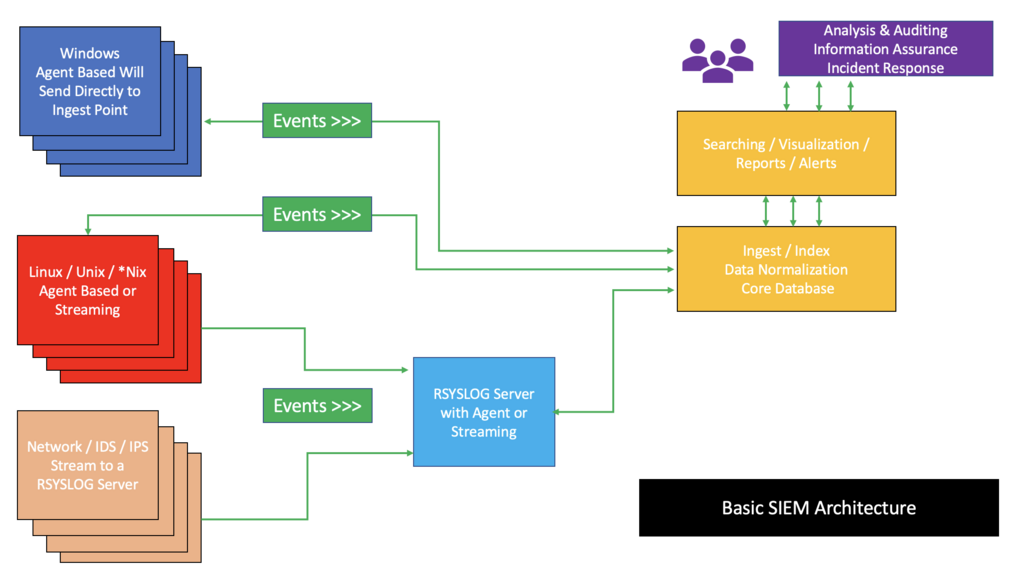
Now let's look at the other half of the equation.
XDR
noun
Stands for Extended Detection and Response. XDR goes beyond simple log analysis by collecting and correlating deeper data from endpoints (like laptops and servers), cloud services, and networks. It not only detects threats but also provides tools to respond to them automatically or manually.
If SIEM is the camera system, XDR is the active security guard watching the monitors. An XDR platform doesn't just record the event; it investigates it, understands its context, and takes action. This could mean isolating a compromised machine, blocking a malicious process, or alerting an analyst with a clear, prioritized set of response steps. It answers the question, what should we do about it?
Wazuh unifies these two functions. It combines the broad visibility of a SIEM with the deep analysis and response capabilities of an XDR.
Why This Matters
In modern cybersecurity, threats are more sophisticated than ever. They can move quickly across different parts of your infrastructure. A simple alert from a firewall log might be meaningless on its own, but when correlated with unusual activity on a user's laptop and strange traffic in a cloud environment, it paints a much clearer picture of an attack.
Wazuh's unified approach provides this critical context. It helps security teams see the bigger picture, allowing for faster detection and more effective response. Because it's open-source, it's also highly flexible and accessible to organizations of all sizes, without the hefty price tag of many commercial solutions.
| Feature | Benefit |
|---|---|
| Unified Platform | Combines SIEM and XDR for a single view of security. |
| Open Source | Free to use, highly customizable, and supported by a large community. |
| Broad Coverage | Protects endpoints, cloud workloads, containers, and servers. |
| Compliance Ready | Helps meet regulatory requirements like PCI DSS, GDPR, and HIPAA. |
By centralizing security data and empowering teams to act on it, Wazuh plays a vital role in helping organizations defend against complex cyber threats.