Waves of Appraisal Theory
Introduction to Appraisal Theory
Your Brain's Split-Second Judgment
Picture a large dog suddenly barking. One person might feel a surge of fear, their heart pounding as they back away. Another person might smile, seeing a playful friend who wants to say hello. The event is the same: a dog barked. But the emotional reactions are completely different. Why?
This is the central question that appraisal theory seeks to answer. It suggests that our emotions are not direct reactions to events in the world. Instead, they arise from our interpretation or appraisal of those events.
It's not the event, but your evaluation of the event, that creates the emotion.
In other words, you feel what you feel because of the meaning you assign to what’s happening. This process is often instantaneous and unconscious. You don't stop and think, "That dog is a threat, therefore I should feel fear." Your brain makes that judgment in a fraction of a second, based on your personal history, beliefs, and goals.
appraisal
noun
In psychology, the cognitive process of evaluating the significance of an event or situation to one's well-being.
A Shift in Thinking
For a long time, emotions were thought of as primitive, almost automatic physical responses. You see a bear, your heart races, and that physical reaction is the fear. But this couldn't explain the wide range of human emotions or why people react so differently to the same situation.
In the mid-20th century, pioneers like Magda Arnold and Richard Lazarus started to challenge this view. They argued that cognition—our thought process—couldn't be left out of the equation. Arnold was one of the first to use the term "appraisal," proposing that an initial, lightning-fast assessment of a situation as good, bad, or neutral happens before we feel an emotion. Lazarus expanded on this, developing a comprehensive theory that linked specific types of appraisals to specific emotions. This cognitive revolution changed the way we understand our feelings.
The Basic Principles
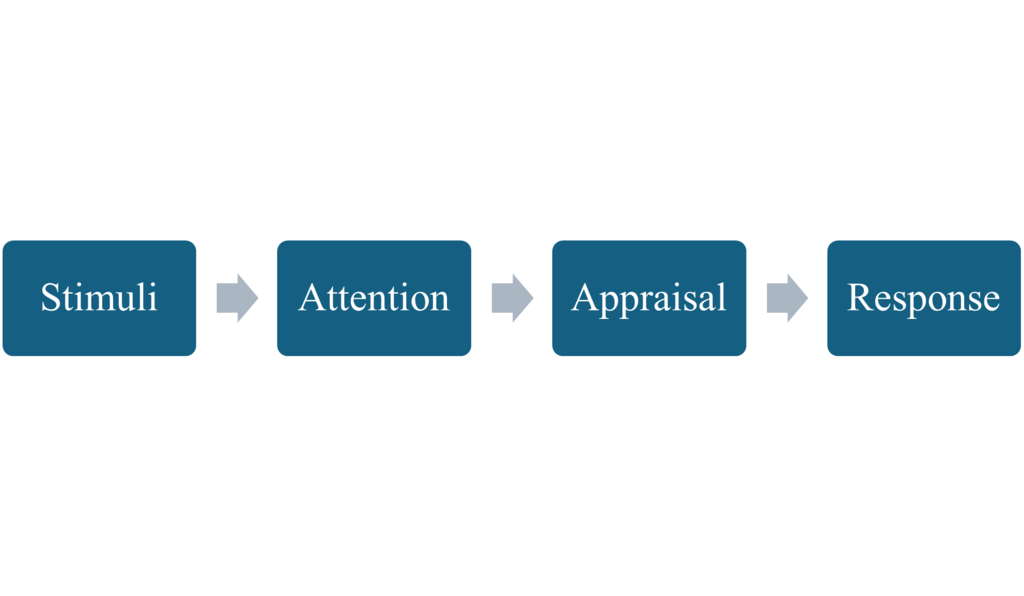
Appraisal theory rests on a few simple but powerful ideas. First, emotions are a process, not just a simple reaction. There's a step between the event and the feeling.
Second, these appraisals are deeply personal. Your goals, values, and past experiences all shape how you interpret an event. If you were bitten by a dog as a child, your appraisal of a barking dog will be very different from someone who grew up with friendly pets. This is why a surprise party can delight one person and overwhelm another.
Finally, the specific nature of your appraisal determines the specific emotion you feel. If you appraise a situation as a threat, you might feel fear. If you appraise it as an unfair offense against you, you might feel anger. If you see it as a loss, you'll feel sadness. The situation itself is neutral until your mind gives it meaning.
Appraisal is the central construct in a cognitive understanding of emotion and is an estimate of personal significance of an event.
This foundational idea—that how we think determines how we feel—has had a massive impact, not just in psychology but also in fields like therapy and artificial intelligence. Understanding that our evaluations drive our emotions gives us a powerful tool for managing them.
Ready to check your understanding of these core ideas?
According to appraisal theory, what is the direct cause of an emotional response?
True or False: Appraisal theory posits that the process of interpreting an event to produce an emotion is always a slow and conscious process.
This is just the beginning. Now that we've covered the basic premise of appraisal theory, we can explore the more detailed models that explain exactly how our brains make these split-second judgments.