Wake Up Naturally Without an Alarm
Understanding Circadian Rhythms
Your Body's Internal Clock
Have you ever wondered why you start to feel sleepy around the same time each night, or why you naturally wake up on weekends even without an alarm? The answer lies within your body's own master timekeeper: your circadian rhythm. Think of it as a 24-hour internal clock, ticking away in the background to carry out essential functions and processes.
This internal clock doesn't just manage sleep. It also regulates your appetite, mood, body temperature, and hormone release throughout the day.
Circadian Rhythm
noun
A natural, internal process that regulates the sleep-wake cycle and repeats on each rotation of the Earth, roughly every 24 hours.
The Brain's Master Clock
So where is this master clock located? Deep inside your brain, in a part of the hypothalamus, sits a tiny cluster of about 20,000 nerve cells called the suprachiasmatic nucleus, or SCN for short. Though it's no bigger than a grain of rice, the SCN acts as the central pacemaker for your entire body.
It coordinates all the other 'clocks' in your various organs, from your liver to your digestive system, ensuring they all work in harmony. The SCN gets its timing information from the world around you, primarily through your eyes.
When light enters your eyes, it sends a direct signal to the SCN, letting it know that it's daytime. The SCN then sends out messages to the rest of your body to be awake and active. This is the most crucial signal for keeping your internal clock synchronized with the outside world.
Light as the Great Conductor
Light is the single most powerful external cue for your circadian rhythm. Morning sunlight is particularly effective at reinforcing your sleep-wake cycle. It tells your SCN to suppress the production of melatonin, the hormone that makes you feel sleepy.
As daylight fades, the SCN gets the message that night is approaching. It then signals the pineal gland, another small structure in the brain, to start releasing melatonin. Your melatonin levels rise in the evening, peaking in the middle of the night to help you stay asleep, and then fall as morning approaches, helping you wake up.
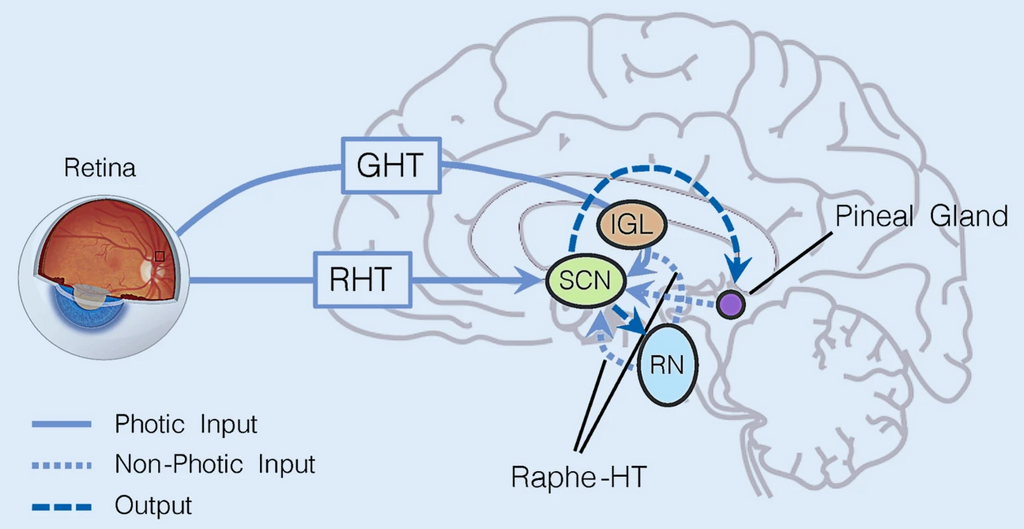
This elegant system is designed to keep you aligned with the 24-hour day. When your circadian rhythm is properly synchronized, you feel more alert during the day and sleep more soundly at night. A stable rhythm supports not just sleep, but also mental clarity, metabolism, and overall well-being. When it's out of sync, you might feel groggy, unfocused, and generally 'off'.
Your circadian rhythm is your body’s internal clock—a complex system synchronized primarily by light exposure, regulating nearly every biological function on a 24-hour cycle.
Now, let's test your understanding of these core concepts.
What is the name of the tiny cluster of nerve cells in the brain that acts as the body's master internal clock?
What is the single most powerful external cue for keeping your circadian rhythm synchronized?