Volume of Rectangular Prisms
Understanding Volume
Space Invaders
Look around you. The chair you're sitting on, the phone in your hand, and even the air in the room all take up space. Volume is simply a measure of how much three-dimensional space an object occupies. It’s not about weight or shape, but about the total amount of room it fills.
Every object you can touch and hold has volume. From a tiny grain of sand to a giant skyscraper, each one carves out its own little section of the universe.
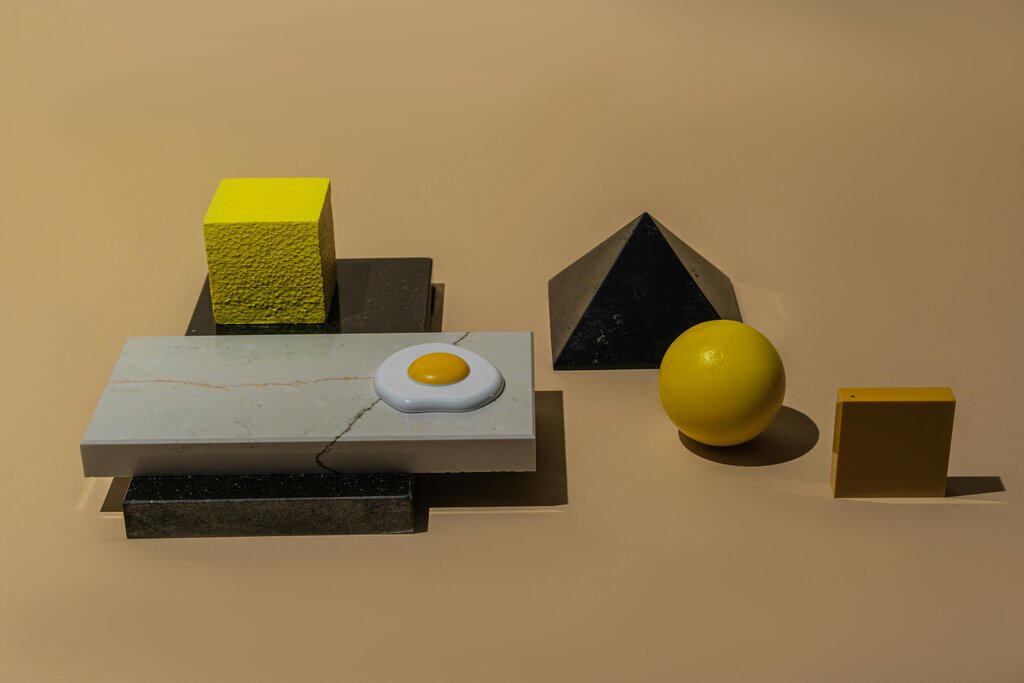
Flat vs. Full
It’s easy to mix up volume with area, but they measure fundamentally different things. Area measures a flat, two-dimensional surface, like the amount of carpet needed to cover a floor. It has length and width, but no height or depth. You can find the area of a shadow on the ground.
Volume, on the other hand, measures a three-dimensional object that has depth. It’s not about the surface; it’s about the entire space the object fills. Think of the amount of water needed to fill a swimming pool, not just the area of the water's surface.
A sheet of paper has area. A stack of paper has volume.
Measuring in Cubes
Since volume is a 3D measurement, we need a 3D unit to measure it. That's where the cube comes in. To find an object's volume, we can imagine filling it with tiny, perfect cubes of a standard size and counting how many fit inside.
This is why units for volume are always "cubic" units: cubic inches, cubic meters, cubic feet, and so on.
A cubic centimeter () is the space taken up by a cube that is 1 centimeter long, 1 centimeter wide, and 1 centimeter high. If a small box has a volume of 10 cubic centimeters, it means that 10 of these 1x1x1 cm cubes could fit perfectly inside it.
Understanding this concept of filling space with unit cubes is the key to measuring the volume of any 3D object. Soon, you'll learn how to calculate this without having to count thousands of tiny blocks.