Voltage Amps Watts Explained
Voltage and Current
The Push and the Flow
To understand electricity, it helps to think about water moving through pipes. Imagine a tall water tower. The height of the water creates pressure. The more water in the tower, the more pressure you get at the bottom. This pressure is what pushes water through the pipes when you open a tap.
In an electrical circuit, voltage is like that water pressure. It's the push or force that makes electricity move. The actual flow of water through the pipes is like current. It’s the movement of electric charge itself.
Without pressure, water doesn't flow. Without voltage, current doesn't flow.
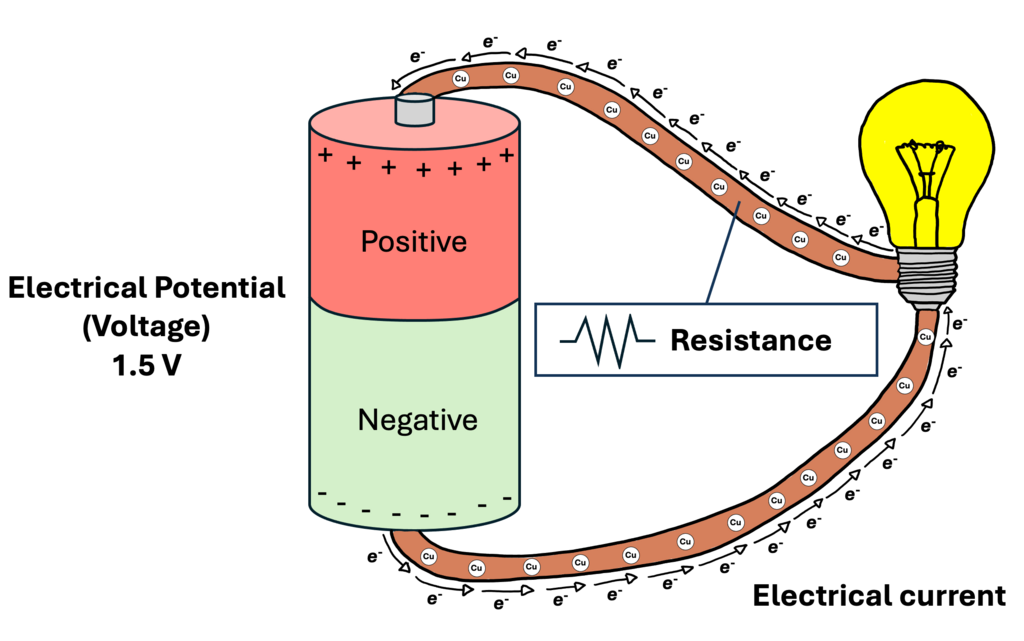
Defining Voltage
Voltage is the difference in electrical potential energy between two points in a circuit. Think of it as a slope. A ball won't roll on a flat surface, but it will roll down a hill. The steepness of that hill is like voltage. It provides the potential for movement.
Voltage doesn't flow through a circuit; it's the pressure applied to a circuit.
A battery, for example, creates a voltage. Its positive terminal has a higher electrical potential than its negative terminal. When you connect something like a light bulb between these two terminals, the voltage pushes electric charges from the high-potential end to the low-potential end, creating a current.
Volt
noun
The standard unit of measurement for electrical potential difference or voltage.
Understanding Current
If voltage is the push, current is what's being pushed. Specifically, current is the flow of electric charge—usually tiny particles called electrons—through a material. It’s the rate at which charge is moving past a certain point.

Returning to our water analogy, current is like the volume of water flowing through the hose per second. A small trickle is a low current, while a gushing firehose is a high current. In electronics, a higher current means more charge is flowing through the circuit each second. This flow is what actually does the work, like lighting up a bulb or spinning a motor.
Ampere
noun
The standard unit of measurement for electric current, often shortened to "amp."
The relationship is simple: voltage causes current. If you increase the voltage in a circuit (like using a more powerful battery), you increase the push on the electric charges, which makes more of them flow. This results in a higher current.