Volcanoes Unveiled The Science of Fire and Earth
Earth's Structure
A Journey to the Center
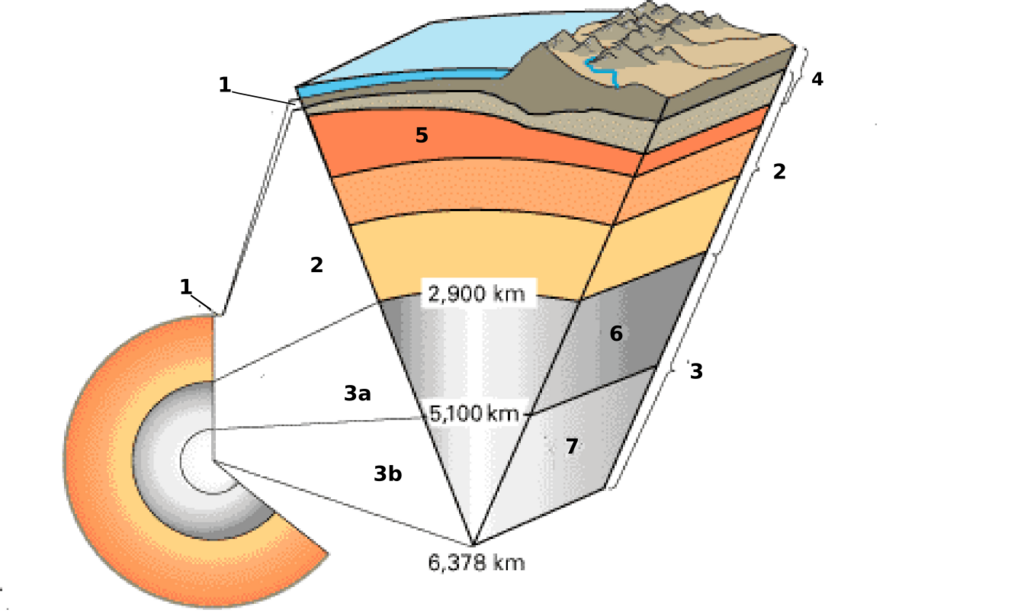
Planet Earth isn't a solid ball of rock. It's made of distinct layers, almost like an onion. If you could travel to its center, you'd pass through three main zones: a thin outer crust, a thick middle layer called the mantle, and a superheated core. Each layer has its own unique properties, composition, and role in shaping the world we see on the surface.
Crust and Mantle
The crust is the layer we live on. It's incredibly thin compared to the rest of the planet, like the skin of an apple. There are two types. Continental crust is what makes up the landmasses. It's thicker, less dense, and primarily composed of rocks like granite. Oceanic crust, found under the oceans, is thinner, denser, and made of basalt.
Beneath the crust lies the mantle, a layer of solid silicate rock that makes up about 84% of Earth's volume. It's not a molten sea of lava, as is often imagined. Instead, it's so hot that it behaves like a very thick, slow-moving fluid over geological timescales, a property known as plasticity. Think of it like a river of rock flowing in ultra-slow motion.
The uppermost, rigid part of the mantle combines with the crust to form a solid layer called the lithosphere. Below that is the asthenosphere, a hotter, more ductile part of the mantle that flows.
The Core
Deeper still is the core, which is made almost entirely of iron and nickel. The core itself has two parts. The outer core is a spinning ball of molten metal. The movement of this liquid iron is what generates Earth's magnetic field, which protects us from harmful solar radiation.
At the very center is the inner core. Even though it's the hottest part of the planet, the immense pressure from the layers above is so great that it forces the iron and nickel into a solid state. It's a solid metal ball hotter than the surface of the sun.
Heat and Magma
Where does all this heat come from? Some is leftover from the planet's formation 4.5 billion years ago, but a significant amount is continuously generated by the radioactive decay of elements within the mantle and crust. This internal furnace powers the planet.
Heat moves from the hot core towards the cooler surface primarily through convection. Hot, less-dense rock in the mantle slowly rises, cools near the surface, and then sinks, creating massive, slow-moving currents. These convection currents are the engine driving many geological processes.
This heat and pressure are what create magma, which is molten or semi-molten rock found beneath the surface. Magma isn't a permanent, planet-wide layer. Instead, it forms in specific areas of the upper mantle and lower crust under certain conditions.
One common way magma forms is through decompression melting. As hot mantle rock rises in convection currents, the pressure on it decreases. This lowering of pressure reduces the rock's melting point, causing it to turn into liquid magma. Another process involves adding water or carbon dioxide, which also lowers the melting point of rock, allowing it to melt at lower temperatures. These pockets of magma are the source for all volcanic activity on Earth.
If you were to travel from the surface to the very center of the Earth, in which order would you pass through its main layers?
What is the primary source of Earth's magnetic field?
Understanding these layers is the first step to understanding how and why volcanoes erupt.