Volcano Eruptions Explained
Introduction to Volcanology
Earth’s Fiery Heart
To understand volcanoes, we first need to look deep inside our planet. The ground beneath our feet is just a thin skin called the crust. Below that lies a massive, hot, and slowly churning layer known as the mantle. Deeper still is the core, a super-heated ball of metal.
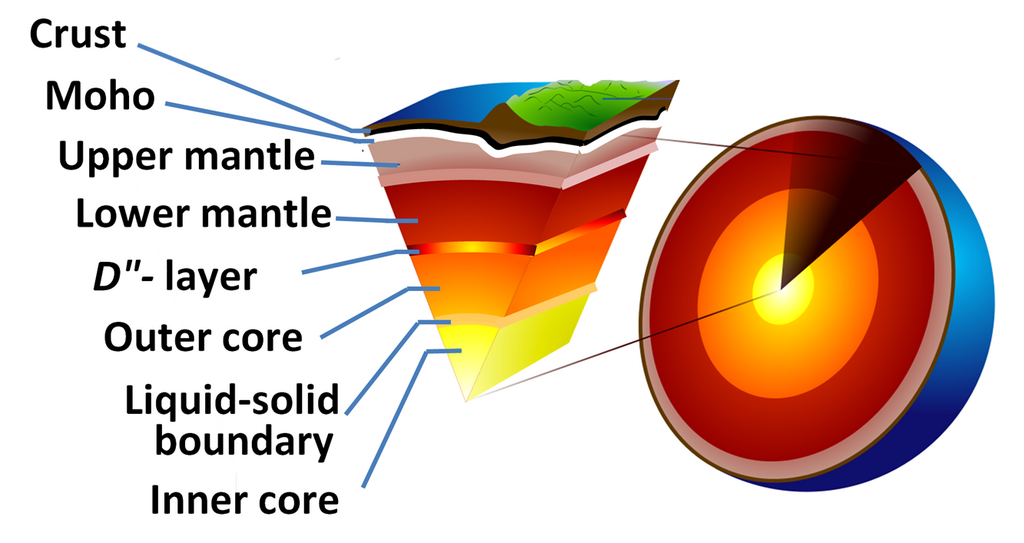
The mantle isn't a sea of liquid rock, as many people imagine. It's mostly solid, but it's so hot that it can flow over millions of years, like extremely thick tar. This intense heat is the engine for all volcanic activity. It's in the upper parts of this mantle, and in the crust above it, that the story of volcanoes begins.
The Making of Magma
Volcanoes are fueled by magma, which is molten rock found beneath the Earth's surface. But since the mantle is mostly solid, what causes rock to melt and form magma in the first place? It's not just about heat. Pressure and the presence of other substances, like water, play crucial roles. There are three main ways magma is born.
Magma
noun
Molten or semi-molten natural material from which all igneous rocks are formed. Magma is found beneath the surface of the Earth.
First is decompression melting. As rock from the deep mantle rises, the pressure on it decreases. This drop in pressure lowers the rock's melting point, causing it to turn into liquid magma, even without any extra heat.
Second is flux melting. When water or other volatile compounds are added to hot rock, they break chemical bonds and dramatically lower the rock's melting point. This allows it to melt at temperatures where it would otherwise remain solid.
Finally, there's heat transfer. This is the most straightforward method. When existing magma rises into the colder crust, it transfers its intense heat to the surrounding rock, causing it to melt and become magma itself.
Once formed, magma is less dense than the solid rock around it, so it begins to rise. It can collect in underground pockets called magma chambers. If the magma finds a path to the surface, a volcanic eruption occurs.
A Restless Planet
Most volcanoes aren't randomly placed; they appear in specific zones around the globe. This pattern is explained by plate tectonics, the theory that Earth's outer crust is broken into giant, shifting plates. Volcanic activity is concentrated where these plates interact.
Volcanoes are found where tectonic plates are pulling apart, crashing together, or where the mantle is unusually hot.
At divergent boundaries, plates pull away from each other. As they separate, pressure on the underlying mantle is released, causing decompression melting. This creates chains of volcanoes, like the Mid-Atlantic Ridge on the ocean floor.
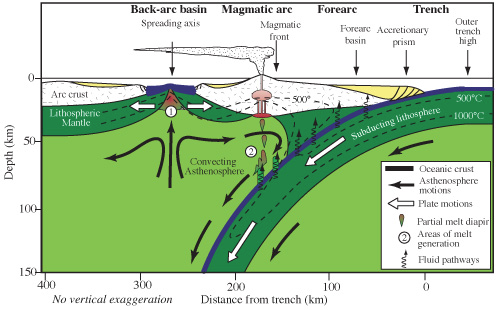
At convergent boundaries, one plate slides beneath another in a process called subduction. The subducting plate carries water down into the mantle. This water triggers flux melting, forming magma that rises to create volcanic arcs, like the Andes Mountains or the islands of Japan.
Volcanoes can also form far from plate boundaries over hot spots. These are areas where plumes of exceptionally hot material from deep within the mantle rise up, melting the crust above them. As a tectonic plate moves over a stationary hot spot, it creates a chain of volcanoes. The Hawaiian Islands are a classic example of this process.
Why Volcanoes Erupt
A volcano erupts when magma, driven by buoyancy and pressure, breaks through the Earth's surface. Think of it like a bottle of soda. The dissolved gases in the soda are held in solution by the pressure inside the sealed bottle. Magma works similarly, containing dissolved gases like water vapor and carbon dioxide under immense pressure.
As magma rises toward the surface, the pressure drops. This allows the dissolved gases to expand and form bubbles. This process is called exsolution.
The formation and rapid expansion of these gas bubbles drastically decreases the magma's density, forcing it upward with even greater speed. The volume of gas can increase by thousands of times as it nears the surface.
This explosive expansion is the primary driver of most eruptions. The more gas trapped in the magma, and the more difficult it is for that gas to escape, the more violent the eruption is likely to be.
Ready to test your knowledge on the forces that shape our planet?
Which statement best describes the Earth's mantle?
At a convergent boundary, one tectonic plate slides under another, carrying water down with it. This water lowers the melting point of the hot rock above, causing it to melt. What is this process called?
Understanding these fundamental processes—from the planet's internal heat to the behavior of gases in magma—is the key to unlocking the secrets of volcanoes.