Vocal Sight-Reading Mastery
Introduction to Musical Notation
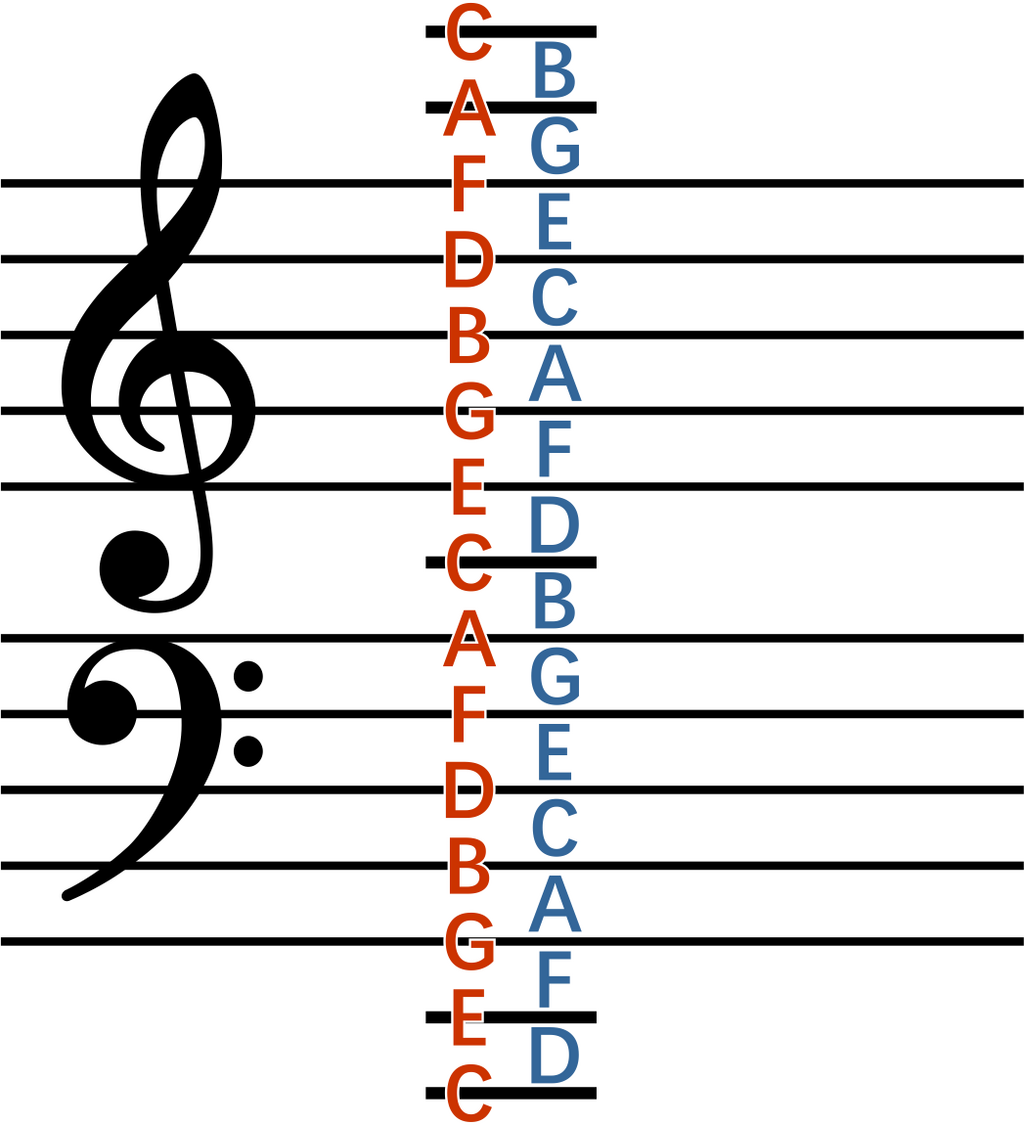
The Musical Staff
Musical notation is a system for writing down music. It's like a recipe that tells you which notes to sing and when. The foundation of this system is the staff (or stave), which consists of five horizontal lines and four spaces.
At the beginning of the staff, you'll always find a clef. The clef tells you the approximate pitch range, or how high or low the notes are. For singing, you'll most often see two types:
The Treble Clef (or G-clef) is for higher-pitched voices and instruments. The Bass Clef (or F-clef) is for lower-pitched voices and instruments.
Each line and space on the staff represents a specific musical pitch, named after the first seven letters of the alphabet: A, B, C, D, E, F, and G. Where a note is placed on the staff tells you which pitch to sing.
To remember the note names, musicians often use mnemonics. For the treble clef, the lines are Every Good Boy Deserves Fudge, and the spaces spell out FACE. For the bass clef, the lines are Good Boys Do Fine Always, and the spaces are All Cows Eat Grass.
Notes and Rhythm
Pitch is only half the story. Music also needs rhythm. The shape of a note tells you how long to hold it. This duration is measured in beats.
A note has two main parts: the note head (the oval part) and sometimes a stem (the vertical line). Whether the note head is filled in or open, and whether it has a stem, helps determine its value.
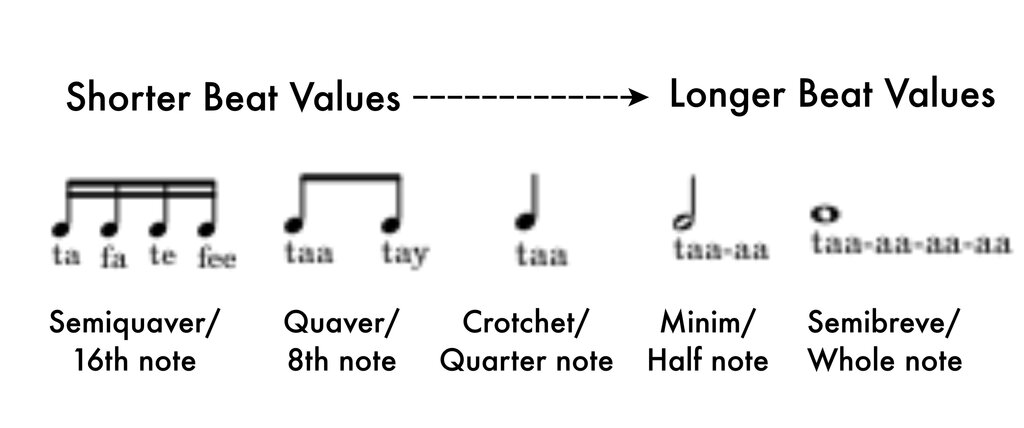
Here are the most common note values you'll encounter:
- Whole Note: Looks like an open oval. It's typically the longest note, often held for four beats.
- Half Note: An open oval with a stem. It lasts for half the duration of a whole note, usually two beats.
- Quarter Note: A filled-in oval with a stem. It lasts for a quarter of a whole note's duration, typically one beat.
- Eighth Note: A filled-in oval with a stem and a flag. It's held for half the duration of a quarter note. Eighth notes are often connected by a beam to make them easier to read.
The Sound of Silence
Music isn't just about the sounds you make; the silences are just as important. In notation, periods of silence are marked by rests. Every note value has a corresponding rest of the same duration.
| Rest Name | Appearance | Duration (in beats) |
|---|---|---|
| Whole Rest | A rectangle hanging from a line | 4 beats |
| Half Rest | A rectangle sitting on a line | 2 beats |
| Quarter Rest | A squiggly line | 1 beat |
| Eighth Rest | A line with one flag | 1/2 beat |
A good way to remember the whole and half rests: a whole rest is "heavier" so it hangs down from the line, while a half rest is "lighter" so it sits on top.
Putting It Together
Notes and rests are organized into small groups called measures (or bars), which are separated by vertical lines called bar lines. This structure makes music easier to read and follow.
At the beginning of a piece of music, right after the clef, you'll see a time signature, which looks like a fraction. The most common time signature is 4/4, often called "common time." It means there are four beats in every measure, and the quarter note gets one beat. All the notes and rests in a measure must add up to the total number of beats defined by the time signature.
Look at the treble clef in the image above. The first measure contains a quarter note (1 beat), two eighth notes (1 beat total), and a half note (2 beats). Add them up: $1 + 1 + 2 = 4$. The second measure has a quarter rest (1 beat), a quarter note (1 beat), and a half note (2 beats), which also adds up to four. This combination of pitch (note placement) and rhythm (note values and rests) creates the melodies we sing.
Ready to check your understanding? Let's see what you've learned.
What is the primary function of a clef at the beginning of a musical staff?
Using the common mnemonic for the spaces in the treble clef, what note is found in the top space?
Understanding these fundamental building blocks is the first step to reading any piece of music. With a little practice, these symbols will become as familiar as letters in the alphabet.