VLIW Processor Performance Optimization
Optimizing Tree Traversal and Hashing
Optimizing Tree Traversal
Tree traversal algorithms are notoriously difficult to optimize on VLIW processors. The core problem is their branching nature. A simple binary tree traversal involves a decision at every node: go left or go right. These conditional branches disrupt the long, predictable instruction sequences that VLIW architectures thrive on. Since the compiler schedules instructions statically, it can't know which path the traversal will take at runtime.
Frequent, unpredictable branches are the enemy of VLIW performance. They force the compiler to be conservative, leaving functional units idle.
One effective technique is to reduce the number of conditional branches through predication, if the architecture supports it. Instead of a hard branch, we can conditionally execute instructions. For example, we can load both the left and right child pointers, and then use a conditional move (cmov) instruction to select the correct one based on the traversal logic. This converts a control dependency into a data dependency, which is much easier for a VLIW compiler to schedule around.
Another powerful method is to change the data structure itself. Instead of storing nodes with pointers, we can represent the tree as a flat array. This is common for complete binary trees, like binary heaps. A node at index has its children at indices and . This eliminates pointers and pointer-chasing entirely. Memory accesses become predictable arithmetic calculations, which VLIW compilers can easily schedule in parallel with other operations, leading to significant speedups.
Enhancing Hashing Algorithms
Hashing algorithms, especially those used in hash tables, present a different challenge: memory latency. The core operation involves calculating a hash value and then accessing a memory location at or near that index. These memory accesses are often random and unpredictable, leading to cache misses. While the VLIW processor's functional units wait for data to be fetched from main memory, they sit idle, wasting precious cycles.
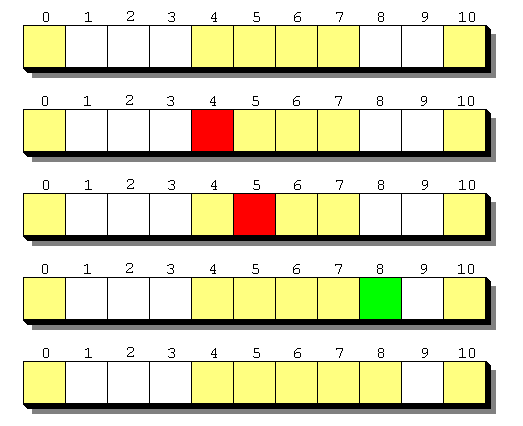
To combat this, we can use software prefetching. The compiler, or the programmer, can insert prefetch instructions for data that will be needed soon. For example, when handling a collision in a hash table that uses chaining (linked lists), we can prefetch the next node in the chain while processing the current one. This hides the memory latency, as the data is likely to be in the cache by the time it's needed.
The goal is to overlap memory access with computation, ensuring the processor's functional units are always busy.
We can also optimize the hash function itself. Many hash functions involve a series of independent arithmetic and bitwise operations. These are perfect candidates for instruction-level parallelism. A VLIW compiler can schedule these operations to execute simultaneously across different functional units (e.g., an integer ALU, a shifter, and a logical unit). By carefully choosing a hash function with high ILP, we can ensure the calculation phase is as fast as possible.
Challenges and Trade-offs
Optimizing for VLIW isn't a free lunch. These techniques come with trade-offs. Predication, for instance, executes instructions on both potential paths, which can be wasteful if one path is much more common than the other. The wasted work might negate the benefit of avoiding a branch.
Similarly, flattening a tree into an array is only practical for dense or complete trees. For sparse, irregular trees, the array representation would be enormous and mostly empty, wasting memory. Software prefetching also requires careful tuning. Prefetching too aggressively can pollute the cache with unneeded data, evicting useful data and actually increasing cache misses. As always, optimization requires understanding the specific algorithm and the data it operates on.
Let's test your understanding of these optimization strategies.
What is the primary reason tree traversal algorithms are difficult to optimize on VLIW processors?
How does representing a complete binary tree as an array, where a node at index has children at and , improve performance on a VLIW processor?
Applying these techniques requires a deep understanding of both the algorithm and the underlying VLIW architecture. It's a process of balancing trade-offs to squeeze the most performance out of the hardware.