Visualizing the ICT Timeline
Understanding ICT Milestones
The Spark of the Digital Age
Before the 1950s, computers were colossal machines, filled with fragile, power-hungry vacuum tubes that burned out frequently. The invention of the transistor in 1947 by scientists at Bell Labs changed everything. It was a tiny, reliable, solid-state switch that could control the flow of electricity.
This small device is the fundamental building block of virtually all modern electronics. Transistors allowed engineers to shrink computers from the size of a room to something that could fit on a desk, and eventually, into your pocket. They were more efficient, generated less heat, and were far more durable than vacuum tubes, paving the way for the digital revolution.
Connecting the World
As computers became more common, the next logical step was to connect them. The forerunner to the internet was ARPANET, a U.S. military project launched in the 1960s. Its goal was to create a communication network that could withstand a potential attack by having no central point of failure.
To achieve this, engineers developed a system called packet switching. Instead of sending data in one continuous stream, it's broken into small pieces, or packets. Each packet is sent independently and can take a different route to its destination, where they are all reassembled. This decentralized approach, governed by a set of rules called the TCP/IP protocol, made the network incredibly robust and scalable. It’s the same fundamental principle the internet uses today.
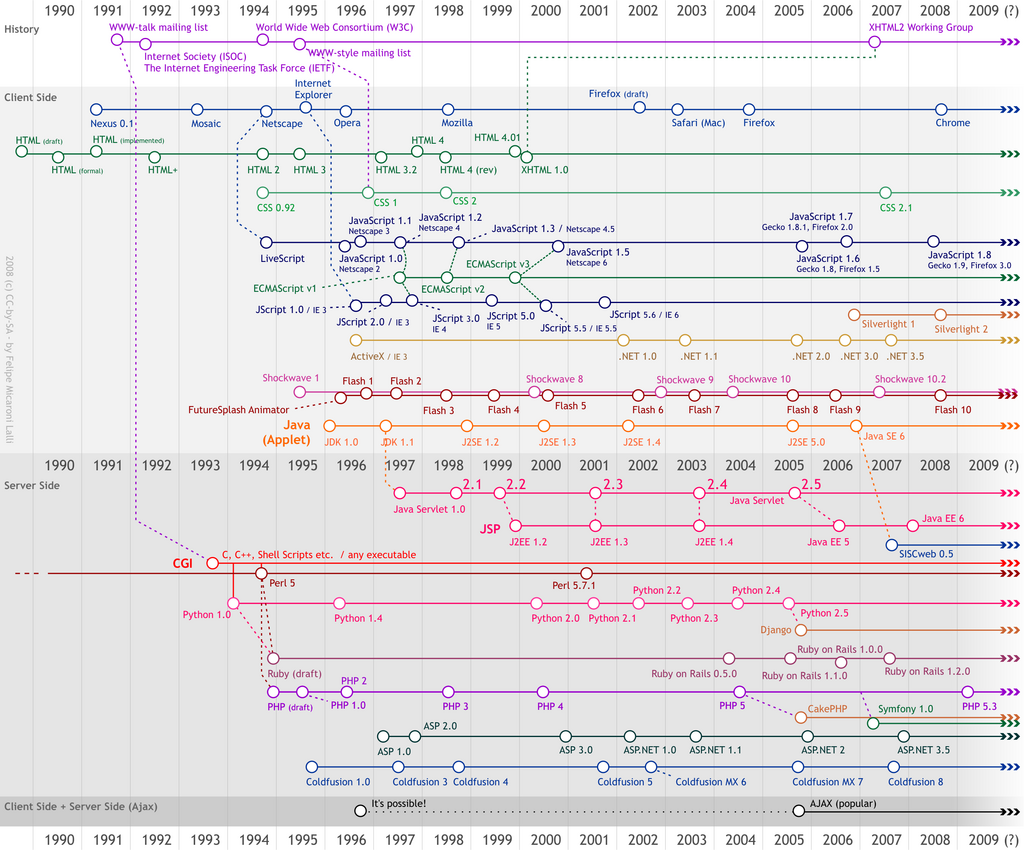
The development of the World Wide Web in the early 1990s made this network accessible to everyone, not just researchers and the military. It introduced a user-friendly way to navigate the internet using hyperlinks, browsers, and websites.
Power in Your Pocket
The same principles of miniaturization that gave us the transistor also drove the evolution of computing hardware. Computers evolved from massive mainframes to minicomputers, and then to the personal computers (PCs) that started appearing in homes and offices in the 1980s. Each generation became smaller, cheaper, and more powerful, a trend famously described by Moore's Law, which observed that the number of transistors on a microchip doubles approximately every two years.
This relentless progress eventually merged two separate technologies: computing and telephony. The emergence of mobile communication brought us from simple car phones to handheld devices that are now powerful computers connected to a global network.
| Generation | Key Feature | Impact |
|---|---|---|
| 1G (1980s) | Analog Voice | First truly mobile phones, but with poor quality and security. |
| 2G (1990s) | Digital Voice & SMS | Improved call quality, encryption, and introduced text messaging. |
| 3G (2000s) | Mobile Data | Enabled web browsing, email, and basic apps on phones. |
| 4G (2010s) | High-Speed Data | Made video streaming and modern app ecosystems possible. |
| 5G (2020s) | Low Latency & High Bandwidth | Supports real-time applications, IoT, and enhanced mobile broadband. |
Underpinning all of this is the continuous advancement in telecommunications infrastructure. The development of fiber optic cables, which transmit data as pulses of light, created the high-speed backbone that the modern internet relies on. These cables can carry immense amounts of information over long distances, connecting continents and enabling the seamless, data-rich experiences we take for granted today. From a single transistor to a global web of connected devices, each milestone built upon the last, creating the connected world we live in.
What was the primary advantage of the transistor over the vacuum tube in early computers?
ARPANET, the forerunner to the internet, used packet switching to achieve what primary goal?