Visualizing Reality and Physics
Introduction to Physics
What is Physics?
Physics is the science of how everything works. It’s the rulebook for the universe, from the smallest particles of matter to the vast expansion of space. Physicists observe the world, look for patterns, and try to describe those patterns with fundamental principles and mathematical laws.
At its heart, physics is about asking basic questions: Why do things fall down? What is light? How does the sun keep shining? The goal is to answer these questions not just with words, but with simple, powerful ideas that can predict how things will behave in any situation.
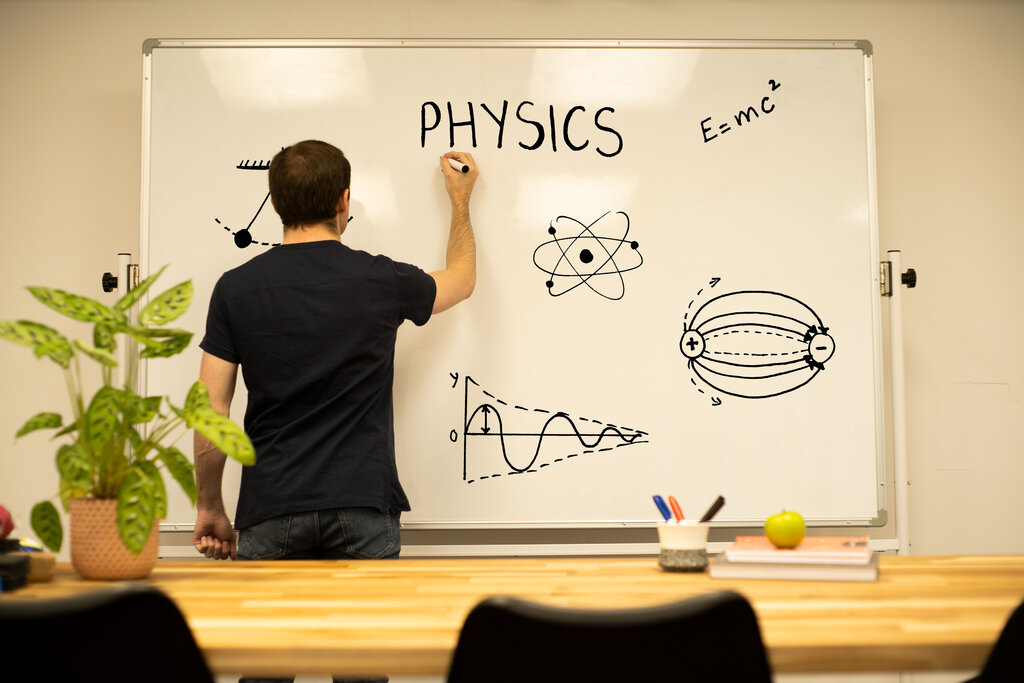
To start understanding these rules, we first need a common language to describe the world. This language is built on a few core concepts.
The Building Blocks
To describe the physical world accurately, we need to measure it. Physicists rely on a set of fundamental quantities. The three most basic are length, mass, and time. Everything else we'll discuss, like speed and force, is built from these.
mass
noun
The amount of matter, or "stuff," in an object. It's a measure of an object's inertia, or its resistance to being moved.
It's important not to confuse mass with weight. Your mass is the same whether you're on Earth or the Moon. Your weight, however, is the force of gravity pulling on your mass, which is much weaker on the Moon.
Length measures distance, and time measures the duration between events. Scientists worldwide agree on a standard set of units for these measurements, called the International System of Units (SI).
| Quantity | SI Unit | Symbol |
|---|---|---|
| Length | meter | m |
| Mass | kilogram | kg |
| Time | second | s |
Making Things Move
Objects don't just start, stop, or change direction on their own. They need a push or a pull. In physics, we call this a force. Understanding how forces affect objects is the subject of dynamics, and its foundations were laid out by Isaac Newton more than 300 years ago.
Newton developed three laws of motion that are essential for understanding the world around us.
Newton's First Law: An object will stay at rest or move in a straight line at a constant speed unless an outside force acts on it. This is often called the law of inertia.
Think about a hockey puck gliding across a sheet of ice. It keeps moving in a straight line because there's very little friction (a force) to slow it down. If you're a passenger in a car that stops suddenly, your body continues to move forward. That's your inertia in action.
Newton's Second Law: The acceleration of an object is directly proportional to the net force applied to it and inversely proportional to its mass.
This is the most famous of the three laws and is often written as an equation. It connects force (), mass (), and acceleration ().
This law tells us two things. First, if you push harder on an object (increase the force), it will accelerate more. Second, if an object has more mass, you need to apply a larger force to get it to accelerate at the same rate. It's much easier to get a bicycle moving than a freight train.
Newton's Third Law: For every action, there is an equal and opposite reaction.
Forces always come in pairs. When you push on a wall, the wall pushes back on you with the same amount of force. A rocket works by pushing hot gas out of its engine (the action). The gas, in turn, pushes the rocket forward (the reaction).

Energy and Motion
While forces explain why things accelerate, the concepts of motion and energy help us describe how they move and the work they can do. Let's start with the basics of describing motion.
Velocity is an object's speed in a specific direction. Saying a car is traveling at 60 miles per hour is describing its speed. Saying it's traveling at 60 miles per hour east is describing its velocity.
Acceleration is the rate at which an object's velocity changes. You are accelerating whenever you speed up, slow down, or change direction. Pushing the gas pedal in a car causes positive acceleration, while hitting the brakes causes negative acceleration (or deceleration).
Closely related to motion is energy, which is the ability to do work. Energy can't be created or destroyed, it can only change from one form to another. This is the law of conservation of energy, one of the most fundamental principles in all of physics.
An object in motion has kinetic energy. A rock held at the top of a cliff has potential energy because of its position in a gravitational field. If you let the rock go, its potential energy is converted into kinetic energy as it falls and speeds up. When it hits the ground, that energy is converted into heat and sound. The total amount of energy remains the same at every step.
According to the fundamental principles of physics, what are the three most basic quantities used to describe the world?
An object's mass is dependent on the gravitational pull it experiences.
These are the first steps into the world of physics. By understanding mass, force, motion, and energy, you have the basic tools to start describing and predicting how the physical world behaves.