Visualizing Quantum Uncertainty
Wave Packet Construction
From Waves to Packets
We know that particles like electrons can behave as waves. But what does that wave look like? A simple plane wave, described by a function like , has a perfectly defined momentum (related to its wave number ). The problem? This wave extends infinitely in space. It has the same amplitude everywhere, from here to Andromeda. That doesn't sound much like a particle, which we typically imagine as being somewhere specific.
To represent a localized particle, we need a wave that is large in one region and zero everywhere else. A single, pure-frequency wave can't do this. The solution lies in combining, or superposing, many plane waves with different frequencies and wave numbers. This is the principle of superposition at work. By carefully choosing which waves to add together, we can make them interfere constructively in one small area and destructively everywhere else.
This localized disturbance, built from a chorus of different waves, is called a wave packet. It's our quantum mechanical description of a particle. The packet is confined to a finite region of space, , which feels much more like a particle's position. But this localization comes at a cost. To create this packet, we had to mix together a range of different wave numbers, . A single, precise momentum is lost in favor of a range of possible momenta.
The Packet's Pace
A wave packet introduces a fascinating wrinkle: it has two different speeds. The individual waves that make up the packet, the little ripples inside, each travel at their own phase velocity, . If all the waves had the same phase velocity, the packet's shape would never change as it moved.
However, in many physical systems (like electrons in a crystal or light in glass), the phase velocity depends on the frequency. This is called dispersion. When this happens, the overall shape of the packet, its envelope, travels at a different speed called the group velocity. This is the speed that corresponds to the particle's classical velocity—the speed we would actually measure in a lab.
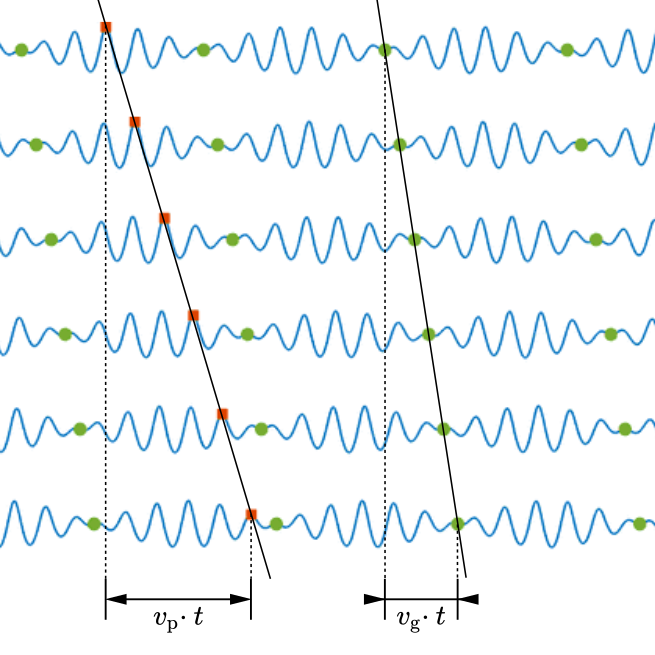
The group velocity, , is defined by how the frequency changes with the wave number.
This relationship is crucial. It shows that the velocity of our 'particle' is determined by the collective behavior of the underlying waves. The very act of creating a spatially localized particle requires a spread in momentum, and the particle's motion is governed by the interplay of those different momentum components. This trade-off between localization in space () and spread in momentum () isn't just a neat mathematical trick; it's a fundamental property of the universe, leading directly to the Heisenberg Uncertainty Principle.