Visualizing Algebraic Geometry
Algebraic Varieties
The Geometry of Equations
In algebra, we often solve for variables in equations like . The solution, , is a single point on a number line. But what happens when we have more variables and more complex equations? We start to create shapes.
This is the core idea of algebraic geometry. It connects the abstract world of polynomial equations with the visual world of shapes. The shapes created by these equations are called algebraic varieties.
Algebraic Variety
noun
The set of all points that are solutions to a system of one or more polynomial equations.
Let's start in two dimensions, using variables and . A simple polynomial equation like defines a straight line. Every point on that line is a solution to the equation.
Things get more interesting with higher-degree polynomials. Consider the equation for a circle with a radius of 1 centered at the origin:
The set of all points that make this equation true forms a perfect circle. This circle is an algebraic variety.
Other familiar shapes are also algebraic varieties. A parabola can be defined by , and a hyperbola can be described by . Each equation carves out a specific shape in the 2D plane.
Shapes in Three Dimensions
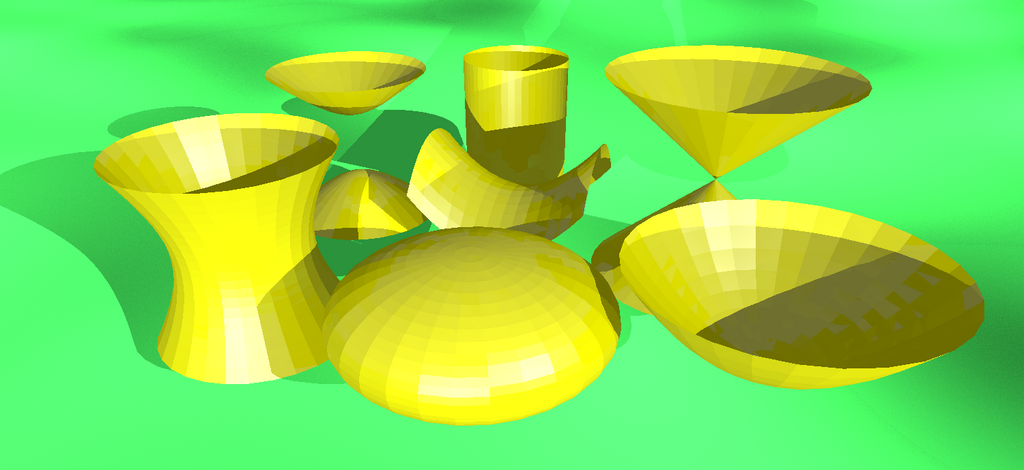
Adding a third variable, , takes us into 3D space. The same principles apply. The solutions to a polynomial equation with , , and form a surface.
For example, the 3D version of a circle is a sphere. A sphere with a radius of 1 is the set of all points that satisfy this equation:
Other equations create different surfaces. The equation creates a double cone, with its tip at the origin.
Combining Equations
An algebraic variety can be defined by a system of several equations. When we use more than one equation, the variety is the set of points that satisfy all the equations simultaneously. Geometrically, this is where their shapes intersect.
Imagine a sphere defined by and a simple plane defined by . The algebraic variety that solves both equations is the set of points lying on both the sphere and the plane. Their intersection is a circle.
By adding more equations, we can describe more complex shapes, like lines and curves in 3D space. This is the power of algebraic varieties: they provide a unified language to describe geometric objects using the rules of algebra.
Now, let's test what you've learned about these geometric solutions.
What is the central concept of algebraic geometry?
Which of the following equations defines a circle with a radius of 1 centered at the origin in a 2D plane?
Understanding that equations can represent shapes is the first step into the rich and visual field of algebraic geometry.