Visual Learning Models Explained
Introduction to Visual Learning Models
What Are Visual Learning Models?
We learn a lot with our eyes. From recognizing a friend's face to navigating a new city with a map, our brains are constantly processing visual information. A visual learning model is essentially a framework that explains how this process works. It's not just about seeing things; it's about how we interpret, understand, and remember information presented visually.
Think of it this way: learning to assemble furniture from a text-only manual is tough. Add diagrams, and suddenly the process becomes much clearer. The diagrams provide a visual model of the steps, which our brains find easier to follow.
These models can describe how humans learn, but they can also be used to design systems that teach. In technology, a visual learning model might be an AI that learns to identify objects in photos. For our purposes, we'll focus on the human side—how our minds create meaning from what we see.
cognition
noun
The mental process of acquiring knowledge and understanding through thought, experience, and the senses.
How Our Brains Process Visuals
When you look at something, say, an apple, your eyes don't just send a picture to your brain. Your brain performs a series of complex operations almost instantly. It detects edges, colors, and shapes. Then, it compares this information to memories and existing knowledge. "Round, red, has a stem... that's an apple."
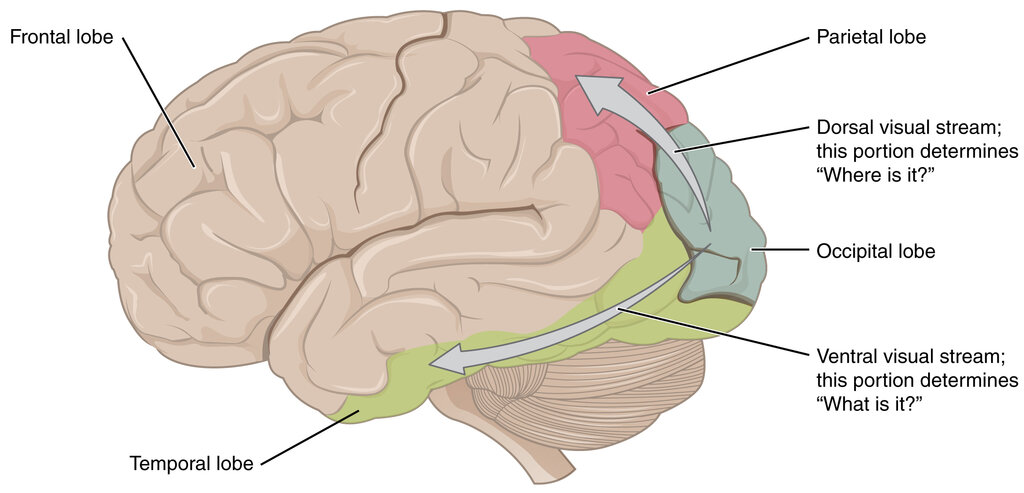
This happens in different parts of the brain. Information flows from the eyes to the occipital lobe at the back of the brain, which is the primary visual processing center. From there, it splits into two main pathways.
-
The Dorsal Stream helps us understand an object's location and movement. It's the "where" pathway. It's what lets you catch a ball or walk around a room without bumping into furniture.
-
The Ventral Stream is responsible for object recognition. It's the "what" pathway. It connects the shape and color of the apple to your concept of "apple."
Effective visual learning materials engage both of these pathways. A good chart doesn't just present data (what); it also organizes it spatially to show relationships (where).
Why Visuals Work So Well
Our brains are wired for visuals. A large portion of the human brain is dedicated to visual processing, making it a very powerful and efficient way to learn. When we see something, we tend to remember it better than if we just read or hear about it. This is sometimes called the picture superiority effect.
Visuals help in several ways:
They make abstract concepts concrete. It's easier to understand the water cycle from a diagram than from a paragraph of text.
They simplify complex information. A flowchart can clarify a multi-step process that would be confusing to read.
They improve memory. Associating an image with information creates a stronger mental link, making it easier to recall later.
Ultimately, visual learning models help us understand this powerful cognitive tool. By recognizing how the brain processes images, educators and designers can create more effective learning materials that lead to better understanding and retention.
Ready to check your understanding?
In the context of human cognition, what is the primary purpose of a visual learning model?
When you identify a specific object, like recognizing that a round, red fruit is an apple, which visual processing pathway is primarily responsible?