Viruses Acellular Entities and Their Origins
Introduction to Viruses
What Is a Virus?
Viruses are unlike any other form of life you've encountered. They aren't animals, plants, fungi, or even bacteria. They exist in a strange grey area, following a set of rules all their own. At their core, they are incredibly simple agents of infection.
Viruses are microscopic packages of genetic information (DNA or RNA, depending on the type of virus), enveloped in a protein coat.
Think of a virus as a tiny instruction manual. This manual, made of genetic material like DNA or RNA, carries the blueprint for making more viruses. But on its own, this manual is useless. It needs a reader and a factory to carry out its instructions. That's where other living cells come in.
Not Quite a Cell
The most fundamental difference between a virus and, say, a bacterium or one of your own cells is that a virus is acellular. It's not a cell at all. Your cells have a nucleus, mitochondria to produce energy, and ribosomes to build proteins. They are bustling little factories of activity. A virus has none of this.
acellular
adjective
Lacking cells or not consisting of cells.
This lack of cellular machinery means a virus can't perform the basic processes of life on its own. It has no metabolism. It can't generate energy, it can't create its own building blocks, and it can't replicate by itself. To do anything, it must hijack a living cell.
Viruses act as obligate cellular parasites.
This is why viruses are considered parasites. They can only multiply by invading a host cell and reprogramming it to become a virus-making factory.
The Basic Blueprint
Despite their incredible diversity, most viruses share a simple, two-part structure.
- Genetic Material: This is the core of the virus, its blueprint. It can be DNA or RNA, and it contains all the information needed to create new viruses.
- Capsid: This is a protective protein coat that surrounds the genetic material. The capsid's shape is one way scientists classify different types of viruses.
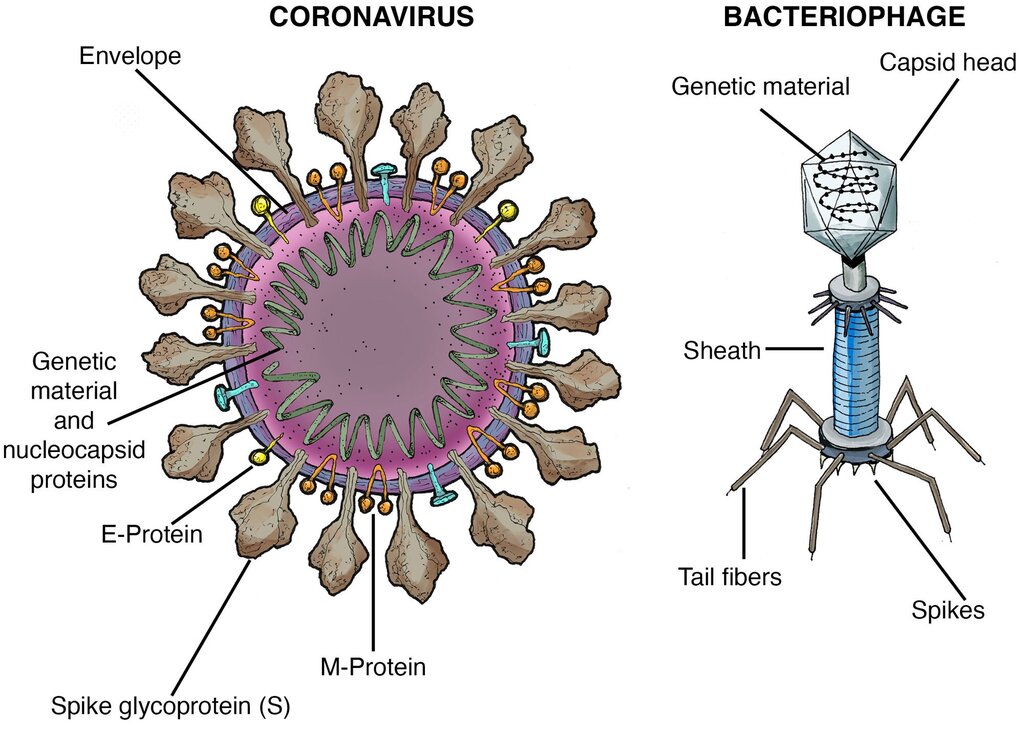
Some viruses also have an outer envelope made of lipids, which they steal from the host cell's membrane as they exit. This envelope can help the virus hide from the host's immune system and attach to new cells.
Living or Not?
This brings us to one of the most interesting debates in biology: are viruses alive? The answer isn't a simple yes or no. It really depends on how you define 'life'.
On one hand, viruses have genetic material and they evolve through natural selection, two key characteristics of living things. When they infect a cell, they certainly seem 'alive' as they replicate and create thousands of copies.
On the other hand, they are completely inert outside of a host cell. They are just complex chemical structures, with no ability to move, metabolize, or reproduce on their own. They're more like a seed waiting for the right conditions than a self-sufficient organism.
| Argument for Living | Argument for Non-Living |
|---|---|
| Possess genetic material (DNA/RNA) | Are acellular (no cells) |
| Evolve through natural selection | Have no independent metabolism |
| Can replicate (with a host) | Are inert outside of a host cell |
| Can assemble themselves | Cannot reproduce independently |
Because they blur this line, many scientists place viruses at the 'edge of life'. They are not truly living organisms, but they are far more than just inanimate molecules. This unique status makes them a fascinating and critical subject of study.
What is the most fundamental characteristic that distinguishes viruses from cellular life forms like bacteria?
Why are viruses described as being at the 'edge of life'?