Vibroacoustic Analysis Explained
Introduction to Vibroacoustics
Shakes, Rattles, and Hums
Everything around us has a tendency to move. When an object moves back and forth around a fixed point, we call that movement a vibration. Think about a guitar string after you pluck it. It doesn't just move once; it oscillates rapidly, blurring in the middle and staying still at the ends. This is vibration in its simplest form.
Two key ideas describe any vibration: frequency and amplitude. Frequency is how fast the object is vibrating. We measure it in Hertz (Hz), which means cycles per second. A low-frequency vibration is a slow wobble, while a high-frequency vibration is a fast buzz. Amplitude is the size of the vibration—how far the object moves from its resting position. A gentle pluck creates a small amplitude vibration, while a hard strum creates a large one.
This back-and-forth motion can be described mathematically. A simple, smooth vibration, like the hum from a tuning fork, follows the pattern of a sine wave. Its displacement, , at any time, , can be written as:
Here, represents the amplitude (the peak displacement) and is the frequency of the vibration.
Vibrations on the Move
A vibration rarely stays in one place. When one part of a structure starts to vibrate, it pushes and pulls on the parts next to it, causing them to vibrate as well. This chain reaction creates a wave that travels through the material. This is known as wave propagation.
Going back to the guitar, the vibration that starts in the string doesn't end there. It travels down the string to the bridge, which is the small piece holding the strings on the guitar's body. The bridge then starts to vibrate, and it passes that vibration along to the large wooden surface of the guitar. The entire guitar body begins to vibrate, which is what makes the sound so much louder than the string by itself. This is structure-borne sound—vibrations traveling through an object.
The speed and nature of these waves depend on the material. Vibrations travel differently through steel, wood, or plastic because of their different properties, like stiffness and density.
Finding the Right Rhythm
Every object has certain frequencies at which it prefers to vibrate. These are called its natural frequencies or resonant frequencies. Think about pushing a child on a swing. If you push with just the right rhythm—matching the swing's natural back-and-forth frequency—you can make the swing go very high with little effort. If you push at the wrong rhythm, you'll disrupt the motion, and the swing won't go nearly as high.
This phenomenon is called resonance. When an external force applies a vibration that matches one of an object's natural frequencies, the object's vibrations can grow dramatically in amplitude. This is why a singer can shatter a wine glass. If she sings a note that precisely matches a natural frequency of the glass, the vibrations in the glass build up until they're large enough to break it.
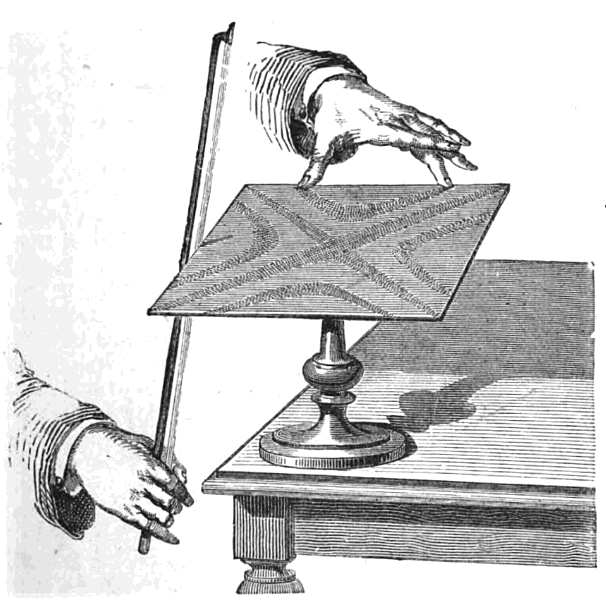
Resonance isn't always destructive. Musical instruments are designed to resonate. The body of a violin or guitar is shaped to resonate strongly at musical frequencies, amplifying the sound produced by the strings. Understanding resonance is critical for controlling vibrations—either to enhance them, as in music, or to suppress them, as in designing earthquake-proof buildings.
From Shake to Sound
So how does a silent vibration become a sound we can hear? It happens when a vibrating object makes contact with the air. As the surface of the guitar's body vibrates, it pushes on the air molecules around it. When the surface moves outward, it compresses the air, creating a region of high pressure. When it moves inward, it leaves a region of lower pressure, called a rarefaction.
This series of compressions and rarefactions travels outward through the air as a sound wave. When this wave reaches our ears, our eardrums vibrate in response, and our brain interprets this as sound. This is the heart of vibroacoustics: the conversion of structural vibration into an acoustic field, or sound waves.
Vibration in a structure creates pressure waves in the surrounding fluid (like air). This is sound.
The relationship works both ways. Just as a vibrating structure can create sound, sound waves can cause a structure to vibrate. If you stand near a loud speaker, you can feel the vibrations in your chest. The powerful sound waves are pushing on your body, causing it to vibrate in sympathy. This is how microphones work. A sound wave hits a small, thin diaphragm, causing it to vibrate. The microphone converts this tiny vibration into an electrical signal.
This two-way interaction is fundamental. Any structure can be a source of sound, and any structure can be a receiver. Understanding this link allows us to design quieter machines, build concert halls with perfect acoustics, and analyze how noise travels through our environment.
If you strum a guitar string much harder, which property of its vibration increases significantly, resulting in a louder sound?
Resonance occurs when an external force applies a vibration that __________ an object's natural frequency.