Vibe Coding
Define clear goals
Welcome to Vibe Coding 101! Historically, building software required you to write code line by line, focusing on syntax and compilation. Today, a paradigm shift is happening where you describe what you want in plain English, and AI handles the implementation. This elevates your role from a classical programmer to a high-level product lead, whose job is to orchestrate, refine, and steer the system to life.
Key Takeaway: In the era of vibe coding, your taste, goals, constraints, and feedback are the primary drivers of the software. The AI executes the manual typing, but you own the ultimate direction.
Because the AI relies on your instructions, starting with a vague or half-formed idea is the quickest way to end up in a frustrating loop of bugs and design dead-ends. Instead, successful vibe coders use a structured, high-level roadmap before any code is generated. This roadmap explicitly defines the project's goal, target audience, technical constraints, and success criteria, forming an unmistakable instruction manual for the AI agent.
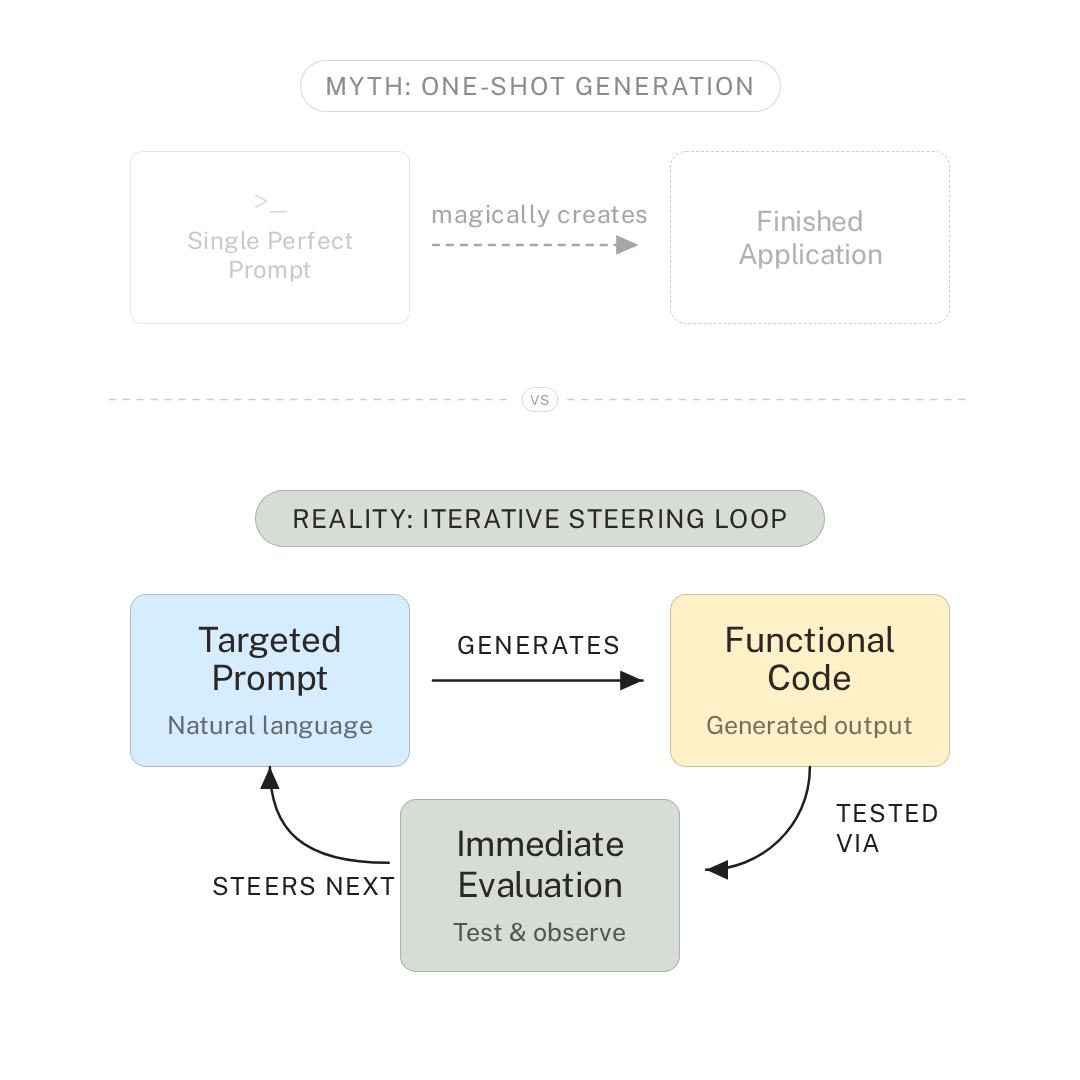
To keep the AI aligned, we use the five core principles of AI-assisted loops: starting with a clear goal, building in small slices, managing context carefully, reviewing and testing each change, and continuously improving with iterative feedback. By acting as a product lead and laying down these guardrails, you ensure that the AI builds exactly what you intend.
Answer: You will get stuck in a frustrating loop of bugs, tech debt, and design dead-ends.
Correct
Building without a clear destination forces the AI to guess the software architecture. It is like asking a construction crew to build a house without blueprints; they will keep tearing down walls as your vague ideas shift, leaving behind structural wreckage. To bypass this, we establish a first. This is not a complex corporate document, but a lean, highly specific set of definitions that outlines what success looks like before any code is generated.
A strong roadmap consists of four pillars: your target audience, clear functional goals, strict tech constraints, and explicit success criteria. For instance, if you are building a simple budget tracker, your constraint might be that all data must be saved locally in the browser with no external database. Declaring these boundaries upfront prevents the AI from choosing overly complex database configurations that you do not need, instantly keeping the codebase lean and maintainable.
Let us see how well you grasp how these boundaries keep your AI-assisted project on track.
Answer: constraints
Correct
By specifying tech constraints upfront, you prevent the AI from defaulting to overly complex architectures that require external databases or heavy servers. This keeps your early iterations lightweight and incredibly fast to run.
The next pillar of your product roadmap is defining . These are clear, binary indicators that tell you and the AI exactly when a feature is fully complete and functional. Instead of a vague goal like "make the interface look nice," a strong success criterion is: "the user can click a button to export their budget data as a CSV file."
Success criteria turn subjective goals into binary, testable outcomes. This ensures you only mark a feature as finished when it actually delivers the intended value.
To close out our focus on roadmap planning, let's check your understanding of how to define these clear goals for your AI assistant.