Vibe Coding for Product Managers
Introduction to Coding for Product Managers
Why PMs Should Speak Code
You don't need to become a software engineer to be a great product manager. But understanding the language your engineering team speaks can transform how you work together. Think of it like a film director who understands the basics of cinematography. They don't need to operate the camera, but knowing what a lens can and can't do helps them communicate their vision and make more informed decisions.
Learning coding fundamentals isn't about writing code yourself. It's about building empathy, improving communication, and gaining a better intuition for the technical trade-offs that shape your product. When you grasp the basics, you can have more productive conversations about feature feasibility, effort estimation, and technical debt. You move from just defining the "what" to better understanding the "how."
Product managers explain what needs building, why it’s essential, and the desired outcomes while highlighting any particular constraints or specific issues.
This grasp of the fundamentals allows you to ask smarter questions and participate more deeply in technical discussions, ultimately earning you more credibility with your team.
The Building Blocks of Code
Programming might seem complex, but most languages are built on a few core concepts. Understanding these will give you a framework for thinking like a developer.
- Variables: These are like labeled containers for storing information. You could have a variable called
userNamethat holds the value "Alex" or one calledloginAttemptsthat holds the number3. - Data Types: This specifies what kind of information a variable can hold. Common types include strings (text), integers (whole numbers), and booleans (true or false).
- Functions: A function is a named block of code that performs a specific task. Think of it as a recipe. You give it some ingredients (inputs), it follows a set of steps, and gives you a dish (output). Functions are reusable, which saves a lot of time.
- Conditional Logic: This is how programs make decisions. It's usually expressed as an "if-then-else" statement. For example: If the user's password is correct, then log them in. Else, show an error message.
- Loops: Loops allow a program to repeat a block of code multiple times. For instance, a loop could go through a list of products on a shopping site and display each one on the page.
# A simple Python example

# Define a variable
user_name = "Maria"

# A function to greet a user
def create_greeting(name):
  greeting = "Welcome, " + name + "!"
  return greeting

# Use conditional logic
if user_name == "Maria":
  # Call the function and print the result
  print(create_greeting(user_name))
else:
  print("Welcome, guest!")
This simple script defines a variable for a user's name, creates a reusable function to generate a greeting, and then uses a conditional statement to decide what message to display. These are the kinds of fundamental structures that underlie even the most complex applications.
A Tour of Common Languages
There are hundreds of programming languages, each with its own strengths and weaknesses. You don't need to know them all. The key is to know which languages your team uses and what they are generally used for. This context is invaluable.
For example, the code that runs in a user's web browser (the front-end) is often different from the code that runs on the server to process data (the back-end). Mobile apps for iOS and Android are also built using different languages and technologies.
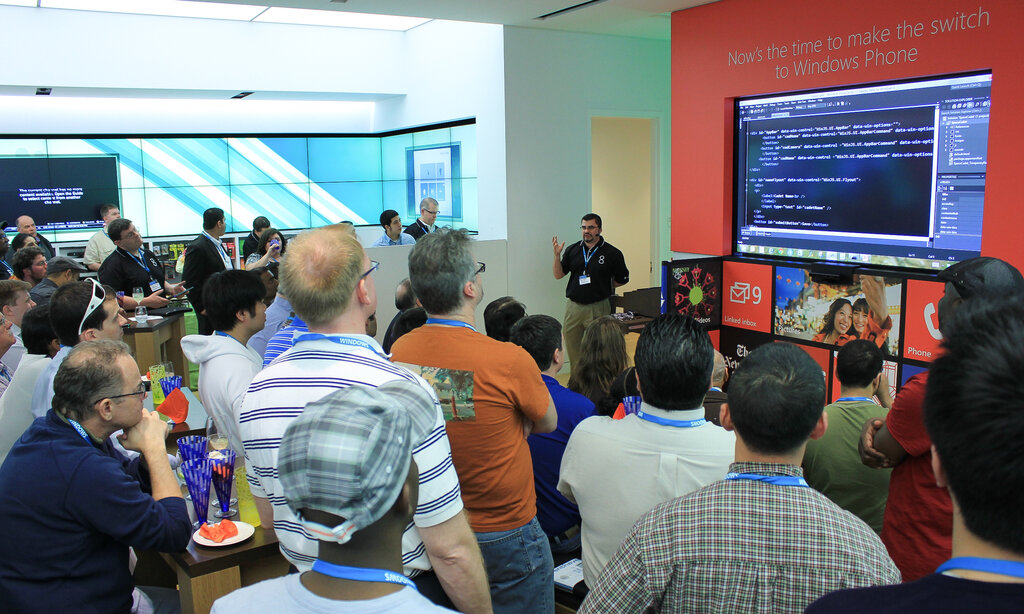
Here’s a quick look at some languages you’ll likely encounter in product development.
| Language | Primary Use | Key Trait |
|---|---|---|
| JavaScript | Web front-end, web back-end | The language of the web browser |
| Python | Web back-end, data science, AI | Known for its simple, readable syntax |
| Java | Web back-end, Android apps | Platform-independent ("write once, run anywhere") |
| Swift | iOS and macOS apps | Modern language developed by Apple |
| Kotlin | Android apps | Google's preferred language for Android |
Knowing the difference helps you understand context. If your team is discussing a challenge with a Python script, you'll know it likely relates to your product's back-end logic. If they mention a bug in the Swift code, it’s probably an issue with the iOS app.
This level of awareness makes you a more effective partner to your engineering team and empowers you to contribute to technical conversations in a meaningful way.
What is the primary benefit for a product manager to understand coding fundamentals?
A program needs to check if a user is over 18 to grant access to a feature. Which programming concept is most directly used to make this decision?
By understanding these basic concepts, you're not just learning jargon; you're learning the logic and constraints that shape the product you're building. This shared language is the foundation of a strong, collaborative product team.