Venture Capital Law Essentials
Introduction to Venture Capital
Fueling Innovation
Venture capital, or VC, is a type of financing that investors provide to startups and emerging companies that show high growth potential. Think of it as high-octane fuel for businesses that are just getting started but aim to become industry leaders. These aren't just loans; venture capitalists take an equity stake in the company, meaning they become part-owners. They're betting that the company will grow to be incredibly valuable.
The core idea is simple: invest in many promising young companies, knowing that most will fail, but a few will succeed spectacularly. The massive returns from these few successes are expected to more than cover the losses from the others.

How VC Firms Work
A venture capital firm isn't just one wealthy person's bank account. It's a structured fund, typically with a lifespan of 10 years, that pools money from various sources to invest in a portfolio of startups. Two main groups of people make this possible.
Limited Partners
noun
Institutions or high-net-worth individuals who provide the capital for a venture fund. They have limited liability and are not involved in the fund's day-to-day decisions.
Limited Partners (LPs) are the investors who put money into the VC fund. They're often large organizations like pension funds, insurance companies, and university endowments. They trust the fund managers to find and grow the next big thing.
General Partners
noun
The managers of a venture capital fund who are responsible for making investment decisions and actively working with the companies they fund. They bear unlimited liability.
General Partners (GPs) are the classic "venture capitalists." They are the decision-makers who run the fund. Their job is to source promising startups, perform due diligence, negotiate investment deals, and then take a seat on the company's board of directors to provide guidance and connections.
The Investment Journey
VC investment isn't a one-time cash injection. It happens in stages, called rounds, each tied to specific milestones in a startup's growth. This allows investors to manage risk by committing more capital only as the company proves itself.
| Round Name | Company Stage | Typical Goal |
|---|---|---|
| Seed | Idea/Prototype | Build a minimum viable product (MVP) and find initial customers. |
| Series A | Early Traction | Optimize product-market fit and scale the business model. |
| Series B | Scaling | Expand market reach and build out the team. |
| Series C+ | Mature Growth | Prepare for an IPO or acquisition, enter new markets, or develop new products. |
Each round—from Seed to Series A, B, C, and beyond—comes with a new valuation for the company. As the company hits its goals and reduces risk, its valuation typically increases, making it more attractive for the next round of investors.
Founders that invest the time to understand cap tables may be better equipped to lead their companies to long-term success.
This staged financing creates a clear path for growth, with each round unlocking the resources needed for the next phase of the journey.
A Startup's Lifecycle
The journey of a VC-backed company follows a common arc, from a spark of an idea to a fully established business.
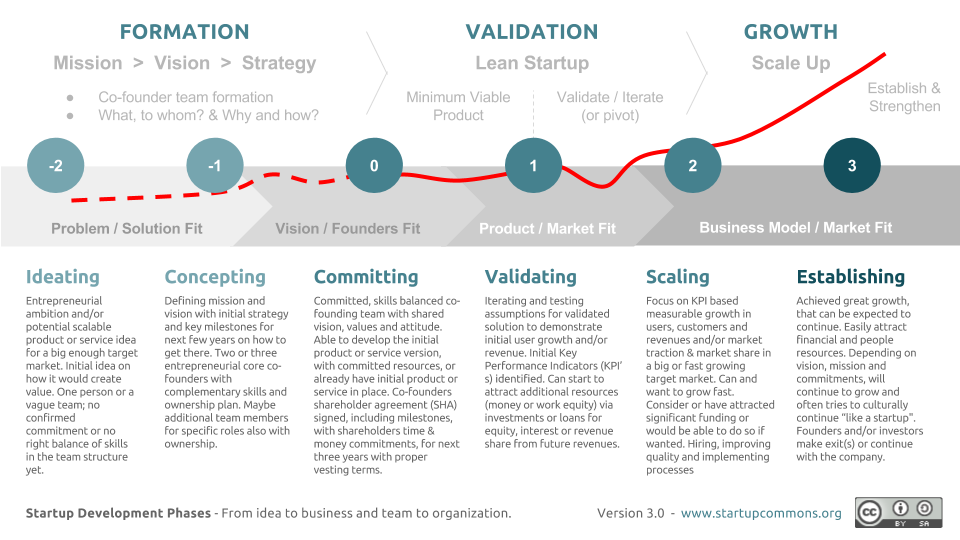
1. Formation: This is the beginning, where founders have an idea and perhaps a basic prototype. Funding, if any, often comes from friends, family, or angel investors in a pre-seed or seed round.
2. Validation: The company has launched a product and is working to find product-market fit—the point where a solid customer base is actively using and paying for the product. The Series A round usually happens here, providing the capital to hire a team and refine the business model.
3. Growth: With a validated product and business model, the focus shifts to scaling. The company raises Series B and C rounds to rapidly expand its customer base, enter new markets, and solidify its position as a leader. The goal is to grow revenue at a fast pace.
4. Exit: This is the final stage for a VC investment. The VC firm needs to return capital to its own investors (the LPs). This happens through an "exit," which is typically an Initial Public Offering (IPO), where the company sells shares on the stock market, or through a strategic acquisition, where a larger company buys the startup.
This lifecycle is a demanding and fast-paced journey. Venture capital provides the resources to make it possible, turning ambitious ideas into impactful companies.
In a venture capital fund, what is the primary role of the Limited Partners (LPs)?
A startup is working to achieve product-market fit, has an early version of its product, and is looking to build out its initial team. Which financing round is most commonly associated with this stage?