Vector Mathematics for Semantic Document Processing
Similarity Metric Mechanics
Choosing the Right Metric
When comparing document embeddings, the choice of similarity metric is crucial. It’s not just about finding the “closest” vectors; it’s about defining what “close” means in the context of your task. The two most common metrics, dot product and cosine similarity, seem similar on the surface but measure different things. Their distinction lies in how they handle vector magnitude and direction.
The dot product measures how much one vector goes in the direction of another. It considers both the alignment (direction) and the lengths (magnitudes) of the two vectors. If you have two vectors, and , their dot product is defined as:
A larger dot product means the vectors are not only pointing in a similar direction but are also long. In NLP, this means a longer document, which often has a larger vector magnitude, could be considered more similar to another long document, even if their topics are less aligned than a shorter, more focused document.
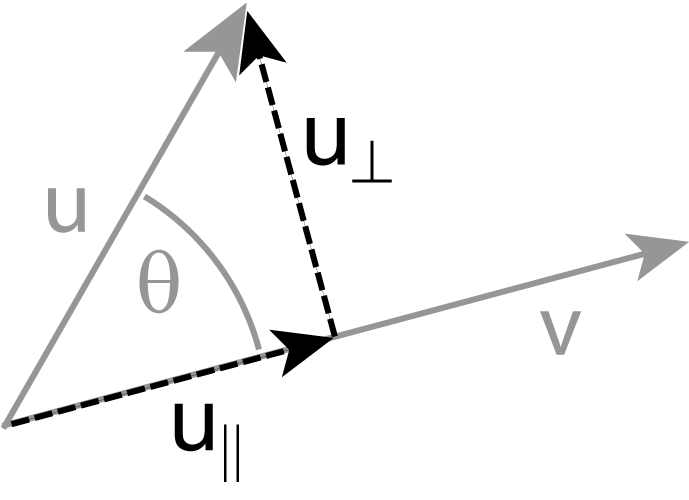
Cosine similarity, on the other hand, isolates the direction. It deliberately ignores the magnitude of the vectors by dividing the dot product by the product of their magnitudes. This process is called normalization and it forces every vector to a length of 1.
This focus on direction is why cosine similarity is the standard for semantic search. When comparing text, you usually care about the topic, not the word count. A short, concise article and a long, detailed dissertation on the same topic should be considered highly similar. Cosine similarity achieves this by ensuring that doesn't bias the relevance score.
Magnitude vs. Direction
So, when does magnitude matter? The dot product is useful when the magnitude of the vector carries meaningful information. For example, in a recommendation system, the magnitude of a user's vector might represent their level of engagement. A user who has rated many movies (a high-magnitude vector) might be a better match for another highly engaged user, even if their tastes are only moderately aligned.
Use dot product when vector magnitude is a meaningful signal. Use cosine similarity when it's noise.
In where text embeddings live, our geometric intuition can be misleading. As the number of dimensions increases, vectors tend to become almost orthogonal (at 90-degree angles) to each other. The angle between vectors becomes a more reliable measure of similarity than Euclidean distance, as the concept of “distance” becomes less meaningful. This is another reason why angular-based metrics like cosine similarity are so effective for NLP tasks.
| Metric | Measures | Ignores | Best For... |
|---|---|---|---|
| Dot Product | Magnitude & Direction | Nothing | Recommendation systems, where engagement level (magnitude) matters. |
| Cosine Similarity | Direction Only | Magnitude | Semantic text search, where topic (direction) is key, not document length. |
For practical purposes, if your vectors are already normalized to unit length, the dot product and cosine similarity become equivalent and computationally faster. The denominator in the cosine similarity formula becomes 1, leaving just the dot product.
If your vectors are already normalized or if your data set is agnostic to vector normalization (i.e., relevancy will not suffer), you can go ahead and normalize your vectors and use dot product similarity, as it is much faster to compute than the cosine one since there is no need to compute the length of each vector.
Let's review the key terms we've covered.
Now, check your understanding of these concepts.
What is the primary distinction between dot product and cosine similarity when used for comparing document embeddings?
In the context of semantic search, why is cosine similarity often preferred over the dot product?
Ultimately, the choice depends on what you want similarity to mean for your specific problem. For most text analysis tasks, that meaning is purely semantic, making cosine similarity the default choice.