Vector Forces: Composition and Decomposition
Vector Basics
What Are Vectors?
In physics and engineering, we work with two types of quantities: scalars and vectors. A scalar is a quantity that only has magnitude, or size. Things like temperature, mass, and speed are scalars. If you say you're driving at 50 miles per hour, you're describing a scalar value.
A vector, on the other hand, has both magnitude and direction. Velocity is a perfect example. Driving 50 miles per hour north is a vector. It tells you not just how fast you're going, but also where you're headed. Forces, displacement, and acceleration are all vector quantities because their direction is crucial.
A vector is a quantity with both magnitude and direction. A scalar has only magnitude.
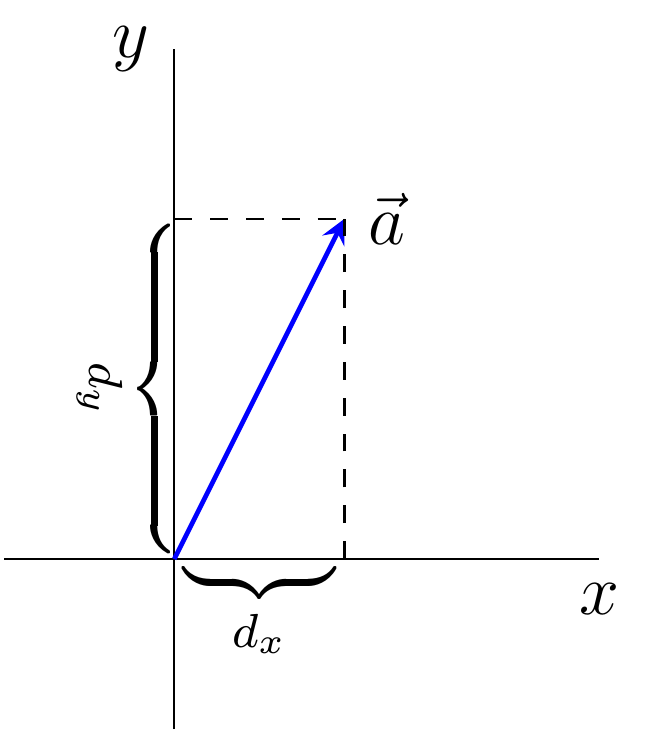
Visually, we represent a vector as an arrow. The length of the arrow corresponds to its magnitude, and the way it points indicates its direction. Mathematically, you'll see vectors denoted with an arrow above the letter, like , or as a bold letter, like v. Vectors are often broken down into components along coordinate axes, such as the x and y axes in a 2D plane.
Magnitude and Direction
Every vector is defined by its two key properties: magnitude and direction. The magnitude is simply the vector's length or intensity. For a vector with components and , we find its magnitude using a variation of the Pythagorean theorem. The notation for magnitude is a pair of double vertical bars: .
The direction of a vector is often expressed as an angle relative to a reference, usually the positive x-axis. This angle tells us which way the vector is pointing in space. We can find it using the arctangent of the ratio of its y-component to its x-component.
Basic Vector Operations
We can perform mathematical operations with vectors, but the rules are different from those for scalars. The two most common operations are scalar multiplication and vector addition.
Scalar Multiplication
other
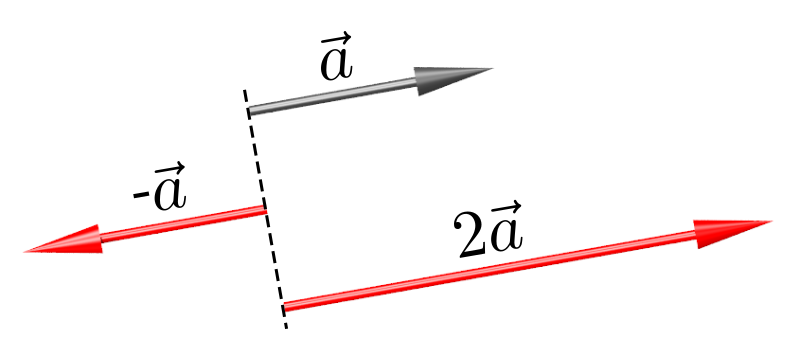
Multiplying a vector by a scalar. This operation scales the vector's magnitude and can reverse its direction.
When you multiply a vector by a scalar (a regular number), you scale its magnitude. Multiplying a vector by 2 doubles its length but keeps its direction the same. Multiplying it by -1 reverses its direction completely while keeping its length the same. This is as simple as multiplying each component of the vector by the scalar.
Vector addition combines two or more vectors to find a resultant vector. Think of it as following one path, then another. The result is a single vector from your starting point to your final destination.
The most intuitive way to visualize this is the "tip-to-tail" method. You draw the first vector, and then draw the second vector starting from the tip of the first one. The resultant vector is the arrow drawn from the tail of the first vector to the tip of the second.
Mathematically, adding and subtracting vectors is straightforward: you just add or subtract their corresponding components.
These basic definitions and operations form the foundation for analyzing forces and motion. By breaking complex forces into vector components, we can add and subtract them to understand the net effect on an object.
Which of the following best describes the fundamental difference between a scalar and a vector?
Which of these quantities is a vector?