Vector Calculus Essentials
Vector Fields
Mapping Space with Arrows
Imagine you're looking at a weather map. At various points across the country, you see little arrows showing wind speed and direction. This is a perfect real-world example of a vector field. It's a way of understanding a space where every single point has a vector—a magnitude and a direction—associated with it.
A vector field is a function that assigns a vector to each point in a subset of space.
Instead of assigning a single number (like temperature) to a point, a vector field assigns an arrow. In two dimensions, we can represent a vector field with a function that takes a point and outputs a two-dimensional vector.
Visually, we can't draw an arrow at every point, since there are infinitely many. Instead, we draw a selection of vectors on a grid. The length and direction of each arrow show the field's magnitude and direction at that specific point.
Fields in the Real World
Vector fields are not just mathematical curiosities; they are essential for describing the physical world. They model forces, fluid motion, and much more.
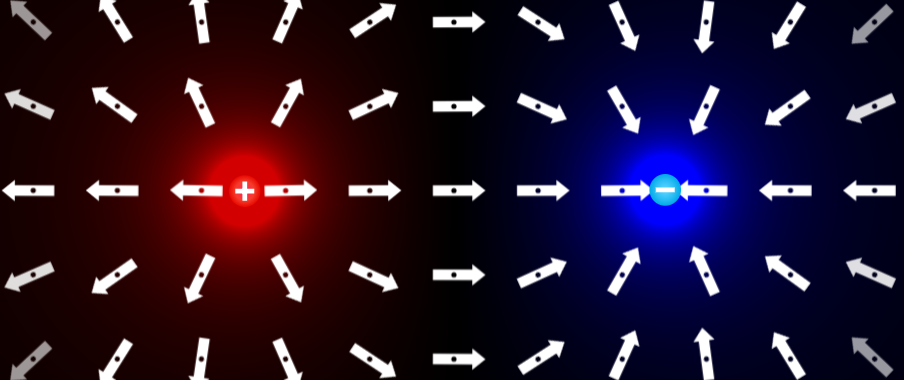
One of the most common examples is an electric field, like the one shown above. The arrows show the direction and strength of the force that a positive test charge would feel at any given point. Notice how the vectors point away from the positive charge and toward the negative charge, and how they get smaller as you move further away.
A gravitational field is similar. Every point in the space around Earth has a vector pointing toward the planet's center. The magnitude of that vector is the strength of gravity at that point.
Another great example is the flow of a fluid. Imagine a river. The velocity field of the river would assign a vector to each point in the water, representing the velocity (speed and direction) of the current at that point. Near the center, the vectors might be long and straight. Near the bank or an obstacle, they might be shorter or swirl around, forming an eddy.
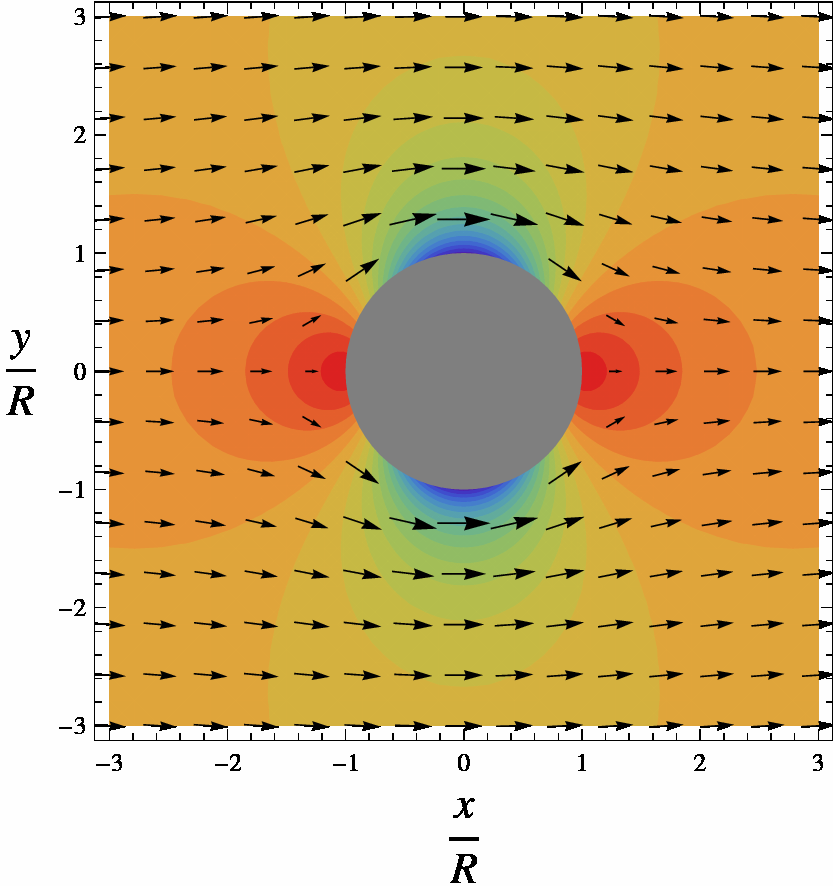
Vector fields can also exist in three dimensions. The concept is identical, but each vector now has three components (x, y, and z). For example, the gravitational field of a mass at the origin can be described by a 3D vector field.
Scalar Fields vs Vector Fields
It's helpful to contrast vector fields with something simpler: scalar fields. A scalar field assigns a single number, or scalar, to every point in space. A temperature map is a scalar field; each point has a value (like 72°F), but no direction.
| Field Type | Assigns to Each Point | Example |
|---|---|---|
| Scalar Field | A single number (magnitude) | Temperature map |
| Vector Field | A vector (magnitude and direction) | Wind map |
Understanding vector fields is the first step into the broader world of vector calculus. They provide the framework for describing how things move and interact in space, from the flow of air over a wing to the magnetic field that makes a compass work.