Variational Method in Quantum Mechanics
Introduction to Quantum Mechanics
The Quantum State
In classical physics, we can know a particle's exact position and momentum at any given time. It's like tracking a baseball after it's been hit. We can calculate its trajectory and predict exactly where it will land.
Quantum mechanics works differently. Instead of definite properties, we have probabilities. The state of a quantum particle, like an electron, is described by a mathematical function called the wavefunction, represented by the Greek letter psi ($ \Psi $).
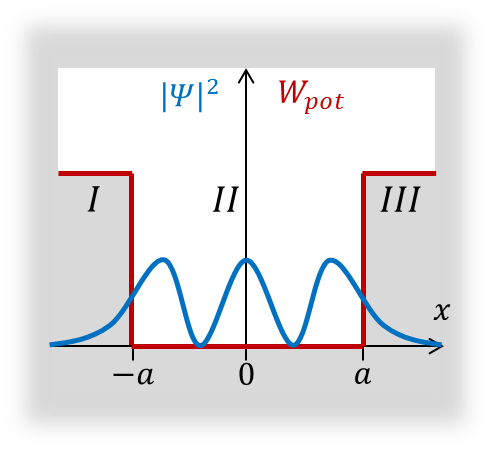
This wavefunction contains all the information about the particle. But it doesn't tell you where the particle is. Instead, it tells you the probability of finding the particle at any given point in space. To find this probability, you take the square of the absolute value of the wavefunction, written as $ |\Psi|^2 $. A high value means a high probability of finding the particle there; a low value means a low probability.
Wavefunction
noun
A mathematical function in quantum mechanics that describes the quantum state of an isolated system of one or more particles. Its value at a particular point in space and time is related to the probability of the particle's presence at that position and time.
Imagine a cloud of smoke. The cloud is densest where the smoke particles are most likely to be, and it thins out where they're less likely. The wavefunction is like the mathematical description of this cloud's density. The particle is somewhere in the cloud, but we only know the odds of where it might be until we actually look for it.
The Rulebook
If the wavefunction describes the state, what determines the wavefunction? That's the job of the Schrödinger equation, the master equation of quantum mechanics. It's the quantum equivalent of Newton's second law ($ F=ma $).
Just as Newton's law tells us how an object's motion changes under a force, the Schrödinger equation describes how a system's wavefunction evolves over time. For many situations, we use a simpler, time-independent version that focuses on the possible energy states a system can have.
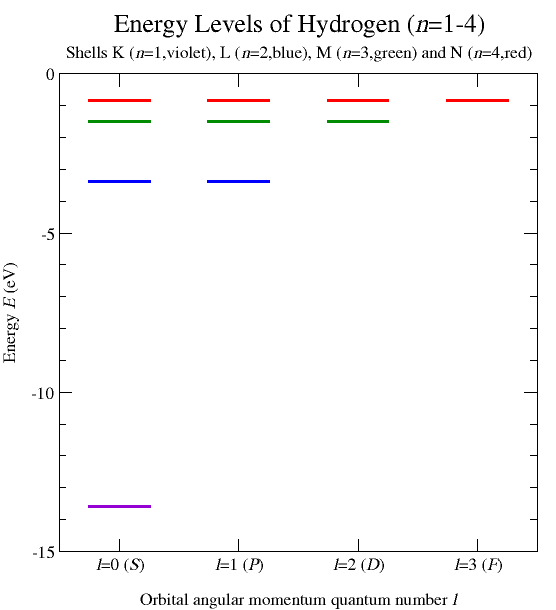
Solving this equation tells us two things: the allowed wavefunctions () for a system, and the specific, quantized energy levels () associated with each of those states. For an electron in an atom, for instance, the Schrödinger equation predicts that it can only exist at certain discrete energy levels, which is a foundational concept in chemistry and physics.
Asking the Right Questions
In quantum mechanics, you can't just ask, "What's the momentum of this electron?" Instead, you perform a measurement. The tools for this are called operators.
Every physical property you can measure—like position, momentum, or energy—has a corresponding operator. An operator is a mathematical instruction that you "apply" to the wavefunction to extract information about that property.
| Observable | Operator Symbol |
|---|---|
| Energy | |
| Momentum | |
| Position |
Sometimes, when an operator acts on a wavefunction, the result is simply the original wavefunction multiplied by a constant number. When this happens, the wavefunction is called an eigenfunction of that operator, and the number is called the eigenvalue.
This is incredibly important. The eigenvalues are the only possible values that can be measured for that observable when the system is in that specific eigenstate. If an electron's wavefunction is an eigenfunction of the energy operator, measuring its energy will always yield the corresponding energy eigenvalue. This is why we say properties like energy are "quantized"—they can only take on these specific, discrete values, and nothing in between.
The Core Principles
These ideas can be summarized in a few core rules, or postulates, that form the foundation of quantum mechanics.
-
The State Postulate: The state of a quantum system is completely described by its wavefunction $ \Psi $, which contains all the information about the system.
-
The Operator Postulate: For every measurable physical property (observable), there is a corresponding mathematical operator.
-
The Measurement Postulate: When you measure an observable, the only possible outcomes are the eigenvalues of its corresponding operator. After the measurement, the system's wavefunction "collapses" into the eigenfunction corresponding to the measured eigenvalue.
-
The Time-Evolution Postulate: The evolution of the wavefunction over time is governed by the Schrödinger equation.
These postulates create a complete framework for describing the microscopic world. They replace the certainties of classical mechanics with the probabilities and quantized properties that are the hallmarks of quantum physics.
What does the square of the absolute value of the wavefunction, written as , represent in quantum mechanics?
The Schrödinger equation's role in quantum mechanics is most analogous to which of the following in classical mechanics?