Valuing Forest Ecosystem Services
Forest Ecosystem Services Identification
Beyond Timber and Biomass
When we look at a forest, the most obvious value is the wood itself. But that's like judging a factory only by the weight of its bricks. The real value lies in what it produces. Forests provide a vast array of services essential for environmental stability and human well-being, many of which are easy to overlook.
To properly value these contributions, we need a consistent way to categorise them. This is where frameworks like the come in. It provides a standardised language to identify and group ecosystem services, moving the conversation beyond simple biomass to a more holistic view. For forests, we can break these services down into three main categories: provisioning, regulating, and cultural.
| Category | Description | Forest-Specific Examples |
|---|---|---|
| Provisioning | Goods or products obtained directly from the ecosystem. | Timber, firewood, medicinal plants, mushrooms, berries, fresh water. |
| Regulating | Benefits obtained from the regulation of ecosystem processes. | Climate regulation, carbon sequestration, air filtration, soil erosion control, water purification. |
| Cultural | Non-material benefits people obtain from ecosystems. | Recreation (hiking, camping), spiritual enrichment, aesthetic beauty, scientific education. |
This classification helps us see the full picture. Provisioning services include more than just timber; they encompass all the tangible goods we harvest, often referred to as or NTFPs. These can be a critical source of income and sustenance for local communities.
How Regulating Services Work
Regulating services are the behind-the-scenes workhorses. They aren't products you can hold, but processes that maintain a stable and healthy environment. The functionality of these services depends directly on the health and structure of the forest ecosystem.
Consider micro-climate regulation. A dense forest canopy acts like a giant parasol, shielding the ground from direct sunlight. This keeps the forest floor cooler and more humid than exposed areas. The process of transpiration, where trees release water vapour, further cools the air and can even influence local rainfall patterns. The larger and healthier the forest, the more significant this cooling and humidifying effect becomes.
A mature forest's root network is a living net, binding the soil together. The layer of fallen leaves, or leaf litter, cushions the impact of rain, allowing water to soak in slowly rather than running off and washing away topsoil.
The Intangible Value
Cultural services are the non-material benefits that enrich our lives. They are often deeply personal and vary across different societies, making them the most challenging to quantify in economic terms. Yet, their value is immense. Forests serve as places for recreation, spiritual reflection, and artistic inspiration.
The practice of —managing the growth and composition of forests—can be tailored to enhance these cultural values. For instance, a forest might be managed not just for timber, but to maintain scenic vistas, protect culturally significant ancient trees, or create trail networks for hikers. This approach recognises that a forest's worth extends far beyond its physical resources.
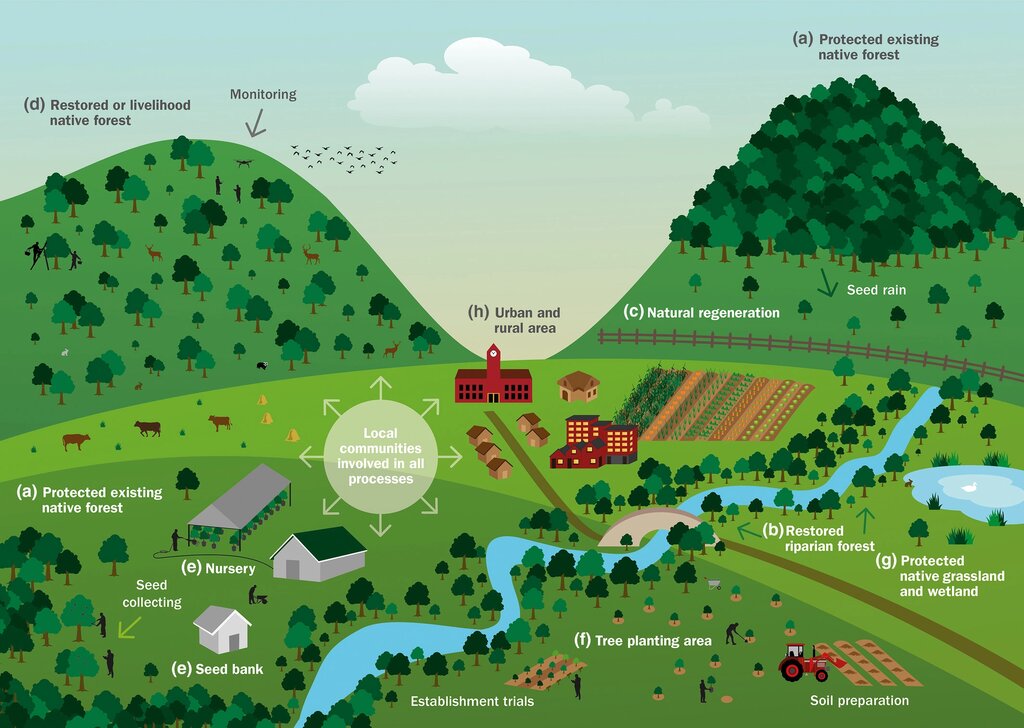
Stock vs. Flow
Finally, when assessing these services, it's crucial to distinguish between the stock and the flow. This is a fundamental concept in ecosystem valuation.
The stock is the forest itself: the trees, the soil, the biodiversity. It's the capital asset.
The flow is the continuous stream of services that the stock produces year after year: the clean air, the filtered water, the timber harvested sustainably, the recreational opportunities.
A healthy, intact forest (a large stock) can provide a steady and robust flow of services. If we degrade the forest—for example, through clear-cutting or pollution—we diminish the stock. Consequently, the flow of services slows to a trickle or stops entirely. Valuing a forest means understanding the condition of the stock to predict the future reliability of the flow.
According to the text, why is judging a forest solely by its timber considered an incomplete valuation?
A forest's ability to cool the surrounding air through transpiration and shade is an example of which type of ecosystem service?