Value Flow Reinforcement Learning
Introduction to Reinforcement Learning
Learning from Experience
Imagine teaching a dog to fetch. You don't give it a textbook on aerodynamics or a step-by-step manual. You throw a ball. If the dog brings it back, you give it a treat. If it wanders off, it gets nothing. Over time, the dog learns that bringing the ball back leads to a reward.
This is the core idea behind Reinforcement Learning (RL). It's a type of machine learning where a computer learns to achieve a goal by trial and error, receiving rewards or penalties for its actions. Instead of being fed a perfectly labeled dataset, the learner, called an agent, figures out what to do by interacting with its surroundings.
Reinforcement Learning (RL) is a type of machine learning where an agent learns to make decisions by interacting with an environment, aiming to maximize a cumulative reward over time.
This makes it different from other machine learning approaches. In supervised learning, a model learns from data that already has the correct answers, like a student studying with an answer key. In unsupervised learning, a model looks for hidden patterns in data without any labels at all. Reinforcement learning is about learning a strategy, or policy, to make the best decisions over time.
The Agent and the Environment
Every reinforcement learning problem has two key components: the agent and the environment.
agent
noun
The learner and decision-maker. It takes actions within the environment.
The environment is everything the agent interacts with. It's the world the agent lives in, including its rules and boundaries. The relationship between the agent and the environment is a continuous feedback loop.
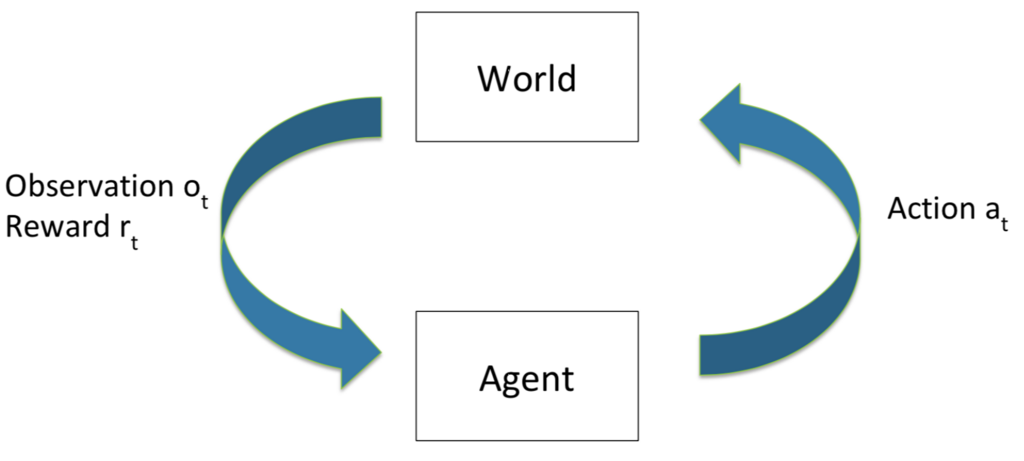
Here's how it works:
- The agent observes the current state of the environment. A state is a snapshot of the situation at a particular moment.
- Based on the state, the agent chooses an action.
- The environment responds. It transitions to a new state and gives the agent a reward (or penalty).
The agent repeats this cycle, continuously learning which actions lead to good outcomes from different states.
Think of a video game character. The character is the agent. The game world, with its levels and enemies, is the environment. The character's position and health are the state. Moving, jumping, and attacking are actions. Gaining points is a reward, and losing health is a penalty.
The Goal Is the Reward
How does the agent know what it's supposed to do? It's guided by the reward signal. The agent's sole objective is to maximize the total reward it collects over time, not just in the next step.
This is called maximizing the cumulative reward. An action that gives a small immediate reward might lead to a much larger reward later. Conversely, a tempting short-term reward could lead to a long-term penalty. The agent must learn to balance immediate gains with future possibilities.
A chess-playing agent might sacrifice a pawn (a short-term loss) to gain a better position that helps it win the game (a large, delayed reward).
This concept of delayed gratification is crucial. The agent develops a policy, which is essentially its strategy for choosing actions in any given state. A good policy is one that consistently leads to the highest possible cumulative reward. Through many cycles of action and feedback, the agent's policy gets better and better, until it masters its task.
How does an agent in Reinforcement Learning primarily learn to achieve its goal?
What is the primary objective of a Reinforcement Learning agent?
This interaction loop of agent, environment, state, action, and reward forms the foundation of all reinforcement learning, from simple games to complex robotics.