Valence Electrons Explained
Atomic Structure
The Building Blocks of Matter
Everything around you, from the air you breathe to the screen you're reading this on, is made of matter. And the fundamental units of matter are atoms. For a long time, people thought atoms were the smallest possible things, solid and indivisible. But we now know they're made of even smaller, or subatomic, particles.
At the center of every atom is a dense core called the nucleus. This is where most of the atom's mass is concentrated. Whizzing around the nucleus are much lighter particles. Let's meet the three key players.
Proton
noun
A subatomic particle with a positive electrical charge, found within the atomic nucleus.
Neutron
noun
A subatomic particle with no electrical charge (it's neutral), found within the atomic nucleus.
Electron
noun
A subatomic particle with a negative electrical charge that moves in the space surrounding the nucleus.
Protons and neutrons are packed together to form the nucleus. Electrons are much smaller and occupy a large area of mostly empty space around this central core. The attraction between the positive protons and the negative electrons is what holds the atom together.
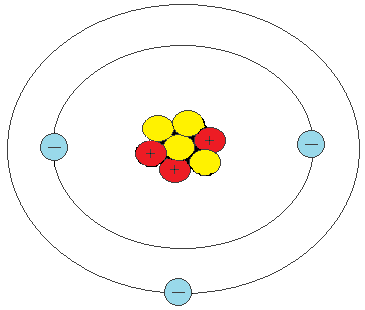
Identifying Atoms
What makes an atom of gold different from an atom of oxygen? It all comes down to the number of protons. The identity of an element is determined solely by the number of protons in its nucleus. This count is so important that it has its own name: the atomic number.
The atomic number (Z) is the number of protons in an atom's nucleus. It's the unique identifier for each element.
For example, any atom with exactly one proton is a hydrogen atom. An atom with six protons is always a carbon atom. If you change the number of protons, you change the element itself.
While the proton count is fixed for an element, the neutron count can vary. To account for both protons and neutrons, we use the mass number.
The mass number (A) is the total count of protons and neutrons in the nucleus. It gives us an idea of the atom's mass, since electrons are incredibly light.
Let's look at a few examples to see how this works.
| Element | Symbol | Protons (Z) | Neutrons | Mass Number (A) |
|---|---|---|---|---|
| Hydrogen | H | 1 | 0 | 1 |
| Carbon | C | 6 | 6 | 12 |
| Oxygen | O | 8 | 8 | 16 |
| Gold | Au | 79 | 118 | 197 |
Where Electrons Live
Electrons don't just orbit the nucleus randomly. They are restricted to specific regions called electron shells or energy levels. You can think of these shells like concentric layers around the nucleus, with each layer being a certain distance away.
Electrons in shells closer to the nucleus have lower energy, while those in shells farther away have higher energy. There are also rules about how many electrons can fit into each shell.
The first shell (closest to the nucleus) can hold a maximum of 2 electrons. The second shell can hold a maximum of 8 electrons. The third shell can also hold up to 8 electrons for the first 20 elements, and it gets more complex after that.
Electrons fill up the shells starting from the lowest energy level (the one closest to the nucleus) and moving outward. A hydrogen atom has one electron, so it goes into the first shell. A helium atom has two electrons, which completely fills the first shell.
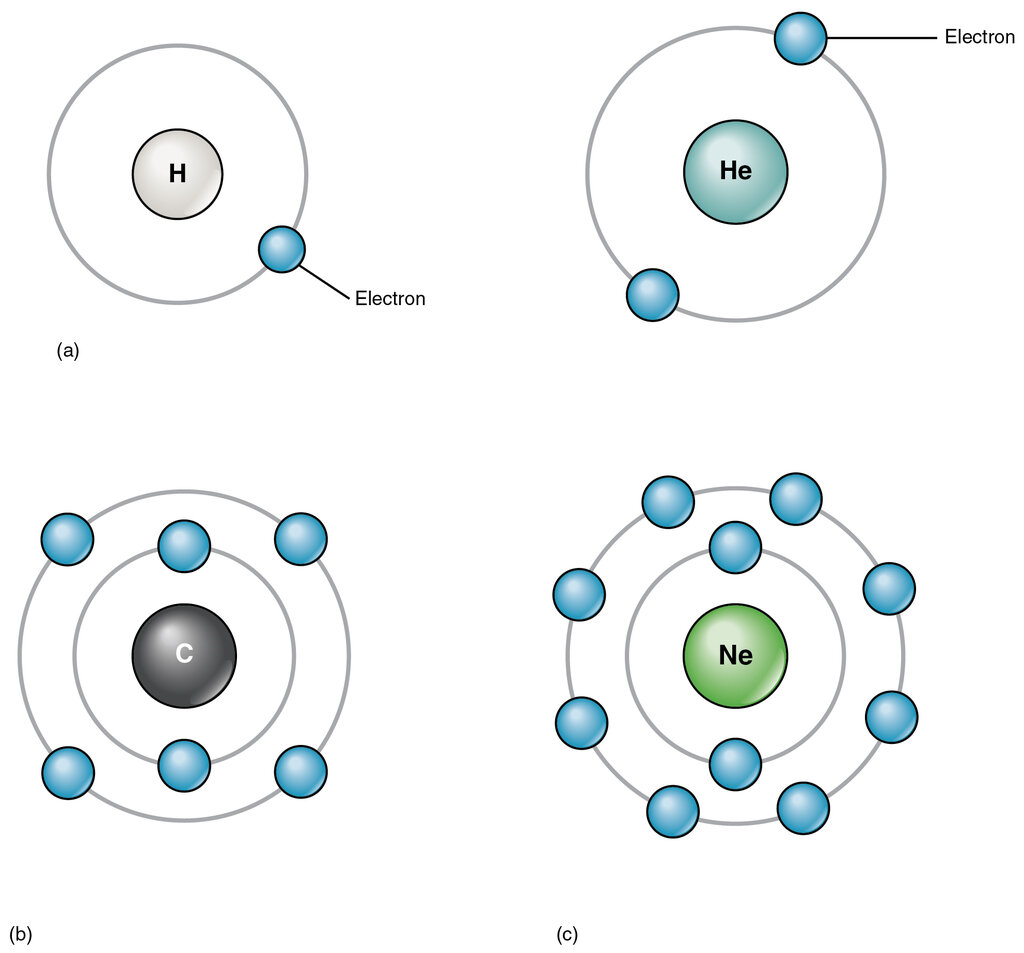
A carbon atom has six electrons. The first two fill the first shell, and the remaining four go into the second shell. This arrangement of electrons in shells is fundamental to understanding how atoms behave and interact with one another.
The identity of an element is determined by the number of which subatomic particle?
Which two particles are found within the atom's nucleus?
Grasping this basic structure of protons, neutrons, and electrons in their energy levels is the first step toward understanding the entire world of chemistry.