Vague Query
Introduction to Learning Objectives
What Are Learning Objectives?
A learning objective is a clear statement of what a learner should be able to do at the end of a lesson, course, or program. Think of it as a destination on a map. Before you start a journey, you need to know where you're going. Learning objectives provide that destination for both the teacher and the student.
They shift the focus from what the instructor will teach to what the student will be able to do. This simple change is powerful. It ensures that every activity, every piece of content, and every assessment has a clear purpose: to help the learner reach that specific goal.
Instead of saying, "The teacher will cover the history of ancient Rome," a learning objective would be, "The student will be able to list three major causes of the fall of the Roman Empire."
Why They Matter
Well-defined learning objectives are the foundation of effective instructional design. For educators, they are a blueprint for building a course. They guide decisions about what content to include, what activities will be most helpful, and how to measure student success. Without them, a course can feel disjointed and unfocused.
For learners, objectives provide a clear roadmap. They answer the crucial question, "What am I supposed to get out of this?" This clarity helps students focus their efforts, monitor their own progress, and understand how each lesson fits into the bigger picture. Knowing the goal from the outset makes the learning process more efficient and meaningful.
Create clear course goals, learning objectives, and assessment instructions to guide students through the learning process.
To be effective, learning objectives must have a few key characteristics:
- Specific: They should be precise and unambiguous. Vague goals like "understand biology" are too broad. A specific objective would be "identify the parts of a plant cell."
- Measurable: There must be a way to determine if the learner has met the objective. This is why they often start with action verbs like "describe," "analyze," or "create." You can observe someone performing these actions.
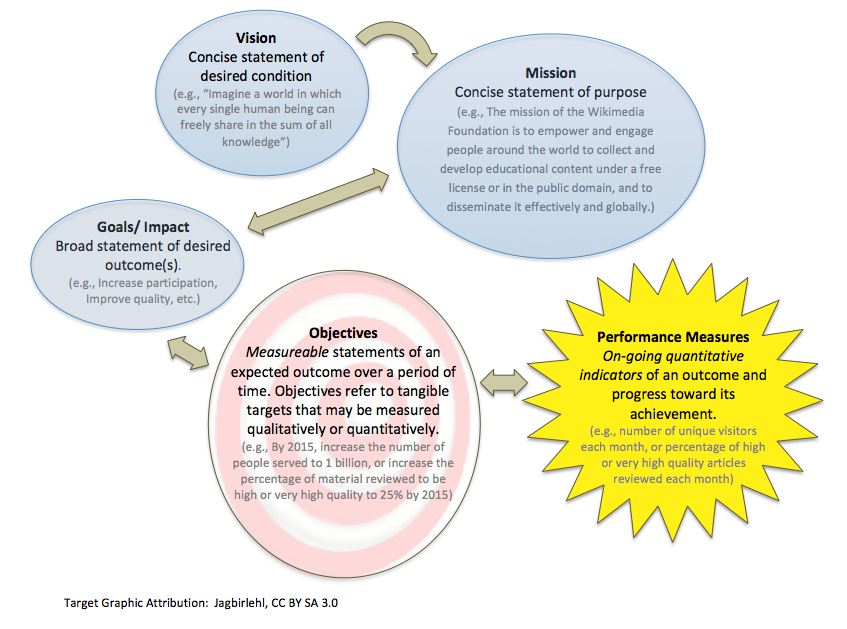
- Aligned: Each learning objective should directly support the larger goals of the course. They are the individual steps that lead to achieving the overall mission.
The Three Domains of Learning
Learning is a complex process that involves more than just thinking. To capture this complexity, educators often categorize learning objectives into three domains. Understanding these helps ensure a well-rounded educational experience.
| Domain | Focus | Example Objective |
|---|---|---|
| Cognitive | Knowledge and intellectual skills. This is about thinking and knowing. | "Analyze the main character's motivations in a novel." |
| Affective | Feelings, attitudes, and emotions. This domain deals with values and appreciation. | "Demonstrate a commitment to teamwork by actively listening to peers." |
| Psychomotor | Physical skills and movement. This involves using the body to perform tasks. | "Calibrate a microscope correctly and safely." |
Most educational experiences focus heavily on the cognitive domain, but all three are essential for holistic development. A surgeon needs the cognitive knowledge of anatomy, the psychomotor skill to perform an operation, and the affective disposition to care for patients with empathy.
By defining these different types of learning, educators can create richer, more comprehensive instruction that prepares learners for real-world challenges.