UX Frameworks Demystified
Introduction to UX Design
What is UX Design?
User Experience (UX) design is the process of making a product or service useful, easy to use, and enjoyable for people. It’s not just about how a product looks, but how it feels. Think about the last time you used an app that was confusing or frustrating. That was bad UX. Now think of an app that felt intuitive and simple. That was good UX.
The core of UX is empathy. It's about understanding the people who will use a product—their needs, their goals, and their frustrations.
When a product has good UX, users can accomplish their tasks without friction. This is why UX is so important. A product can have amazing features, but if it's difficult to use, people will abandon it. Good UX design leads to happier customers, increased loyalty, and a more successful product overall.
A Quick History
While the term "User Experience" was coined in the 1990s by Don Norman, a cognitive scientist at Apple, the principles behind it are much older. From the early days of industrial design, people have worked to make tools and machines more efficient and human-friendly.
Norman’s big idea was to focus on the entire experience a person has with a product. This includes their emotions, beliefs, preferences, and behaviors that occur before, during, and after use. The rise of personal computers and the internet made this focus essential. Suddenly, complex technology was in the hands of everyday people, and it needed to be designed for them, not just for engineers.
The Role of UX in Product Development
UX design is not a single step in the product development process; it's a continuous loop that's involved from the very beginning to long after a product has launched. It acts as the voice of the user, ensuring that business goals are aligned with user needs.
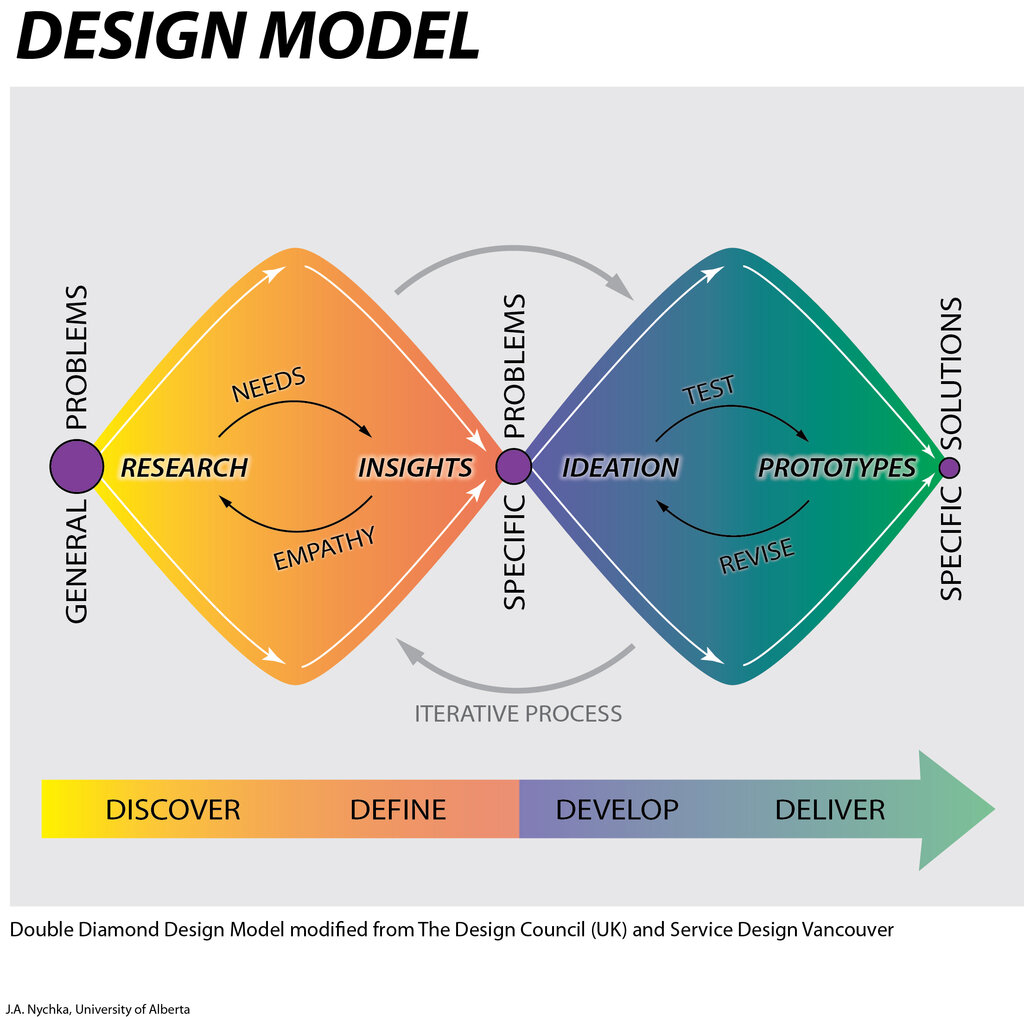
A common way to visualize this process is the Double Diamond model. It breaks the journey into four phases:
- Discover: The team explores the problem space, conducting research to understand users and their context.
- Define: Based on the research, the team narrows its focus to a clear problem that needs solving.
- Develop: The team brainstorms and creates potential solutions, often through sketches, wireframes, and prototypes.
- Deliver: The chosen solution is tested, refined, and ultimately built and launched.
Throughout these stages, UX designers are constantly gathering feedback from users and iterating on their designs. This ensures the final product is truly user-centered.
UX vs. UI
One of the most common points of confusion is the difference between User Experience (UX) and User Interface (UI) design. While they are closely related and often work together, they are distinct disciplines.
If a product is a house, UX is the architectural blueprint—the flow of the rooms, where the doors are placed for convenience. UI is the interior design—the paint colors, the furniture, the doorknobs.
UI design is focused on the visual and interactive elements of a product. It’s about the look and feel, the presentation, and the interactivity. UX design is the broader experience. It encompasses the user's entire journey, including how the interface works and how it serves their needs.
| User Experience (UX) | User Interface (UI) | |
|---|---|---|
| Focus | The user's overall journey and satisfaction | The product's visual look and feel |
| Goal | To make the product functional and useful | To make the product aesthetically pleasing and interactive |
| Components | User research, information architecture, interaction design | Visual design, graphic elements, layout, typography |
You can't have one without the other. A beautiful UI is useless if the UX is confusing. And a brilliant UX can be ruined by a clunky, unattractive UI. They are two sides of the same coin, both essential for creating a great product.
Let's check your understanding of these core concepts.
What is the primary focus of User Experience (UX) design?
User Interface (UI) design is primarily concerned with the visual and interactive elements of a product, while UX design is concerned with the ____.
Understanding these fundamentals—what UX is, where it came from, and how it differs from UI—is the first step. It's all about designing for people, which is the foundation of every successful product.