US Tax Laws Practical Guide
US Tax System Overview
The Layers of US Taxes
In the United States, taxes are collected by three different levels of government: federal, state, and local. Each level funds different public services.
Federal taxes are uniform across the country. They pay for national programs like Social Security, Medicare, and the military. State and local taxes, however, vary widely depending on where you live. These fund state-specific needs like highways, public universities, and state parks, as well as local services like police departments, public schools, and libraries. This multi-layered system means your total tax picture depends heavily on your location.
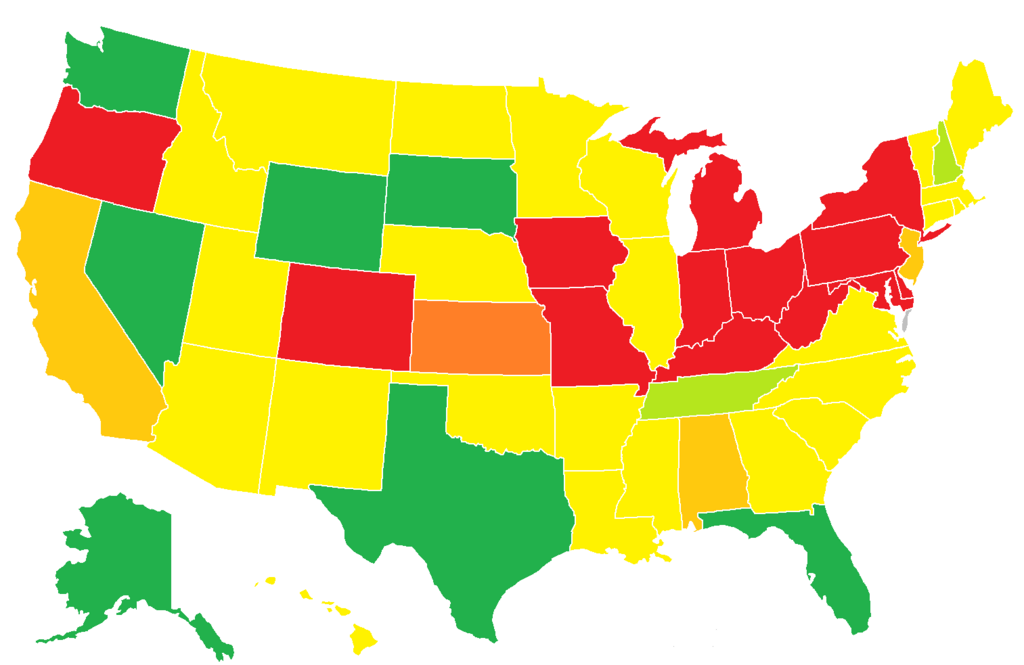
Some states have a high income tax but no sales tax, while others have the reverse. A few states, like Florida and Texas, have no state income tax at all. This is a major reason why the same salary can result in a very different take-home pay depending on the state you call home.
How Federal Income Tax Works
The federal government uses a progressive tax system to collect income tax. This means that people with higher taxable incomes are subject to higher tax rates. However, it's a common misconception that if you move into a higher tax bracket, all of your income is taxed at that new, higher rate. That’s not how it works.
Instead, the U.S. system uses marginal tax rates. Think of your income filling up a series of buckets. The first bucket is taxed at the lowest rate. Once it's full, any additional income spills over into the next bucket, which is taxed at a slightly higher rate, and so on. Your marginal tax rate is simply the rate you pay on your highest dollar of earnings, not on your entire income.
| Tax Rate | Single Filers | Married Filing Jointly |
|---|---|---|
| 10% | Up to $11,600 | Up to $23,200 |
| 12% | $11,601 to $47,150 | $23,201 to $94,300 |
| 22% | $47,151 to $100,525 | $94,301 to $201,050 |
| 24% | $100,526 to $191,950 | $201,051 to $383,900 |
| 32% | $191,951 to $243,725 | $383,901 to $487,450 |
| 35% | $243,726 to $609,350 | $487,451 to $731,200 |
| 37% | Over $609,350 | Over $731,200 |
This table shows the federal income tax brackets for 2024. If you're a single filer earning $50,000, you don't pay 22% on the full amount. You pay 10% on the first $11,600, then 12% on the portion from $11,601 to $47,150, and finally 22% only on the income above $47,150.
The agency responsible for collecting these taxes and enforcing the rules is the Internal Revenue Service (IRS).
Calculating Your Tax Bill
Your tax bill isn't based on your gross income, which is all the money you earned. It's based on your taxable income, which is your gross income minus certain adjustments and deductions. The goal of tax planning is to legally reduce your taxable income as much as possible.
There are two main tools for lowering your tax bill: deductions and credits.
A deduction reduces your taxable income. A credit reduces your final tax bill.
This distinction is crucial. A deduction's value depends on your marginal tax rate. For example, a $1,000 deduction for someone in the 22% tax bracket is worth $220 ($1,000 x 0.22). For someone in the 35% bracket, that same deduction is worth $350.
A tax credit, on the other hand, is a dollar-for-dollar reduction of the tax you owe. A $1,000 tax credit reduces your tax bill by exactly $1,000, regardless of your income or tax bracket. This makes credits much more powerful than deductions.
Now that we've covered the basic structure, let's test your understanding.
Which of the following is primarily funded by federal taxes?
True or False: In the U.S. progressive tax system, if you move into a higher tax bracket, all of your income is then taxed at that new, higher rate.
Understanding these core concepts—the different layers of government taxes, the progressive bracket system, and the distinction between deductions and credits—is the foundation for managing your finances and making informed decisions.