US Startup Tax Essentials
Business Entity Selection
Choosing Your Business Structure
Before you can even think about your first sale, you have to make a foundational decision: what kind of legal entity will your business be? This isn't just paperwork. Your choice of business structure affects everything from how you're taxed to your personal liability if the business runs into debt.
In the United States, there are several common structures, each with its own pros and cons. Let's walk through the main options to see which might be the best fit for your venture.
The Four Common Structures
Think of these as the starting lineup for new businesses. Two are simple defaults, and two require a bit more setup but offer powerful protections.
Sole Proprietorship: This is the default structure for a one-person business. If you start working for yourself and don't register as anything else, you're a sole proprietor. Your business is legally indistinct from you, the owner. This means your business profits are simply your personal income, which you report on your personal tax return. The major downside? You have unlimited personal liability. If the business owes money, your personal assets, like your car or house, could be at risk.
Partnership: The default for two or more owners. Like a sole proprietorship, a general partnership is a pass-through entity, meaning profits are passed to the partners and taxed on their personal returns. It also comes with unlimited personal liability. Critically, each partner can be held responsible for the business's entire debt, even if another partner created it.
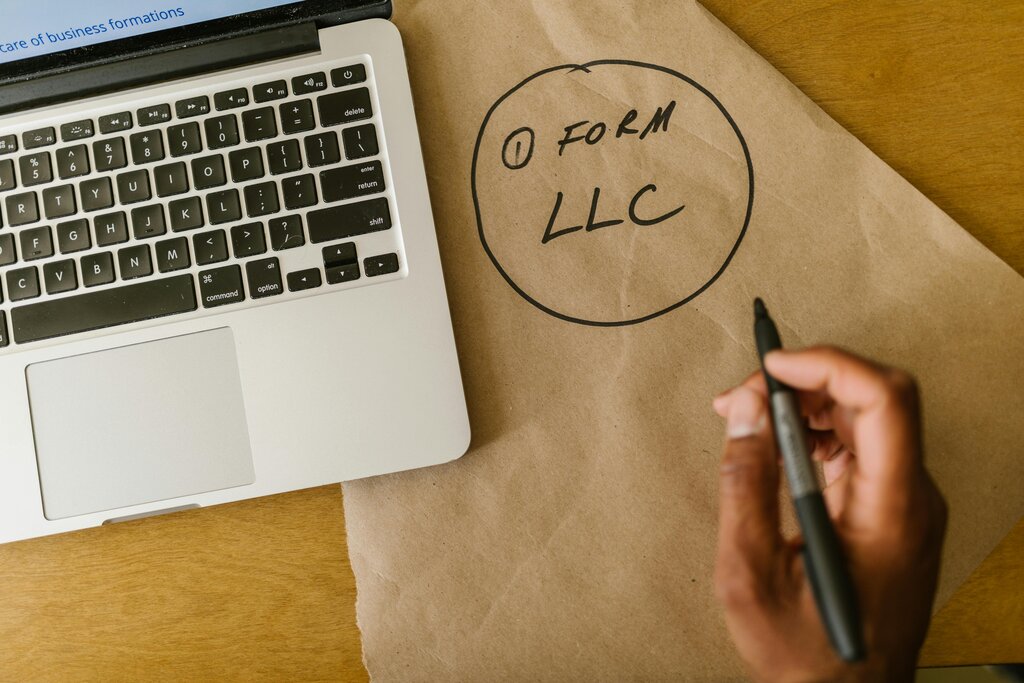
Most entrepreneurs prefer the Limited Liability Company (LLC) business structure, because it costs less and is easier to manage than a Corporation.
Limited Liability Company (LLC): An LLC is a popular hybrid structure. It provides the liability protection of a corporation, meaning your personal assets are generally shielded from business debts, while offering the tax flexibility and simplicity of a partnership or sole proprietorship. By default, a single-member LLC is taxed like a sole proprietorship, and a multi-member LLC is taxed like a partnership. However, an LLC can also elect to be taxed as a corporation, which can sometimes offer tax advantages.
Corporation (Corp): A corporation is a completely separate legal entity from its owners, who are called shareholders. This structure provides the strongest protection against personal liability. Corporations can be more complex to set up and maintain. There are two main types:
- C Corporation: A C Corp is taxed separately from its owners. It pays taxes on its profits, and then if those profits are distributed to shareholders as dividends, the shareholders pay taxes on them again. This is known as "double taxation." C Corps are often preferred by companies that plan to raise significant capital from venture capitalists.
- S Corporation: An S Corp is a special tax designation that allows profits and losses to be passed through directly to the owners' personal income without being subject to corporate tax rates. This avoids the double taxation issue. An LLC can also elect to be taxed as an S Corp.
Why would an LLC elect to be taxed as an S corporation instead of a sole proprietorship or partnership? It all has to do with self-employment tax: sole proprietorships and partnerships have to pay it on 100% of the business profits, but S corp owners only pay self-employment taxes on the salary they take from the business.
| Structure | Liability | Taxation | Best For |
|---|---|---|---|
| Sole Proprietorship | Unlimited personal liability | Pass-through; reported on personal return | Freelancers or single owners testing an idea |
| Partnership | Unlimited personal liability | Pass-through; reported on partners' returns | Two or more owners starting a simple business |
| LLC | Limited liability | Flexible; pass-through (default) or corporate | Most small businesses wanting protection & simplicity |
| Corporation | Limited liability | C Corp: Double taxation. S Corp: Pass-through | Businesses seeking to raise capital or with complex ownership |
Making It Official
Once you've chosen a structure, you need to register your business. The process varies significantly depending on the entity type.
Sole proprietorships and general partnerships usually don't need to register with the state to exist. You simply start doing business. However, if you operate under a name that isn't your own legal name (like "Citywide Plumbing" instead of "Jane Doe"), you'll likely need to file for a DBA ("Doing Business As") name with your local government.
To create an LLC, the freelancer must file formation documents (Articles of Organization, sometimes called Certificate of Organization) with their state.
LLCs and corporations are formed at the state level. This involves filing formation documents with the Secretary of State or equivalent agency. For an LLC, this is typically called the "Articles of Organization." For a corporation, it's the "Articles of Incorporation."
Getting Your Tax ID
Many businesses need an Employer Identification Number (EIN) from the IRS. Think of it as a Social Security number for your business. It's a unique nine-digit number used to identify your business entity for tax purposes.
You will need an EIN if you:
- Hire employees
- Operate your business as a corporation or a partnership
- File certain tax returns (like Employment, Excise, or Alcohol, Tobacco and Firearms)
- Open a business bank account
Applying for an EIN is a simple, free process that can be done online through the IRS website.

Your business structure directly impacts your initial tax filing requirements. If you're a sole proprietor or a single-member LLC taxed as one, you'll report your business income and expenses on a Schedule C, which is filed with your personal Form 1040 tax return.
Partnerships and multi-member LLCs file an informational return (Form 1065) to report income and expenses. The partnership itself doesn't pay tax, but it issues a Schedule K-1 to each partner, who then reports their share of the profit or loss on their personal tax return.
C Corporations file their own tax return, Form 1120, and pay taxes at the corporate rate. S Corporations file Form 1120-S and, like partnerships, issue a Schedule K-1 to each shareholder to report their share of the income.
What is a primary advantage of forming a business as a Limited Liability Company (LLC)?
The term 'double taxation' typically refers to which business structure's default tax treatment?
Choosing a business entity is a big step. It sets the legal and financial foundation for everything that comes next.