US-China Tariffs and Consumer Prices
Introduction to Tariff Policies
What Are Tariffs?
A tariff is a tax on goods that cross international borders. Most often, it's a tax on imports—products brought into a country. Governments use tariffs for a few key reasons: to raise money, to protect domestic industries from foreign competition, or for political leverage.
Think of a tariff as an entry fee for foreign products. Before a product from another country can be sold in a local market, the importer has to pay this fee to the government.
Tariff
noun
A tax or duty to be paid on a particular class of imports or exports.
The main goal of a protective tariff is to make imported goods more expensive. This price increase encourages consumers to buy products made in their own country, which can help local businesses grow and create jobs. Tariffs can also be a source of revenue, just like any other tax. Finally, they can be used as a tool in trade negotiations, giving a country a bargaining chip to encourage other nations to lower their own trade barriers.
Different Kinds of Tariffs
Tariffs aren't one-size-fits-all. They come in a few different forms, each calculated in a unique way.
| Type | How It's Calculated | Example |
|---|---|---|
| Ad Valorem | A percentage of the imported good's value. | A 10% tariff on a $20,000 car is $2,000. |
| Specific | A fixed fee based on the weight, number, or quantity of an item. | A $1 tariff on every barrel of oil. |
| Compound | A combination of an ad valorem and a specific tariff. | A $0.50 fee per kilogram plus 5% of the value. |
Ad valorem tariffs are the most common. The term comes from Latin, meaning "according to value." Specific tariffs are simpler to calculate but don't adjust for changes in a product's price. Compound tariffs offer a middle ground, combining both approaches.
Tariffs in History
Tariffs have been a part of economic policy for centuries. In the early days of the United States, they were the federal government's primary source of income. For much of its history, the U.S. maintained high tariffs to protect its young industries from established European competitors.
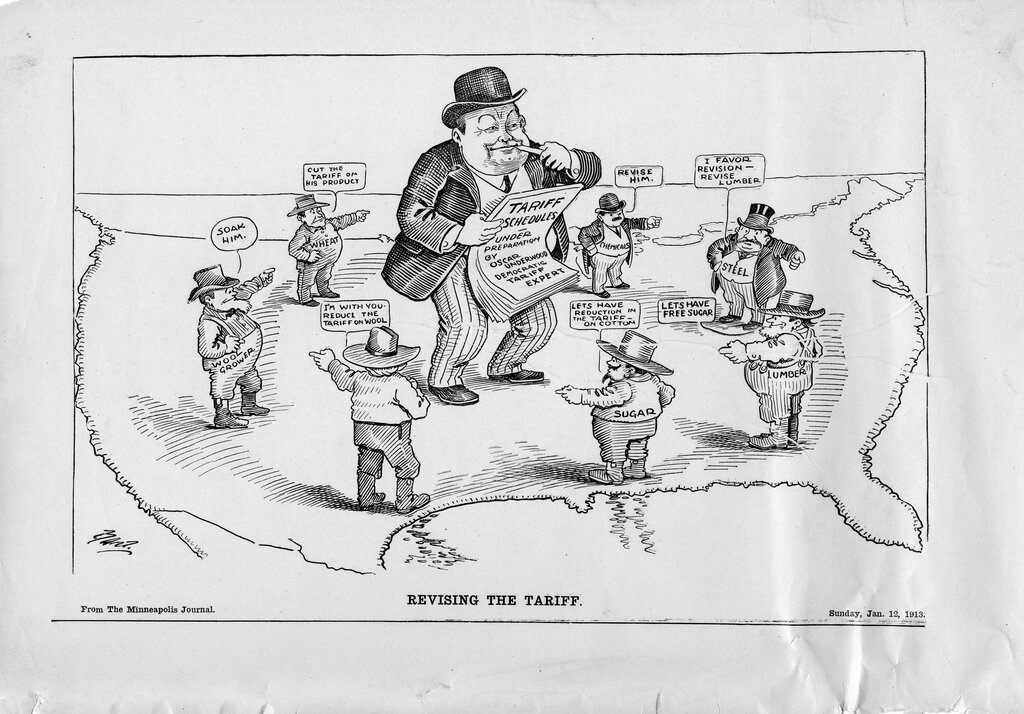
One famous example is the Tariff of 1828, nicknamed the "Tariff of Abominations" by its southern opponents. It placed high taxes on imported goods to shield factories in the North. However, it hurt the agricultural South, which relied on exporting crops and importing cheap foreign goods. This tension over tariffs was one of many economic issues that contributed to the divide between the North and South before the Civil War.
Over time, the global trend has moved toward lower tariffs and free trade, with the belief that it leads to greater efficiency and economic growth. However, debates about the proper use of tariffs continue to this day, as countries weigh the benefits of free trade against the desire to protect domestic jobs and industries.
The graph shows how a tariff works. Without a tariff, the country imports a large quantity of a good at the low world price. After the tariff is added, the price for that good rises inside the country. At this new, higher price, domestic companies are willing to produce more, while consumers buy less. The result is a sharp decrease in the number of imports.
What is the primary purpose of a protective tariff?
A country imposes a tax of 5% on the total monetary value of all imported smartphones. What type of tariff is this?
Understanding what tariffs are and how they work is the first step. They are a powerful tool in international trade, with a long history and complex effects on economies.