UP Board Economics Class 12 Exam Mastery
Consumer Behavior Equilibrium
The Sweet Spot of Satisfaction
Every choice you make as a consumer, from buying a coffee to choosing a smartphone, is an attempt to maximize your satisfaction, or what economists call utility. But how do we model this? It starts with a simple observation about human nature.
Think about eating your favorite snack. The first bite is amazing. The second is still great, but maybe a little less so. By the fifth or sixth, you're still enjoying it, but the extra satisfaction from each additional bite is decreasing. This is the core of the Law of Diminishing Marginal Utility.
Marginal Utility
noun
The additional satisfaction or benefit a consumer gains from consuming one more unit of a good or service.
This law states that as you consume more of a good, the extra utility you get from each additional unit will eventually decrease. It doesn't mean your total satisfaction goes down, just that the rate of increase slows. This simple idea is the bedrock for understanding why we don't spend all our money on just one thing.
The more you have of something, the less you value getting one more.
Mapping Your Preferences
Economists have two ways of thinking about utility. suggests we can measure and assign specific numerical values to satisfaction—like saying an apple gives you 10 'utils' and a banana gives you 20. A more modern and realistic approach is ordinal utility, which simply ranks preferences. You might not know how much more you like bananas than apples, but you know you prefer one over the other.
To visualize these ranked preferences, we use indifference curves. An indifference curve shows all the different combinations of two goods that provide a consumer with the exact same level of satisfaction. You'd be equally happy with 1 pizza and 6 sodas as you would with 2 pizzas and 3 sodas.
Indifference curves have distinct properties:
- They are downward sloping. To keep satisfaction constant, if you get more of one good, you must have less of the other.
- They are to the origin. This shape reflects the diminishing marginal rate of substitution. As you get more of Good X, you're willing to give up less of Good Y to get even more X.
- They can never intersect. Two curves intersecting would imply that the same bundle of goods gives two different levels of satisfaction, which is a logical contradiction.
- Higher curves represent higher utility. A curve further from the origin represents bundles with more of both goods, and thus more satisfaction.
Budget, Meet Preferences
Your preferences show what you want, but your budget shows what you can afford. The budget line represents all possible combinations of two goods that a consumer can purchase, given their income and the prices of the goods.
A budget line can change in two ways. If your income changes, the line will shift in or out, parallel to the original line. If the price of one good changes, the line will rotate or pivot from the axis of the good whose price remained constant.
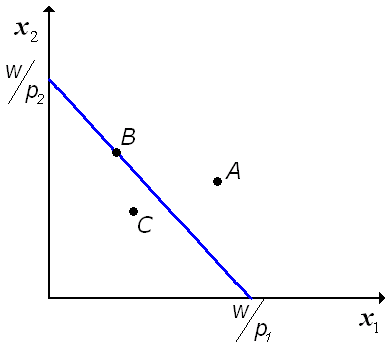
Consumer equilibrium is achieved when you reach the highest possible indifference curve that is still tangent to your budget line. At this single point, you are maximizing your utility given your financial constraints. Any other point on the budget line would be on a lower indifference curve, providing less satisfaction.
Equilibrium – an economic situation where no individual would be better off doing something different.
This equilibrium has a precise mathematical condition. It occurs where the slope of the indifference curve is equal to the slope of the budget line.
In simpler terms, you find equilibrium when the psychological trade-off you're willing to make between two goods exactly equals the financial trade-off the market forces you to make.
You're very thirsty after a run. The first glass of water is incredibly refreshing. The second is good, but not as satisfying. The third you barely finish. This experience is a classic example of what economic principle?
An economist says, 'I prefer coffee to tea, but I can't tell you by how much.' This statement reflects which approach to measuring satisfaction?
By combining what you want (indifference curves) with what you can afford (budget line), we find the precise point of maximum satisfaction. This equilibrium isn't static; it shifts as prices and incomes change, guiding every purchasing decision you make.