Unveiling the Moon's Dance
Earth Moon Sun Geometry
An Ever-Changing Viewpoint
The Moon doesn't generate its own light. Like a ball in a dark room, it only shines because it reflects light from a single, powerful source: the Sun. The phases of the Moon we see from Earth are not about the Moon changing, but about our changing perspective of its sunlit side as it orbits our planet.
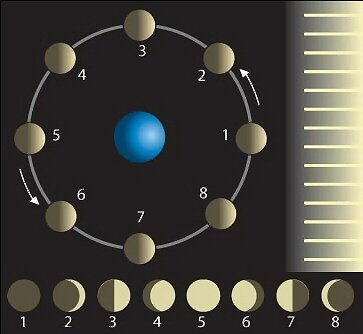
Think of the Moon as a simple gray sphere, constantly moving through space. At any given moment, the Sun illuminates exactly half of it, creating a bright "day" side and a dark "night" side. The line separating these two halves is called the lunar terminator — a zone of sunrise or sunset on the Moon's surface.
terminator
noun
The line dividing the illuminated and unilluminated parts of a celestial body, such as the Moon.
An Orbit in Motion
The Moon completes an orbit around Earth roughly every 27.3 days. Throughout this journey, the Sun continues to light up one half of the Moon. But from our vantage point on Earth, the amount of that lit-up half we can see changes from night to night. Our view is determined entirely by where the Moon is in its orbit relative to us and the Sun.
When the Moon is between Earth and the Sun, the side lit by the Sun faces completely away from us. We see only the unlit side, which we call a New Moon. As the Moon continues in its orbit, we begin to see a small sliver of its sunlit side. This sliver grows night after night until the Moon is on the opposite side of Earth from the Sun. At this point, the entire sunlit face is turned toward us, giving us a Full Moon.
The dance is simple: the Moon orbits the Earth, and our view of the Moon's sunny side changes.
After the Full Moon, the process reverses. We see less and less of the illuminated side each night as the Moon completes its orbit and returns to the New Moon position. This predictable cycle of changing views is what creates the phases. It's a beautiful cosmic clockwork, governed by the simple geometry of light and shadow.
Why does the Moon appear to shine in the night sky?
What is the primary cause of the Moon's phases?