Unveiling the Bhagavad Gita's Wisdom
Dharma and Svadharma
Cosmic Order and Personal Duty
You already know that dharma is the underlying order of the cosmos—the moral law and ethical framework that holds everything together. It's the principle of righteousness that guides the universe. But how does this grand, cosmic concept apply to an individual's life?
Dharma represents the cosmic order, moral duty, and righteous living in Hinduism.
The answer lies in svadharma, or one's personal, individual duty. Think of dharma as a great river and svadharma as the specific current you are meant to follow. It isn’t a one-size-fits-all set of rules. Instead, your svadharma is unique to you, shaped by your innate nature (svabhava), your stage in life, and your role within society. A teacher's duty is to impart knowledge, a soldier's is to protect, and a parent's is to nurture. Each role has its own righteous path.
Svadharma is the personal application of universal Dharma. It is the right and moral path for a specific individual.
Action Without Attachment
Simply knowing your duty is not enough; you must act on it. The Bhagavad Gita, a central Hindu scripture, offers profound insight into how to perform your svadharma. The text unfolds on a battlefield where the warrior Arjuna is overcome with despair. He faces a moral crisis: his duty as a warrior requires him to fight against his own family members.
His charioteer, who is the god Krishna in disguise, advises him. Krishna doesn't tell him to abandon his duty. Instead, he teaches Arjuna a crucial principle: perform your duty without being attached to the results.
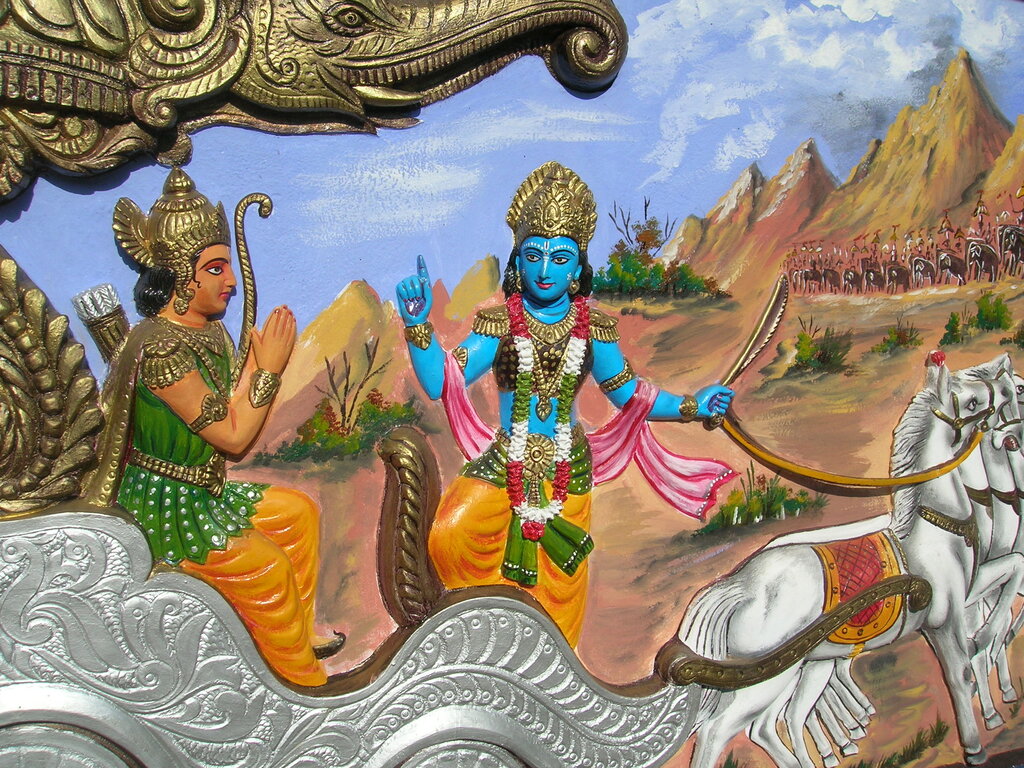
This concept is known as Nishkama Karma, or selfless action. The focus is on the action itself, performed to the best of your ability because it is the right thing to do, not for any potential reward, praise, or outcome. Whether you succeed or fail is secondary to the sincerity and dedication with which you fulfill your role.
“You have the right to perform your duty, but not to the results.” – Bhagavad Gita 2.47
The Consequences of Your Path
Following one's svadharma leads to personal and societal harmony. When individuals fulfill their unique roles with integrity and without attachment, they contribute to the stability and proper functioning of the whole. This alignment with cosmic order brings inner peace and spiritual growth.
On the other hand, deviating from your svadharma, or acting against your innate nature and moral duty, is known as adharma. This path creates conflict, both internally and externally. Neglecting your responsibilities or acting out of greed, fear, or ego leads to suffering, social decay, and a disruption of the cosmic balance.
Adharma
noun
The opposite of dharma. It signifies unrighteousness, moral decay, and actions that are not in accord with one's duty or cosmic law.
Imagine a symphony orchestra. For the music to be beautiful, the violinists must play the violin part, and the drummers must play the percussion part. If a violinist decides they would rather play the drums, regardless of their skill, the result is noise, not music. Adhering to svadharma is like each musician playing their part flawlessly, contributing to a magnificent, harmonious whole.
Ready to check your understanding of these ideas?
What is the relationship between dharma and svadharma?
The principle of Nishkama Karma, as taught in the Bhagavad Gita, is best described as:
Ultimately, the path of dharma is about finding your unique role in the cosmic order and fulfilling it with unwavering commitment and a clear heart.