Unveiling the Atom
Introduction to Atoms
The Building Blocks of Everything
Everything you see and touch is made of matter. Your chair, the air you breathe, the water you drink—it's all matter. If you could zoom in, way past what any normal microscope can see, you'd find that all matter is built from tiny particles called atoms.
Think of atoms like LEGO bricks. You can use the same few types of bricks to build anything from a simple house to a complex spaceship. Similarly, a relatively small number of different types of atoms combine in countless ways to make up everything in the universe.
Atom
noun
The smallest unit of an element that maintains the chemical properties of that element.
Understanding atoms is the key to understanding chemistry. An element's properties, like why gold is shiny or why helium is lighter than air, all come down to the structure of its atoms. When we study chemistry, we're really studying how these fundamental building blocks interact, bond together, and rearrange to form new substances.
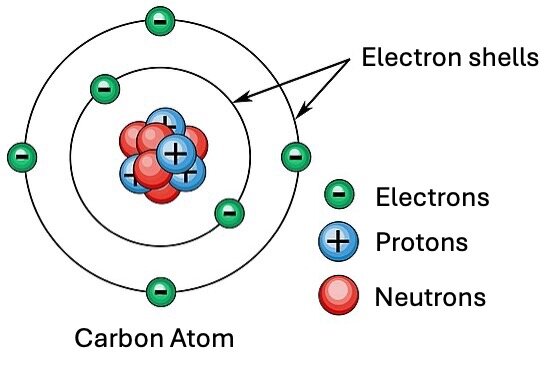
Inside the Atom
For a long time, people thought atoms were the smallest things that could exist. But it turns out they are made of even smaller pieces called subatomic particles. The three most important ones for us to know are protons, neutrons, and electrons.
These particles aren't just thrown together randomly. They have a specific arrangement. At the very center of the atom is a dense core called the nucleus. This is where you'll find the protons and neutrons packed tightly together.
The main thing that distinguishes these particles is their electric charge.
| Particle | Location | Charge |
|---|---|---|
| Proton | In the nucleus | Positive ( +1 ) |
| Neutron | In the nucleus | Neutral ( 0 ) |
| Electron | Outside nucleus | Negative ( −1 ) |
Protons have a positive charge. The number of protons determines what element an atom is. For example, any atom with exactly one proton is a hydrogen atom. An atom with six protons is always a carbon atom. It's the defining characteristic.
Neutrons have no charge at all; they are neutral. They reside in the nucleus with the protons and add mass to the atom but don't change its identity.
Electrons have a negative charge, exactly opposite to the positive charge of a proton. They are much, much smaller and lighter than protons and neutrons. Electrons don't sit still. They zip around the nucleus in a region called the electron cloud.
In a neutral atom, the number of electrons is equal to the number of protons. The positive and negative charges cancel each other out, resulting in an atom with no overall charge.
Mass and Identity
While protons define an element, the mass of an atom comes almost entirely from its nucleus. Protons and neutrons have a similar mass, while electrons are so light their mass is usually considered negligible in basic calculations.
The number of protons is called the atomic number. This number is unique to each element and is how we identify it on the periodic table. The total number of protons and neutrons in the nucleus is called the mass number.
These three particles—protons, neutrons, and electrons—work together to give every element its unique properties. The number of protons gives an atom its identity, while the arrangement of its electrons determines how it will interact with other atoms. And that interaction is what all of chemistry is about.
What are the three fundamental subatomic particles that form an atom?
Which subatomic particle has a negative charge?
With these basics, you have the foundation to understand how all matter is constructed.