Unveiling Quantum Mysteries: The Double-Slit Experiment
Introduction to Waves and Particles
The World of Particles
Let's start with something familiar: a particle. In everyday life, a particle is just a tiny piece of something. A grain of sand, a speck of dust, or even a baseball can be thought of as a particle. The key idea is that a particle is a single, localized object. You can point to it and say, "It's right there."
A particle exists at a specific point in space at any given moment. You can track its path from one point to another, like a ball flying through the air.
In physics, particles have specific properties that we can measure. Two of the most important are mass and charge.
Mass
noun
A measure of how much "stuff" an object contains. It's also a measure of inertia, which is how much an object resists a change in its motion.
Charge
noun
A fundamental property of matter that causes it to experience a force when placed in an electromagnetic field. Charge can be positive, negative, or zero.
When two particles meet, they collide. Think of two billiard balls hitting each other. They bounce off and change direction. They cannot pass through each other or occupy the same exact space at the same time.
The Nature of Waves
Now, let's switch gears to waves. Unlike a particle, a wave isn't a single object in one spot. A wave is a disturbance or an oscillation that travels from one place to another. A classic example is the ripple created when you drop a pebble into a calm pond. The ripple spreads out across the water's surface.
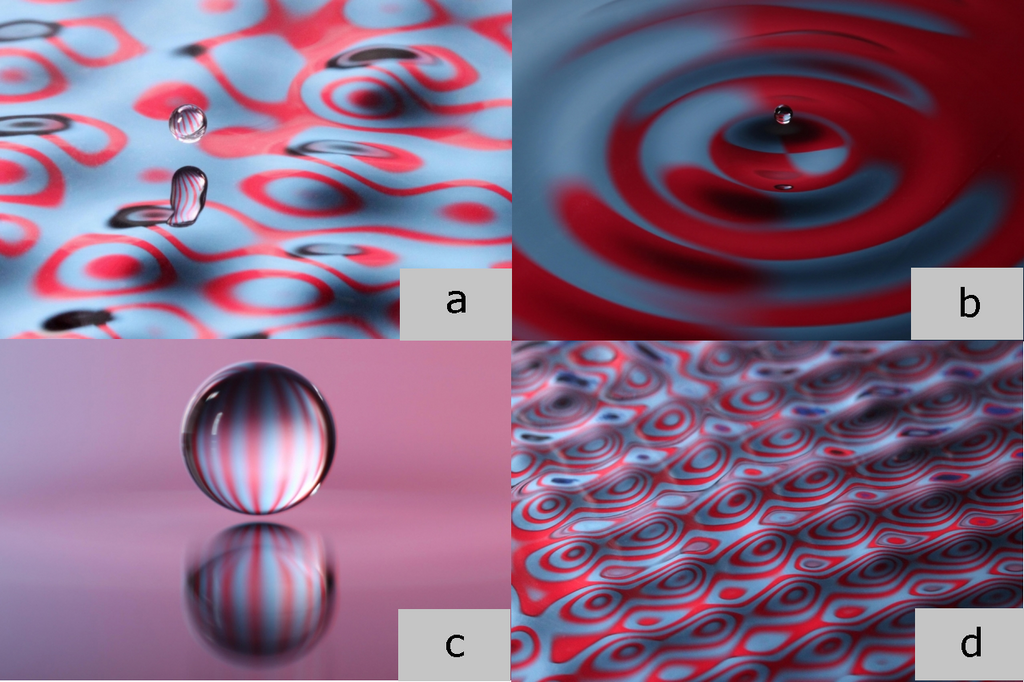
Sound is another example of a wave. It's a vibration that travels through the air. You can't point to a single spot and say "the sound is right here." Instead, the sound wave fills a region of space. Waves are described by a different set of properties.
Wavelength
noun
The distance over which a wave's shape repeats. It's often measured from one peak of the wave to the next peak.
Frequency
noun
The number of complete wave cycles that pass a point in a given amount of time. It's measured in Hertz (Hz), where 1 Hz is one cycle per second.
Amplitude
noun
The maximum displacement or distance moved by a point on a vibrating body or wave measured from its equilibrium position. It corresponds to the wave's intensity or strength.
Particles vs. Waves
The fundamental difference between a classical particle and a classical wave is localization. A particle is localized, meaning it's confined to a tiny region of space. A wave is delocalized, meaning it's spread out.
They also interact with their environment differently. When waves meet, they don't collide and bounce off each other like particles. Instead, they pass right through one another. As they overlap, their amplitudes combine in a process called interference. They can either add up to create a larger wave (constructive interference) or cancel each other out (destructive interference).
| Feature | Particle | Wave |
|---|---|---|
| Localization | Exists at a single point | Spread out over a region |
| Interaction | Collides with other particles | Passes through other waves (interferes) |
| Key Properties | Mass, Charge, Position | Wavelength, Frequency, Amplitude |
In the classical world we experience every day, things are either particles or waves. A baseball is a particle. The sound of the bat hitting it is a wave. They are distinct categories. This clear distinction forms the basis for everything we observe on a large scale. Understanding this separation is the first step toward exploring the more complex behavior of matter and energy at the smallest scales.