Unveiling India's Hidden Folk Melodies
Folk vs Classical Music
The Soundtrack of a Nation
Indian music can be seen as two great rivers. One is a carefully engineered canal, with precise rules governing its flow. The other is a wild, winding river, changing its course with the seasons. Both are beautiful and vital, but they come from different places and serve different purposes.
The canal is classical music, and the wild river is folk music.
Classical music, known as Shastriya Sangeet, is a formal art form built on a foundation of strict rules. It requires years of dedicated study under a teacher, or guru. The two main traditions are Hindustani music from North India and Carnatic music from South India. Though they have different styles, both are based on two core concepts: Raga and Tala.
Raga
noun
A melodic framework for improvisation and composition. Each raga has a specific set of notes, a typical order in which they appear, and characteristic melodic phrases. It's more than a scale; it's a mood or a color the musician paints with.
Tala
noun
A rhythmic cycle or pattern. It provides the metrical framework for a composition, much like a time signature in Western music, but often far more complex. A tala is a repeating cycle of beats.
Think of a classical musician as a master chef following a complex, ancient recipe. They know the exact ingredients (the notes of the raga) and the precise cooking time and method (the rhythm of the tala). While there is room for improvisation, it must happen within these established rules. The performance is structured, deliberate, and aims for technical and emotional perfection.
Music of the People
Folk music, or Lok Sangeet, is the complete opposite. It's the music of everyday life, born from the fields, villages, and festivals. It doesn’t come from textbooks or require formal training. Instead, it's passed down from one generation to the next, like a family story.
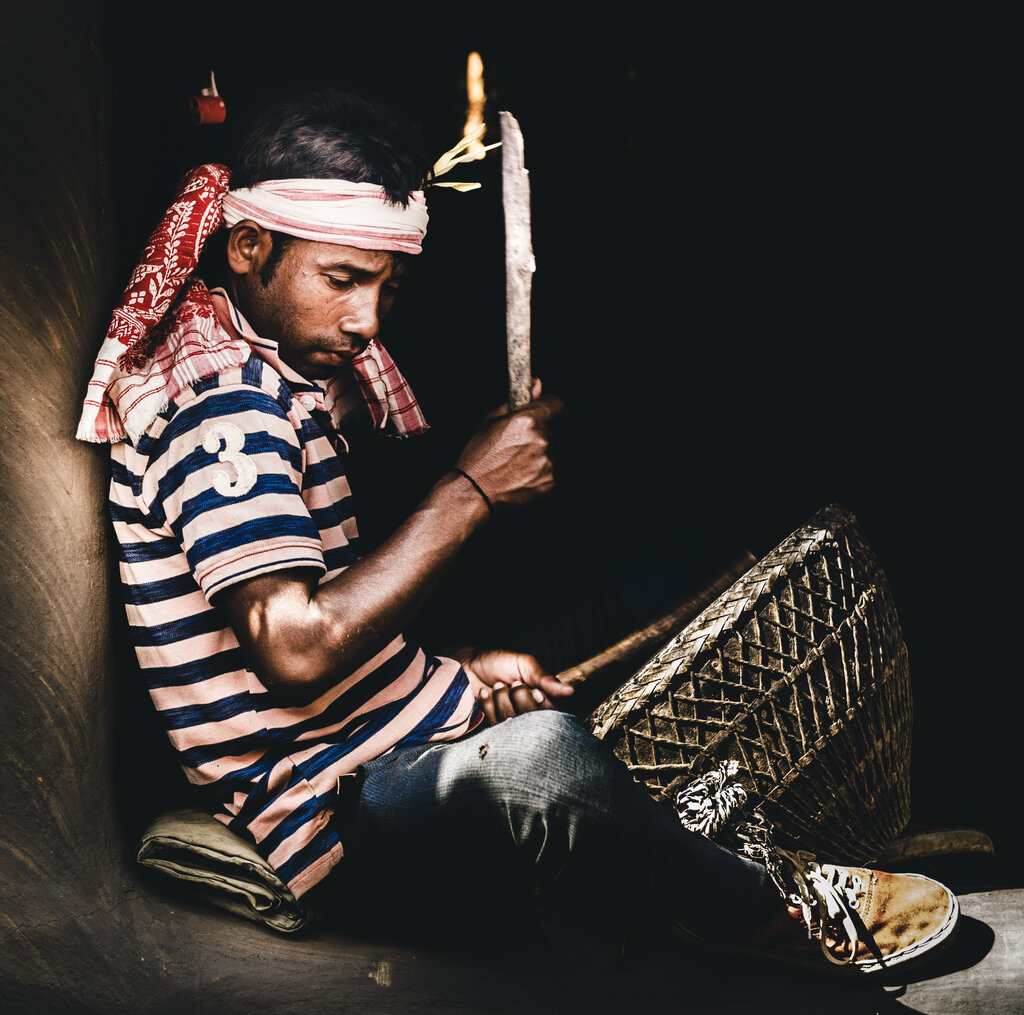
This is music tied to the rhythm of life itself. There are songs for sowing seeds, songs for celebrating a harvest, songs for weddings, and songs for lulling a baby to sleep. Its melodies are simple and its rhythms are direct. The goal isn't technical perfection, but heartfelt expression and community participation.
Folk music is spontaneous. It's music by the people, for the people.
Unlike classical music with its written traditions and theoretical texts, folk music is almost entirely an oral tradition. A farmer in Punjab doesn't read a musical score to sing a harvest song; he sings it the way his father taught him, who learned it from his grandfather. This is why folk music is so diverse, with each region having its own unique sounds, instruments, and lyrical themes.
Structure vs Spontaneity
The core difference lies in their approach to structure. Classical music is a closed system. The rules of raga and tala provide a rigid framework that a musician must master before they can truly express themselves. It was historically the music of the courts and temples, appreciated by a trained audience.
Folk music is an open system. Its structure is loose, defined by the function of the song and the feeling of the moment. A festival song might have a simple chorus that everyone can join in on, encouraging participation over polished performance. It’s the soundtrack of the masses, accessible to all.
| Feature | Classical Music (Shastriya Sangeet) | Folk Music (Lok Sangeet) |
|---|---|---|
| Rules | Strict, based on Raga and Tala | Flexible, varies by region and occasion |
| Training | Years of formal study with a guru | Informal, passed down orally |
| Origin | Courts, temples, and concert halls | Villages, fields, and communities |
| Purpose | Artistic expression, spiritual devotion | Social functions, rituals, work, celebration |
| Performance | Formal, structured, often solo-focused | Spontaneous, communal, participatory |
While classical music sought to refine human emotion into a complex art form, folk music gave voice to the immediate joys and sorrows of life. Both are essential threads in the rich tapestry of Indian culture.
What are the two core concepts that form the foundation of both Hindustani and Carnatic classical music?
Which statement best describes the primary purpose of folk music (Lok Sangeet) as presented in the text?