Unveiling Dark Matter
Introduction to Dark Matter
The Missing Mass
Look up at the night sky. Every star, planet, and galaxy you can see is made of ordinary matter, the same stuff that makes up you, your chair, and the air you breathe. But all this visible material is just a tiny fraction of the universe. The cosmos is mostly made of two things we can't see at all: dark matter and dark energy.
| Component | Percentage of Universe |
|---|---|
| Ordinary Matter | ~5% |
| Dark Matter | ~27% |
| Dark Energy | ~68% |
Dark matter isn't just empty space. It's a mysterious substance that has mass and exerts a gravitational pull, but it doesn't interact with light in any way. It doesn’t shine, reflect, or block light, which is why we call it “dark.” While we can't see it directly, we can see its effects on everything around it.
An Invisible Pull
The first clues about dark matter came in the 1930s from astronomer Fritz Zwicky. He was studying the Coma Cluster, a massive collection of over a thousand galaxies. By measuring the light from these galaxies, he could estimate their total mass. But when he watched how fast they were moving, he found a problem.
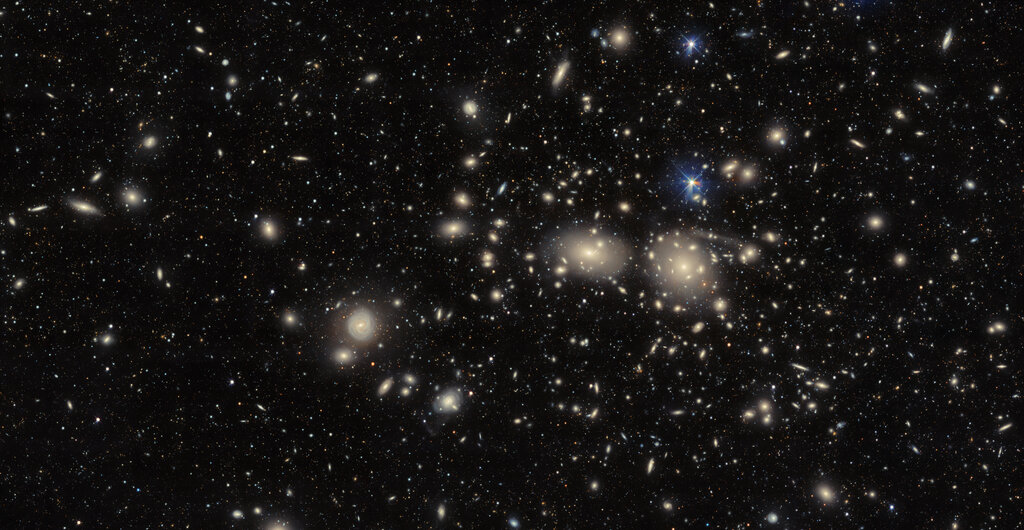
The galaxies were moving so quickly that the gravity from their visible matter wasn't nearly enough to keep them from flying apart. To hold the cluster together, there had to be an enormous amount of unseen mass providing extra gravitational glue. Zwicky called this missing material dunkle Materie, or dark matter. His idea was largely ignored for decades.
Then, in the 1970s, astronomer Vera Rubin provided even stronger evidence. She was studying the rotation of individual spiral galaxies. According to Newton's laws of gravity, stars at the outer edges of a galaxy should orbit more slowly than those closer to the bright, dense center, just like outer planets in our solar system move slower than inner ones.
Instead, Rubin found that the outer stars were moving just as fast as the inner ones. This observation made no sense unless there was a massive, invisible halo of matter surrounding the entire galaxy.
This discrepancy between the expected and observed rotation curves is one of the strongest pieces of evidence for dark matter. The flat curve implies that the galaxy's mass is not concentrated in the center but is spread out in a vast, invisible halo.
Bending Spacetime
Another way we detect dark matter is through gravitational lensing. According to Einstein's theory of general relativity, massive objects warp the fabric of spacetime. Light traveling from a distant source will bend as it passes by a massive object, like a galaxy or cluster of galaxies.
Because dark matter has mass, it also warps spacetime. When we look at distant galaxies, their light is often distorted by the gravity of both visible and dark matter in front of them. This can make background galaxies appear stretched, magnified, or even multiplied into several images.
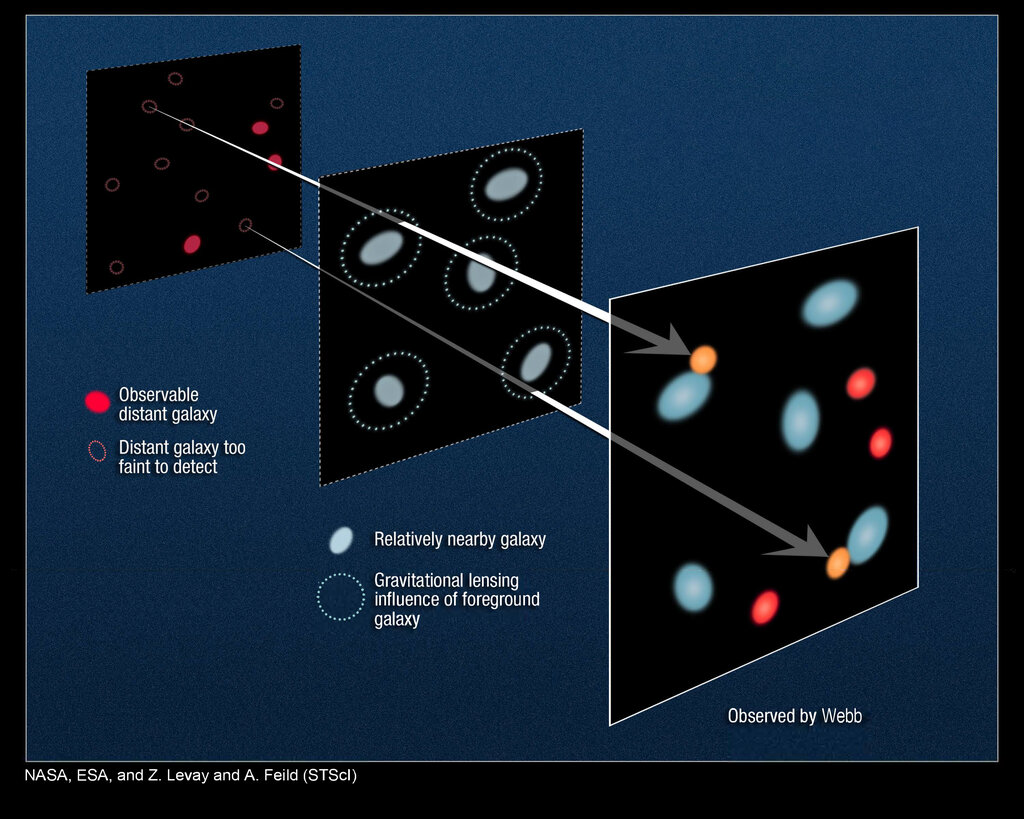
By studying the amount of distortion, astronomers can create a map of all the mass that is bending the light. These maps consistently show far more mass than we can account for with stars and gas alone. The extra mass is dark matter, and it perfectly matches the predictions from galaxy rotation curves.
Let's check your understanding of this mysterious substance.
What is the primary reason dark matter is described as 'dark'?
Astronomer Vera Rubin observed that stars at the edges of spiral galaxies were moving much faster than expected. What did this observation imply?
The combined evidence from galaxy clusters, rotation curves, and gravitational lensing paints a clear picture. The universe is dominated by an invisible substance whose gravity shapes the cosmos on the largest scales.