Unveiling Dark Matter
Introduction to Dark Matter
The Universe's Missing Mass
When we look up at the night sky, we see stars, galaxies, and nebulae. This is what we call normal, or baryonic, matter. It's the stuff that makes up everything we can see and touch. But all this visible matter only accounts for a small fraction of the universe. The vast majority is something else entirely, something we can't see.
About 27% of the universe is made of a mysterious substance called dark matter. It doesn't emit, absorb, or reflect any light, making it completely invisible to our telescopes. We know it's there not by seeing it, but by observing its gravitational effects on the things we can see.
A Cosmic Puzzle
The story of dark matter begins in the 1930s with an astronomer named Fritz Zwicky. He was studying the Coma Cluster, a massive collection of over a thousand galaxies. He noticed something odd: the galaxies on the outskirts of the cluster were moving incredibly fast. They were moving so quickly that the gravitational pull from all the visible matter in the cluster shouldn't have been enough to keep them from flying off into space.
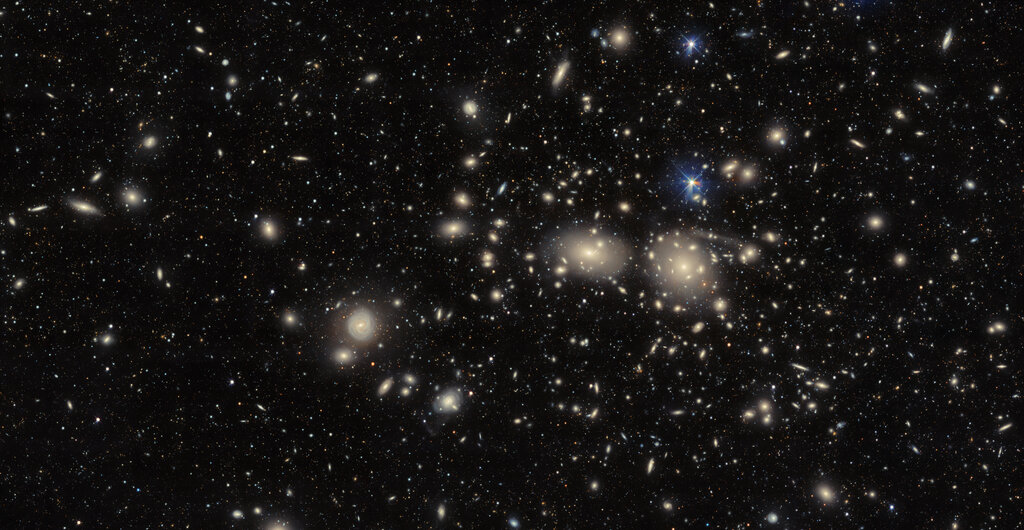
Zwicky concluded there had to be some unseen mass providing the extra gravity needed to hold the cluster together. He called this missing mass "dunkle Materie," or dark matter. His idea was largely ignored for decades.
Then, in the 1970s, astronomer Vera Rubin provided even stronger evidence. She was studying the rotation of individual spiral galaxies. She expected to see stars at the edge of a galaxy moving slower than those near the center, just like the outer planets in our solar system orbit the Sun more slowly than the inner ones. But that's not what she found. The stars at the outer edges were moving just as fast as the stars closer in.
This flat rotation curve was a huge surprise. The only way to explain it was if there was a massive, invisible halo of matter surrounding the galaxy, exerting its gravitational pull on everything within it. This halo had to contain far more mass than all the visible stars combined.
Seeing the Invisible
Another powerful piece of evidence for dark matter comes from a phenomenon predicted by Albert Einstein's theory of general relativity: gravitational lensing. The theory states that massive objects warp the fabric of spacetime. When light from a distant object travels past a massive object, like a galaxy cluster, its path is bent.
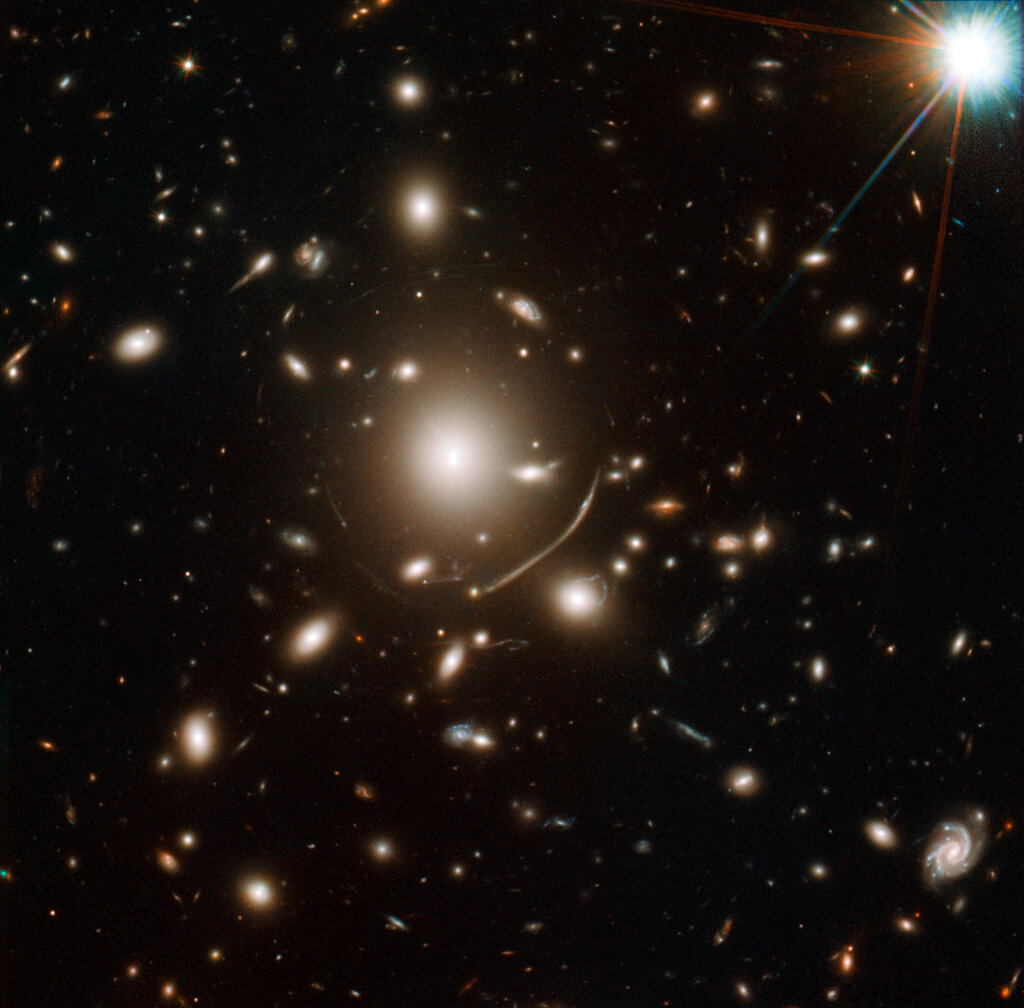
This effect acts like a cosmic magnifying glass. By studying how much the light is bent, astronomers can calculate the total mass of the object acting as the lens. In case after case, they found that galaxy clusters bend light far more dramatically than their visible mass could account for. The lensing reveals that the true mass is five to ten times greater than what we can see. The extra mass is dark matter.
These observations, from galaxy clusters to individual galaxies to the large-scale structure of the universe, all point to the same conclusion. The universe is filled with a mysterious, invisible substance that shapes the cosmos through its gravity.
Dark matter doesn't interact with light, but its gravity holds galaxies and galaxy clusters together.
So while we don't know what dark matter is made of, we are certain it's out there. It forms a vast, invisible scaffold upon which the visible universe is built, a cosmic web that dictates where galaxies form and how they evolve.
What did astronomer Fritz Zwicky observe about the Coma Cluster that led him to propose the existence of "dunkle Materie" (dark matter)?
Astronomer Vera Rubin's study of galactic rotation curves provided strong evidence for dark matter. What was her key finding?