Unveiling Artificial Intelligence
Introduction to Artificial Intelligence
What is Artificial Intelligence?
At its core, artificial intelligence is the science of making machines smart. It's about creating computer systems that can perform tasks that typically require human intelligence, like learning from experience, solving problems, and understanding language.
Think of it as teaching a computer to think and adapt, rather than just follow a rigid set of instructions.
Artificial Intelligence
noun
A field of computer science dedicated to creating systems that can perform tasks requiring human intelligence, such as visual perception, speech recognition, decision-making, and translation between languages.
This doesn't mean creating machines that are human. It means building tools that can recognize patterns, make predictions, and learn from new data to get better at their jobs over time.
A Brief History
The idea of intelligent machines has been around for centuries, but the actual field of AI began in the 1950s. A small group of researchers believed they could build a machine that could think. This led to a famous 1956 workshop at Dartmouth College, where the term "artificial intelligence" was officially coined.
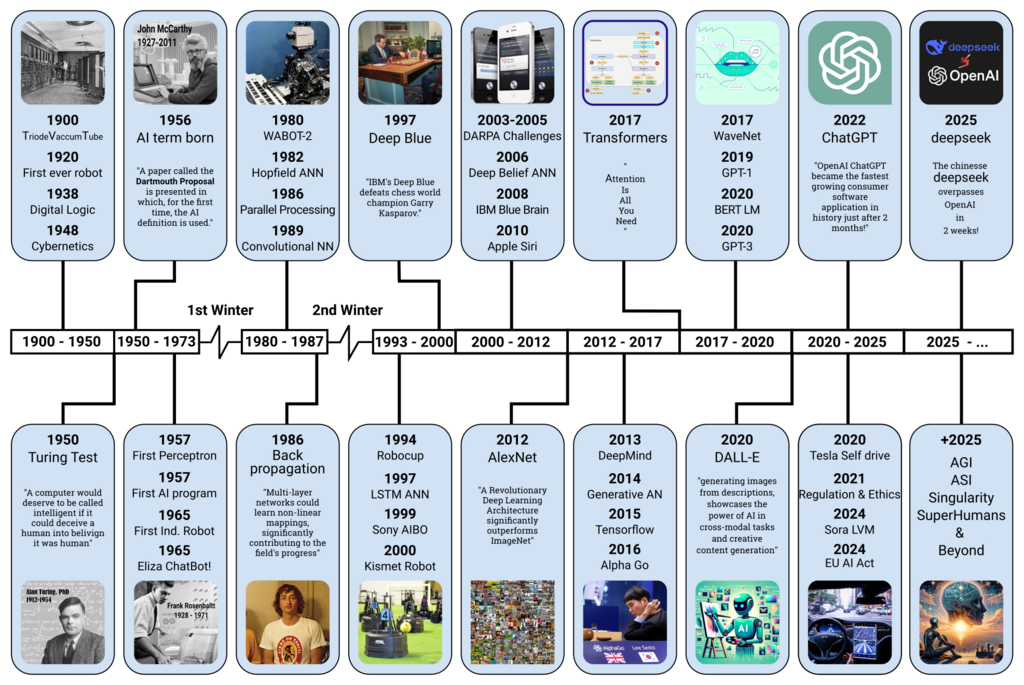
The early years were full of excitement and bold predictions. Progress was slower than expected, however, leading to periods of reduced funding and interest known as "AI winters." But in the last couple of decades, two things changed everything: the explosion of data from the internet and the availability of powerful, affordable computers. These developments fueled the massive breakthroughs we see today.
Two Kinds of AI
When people talk about AI, they are usually referring to one of two broad categories: Narrow AI or General AI.
Almost all AI in use today is Narrow AI. It's designed to perform one specific task very well. Think of a spam filter in your email, a navigation app on your phone, or a system that recommends movies. These tools are incredibly smart within their limited context but can't do anything outside of it.
General AI, or Artificial General Intelligence (AGI), is different. This is the type of AI you often see in science fiction. It refers to a machine with the ability to understand, learn, and apply knowledge across a wide range of tasks at a human level. AGI doesn't exist yet; it's still a theoretical goal for researchers.
| Feature | Narrow AI (ANI) | General AI (AGI) |
|---|---|---|
| Scope | Performs a specific, single task. | Can handle any intellectual task a human can. |
| Example | Image recognition, voice assistants. | A hypothetical robot with human-like consciousness. |
| Status | Widely used today. | Theoretical, does not yet exist. |
Why AI Matters Now
AI is no longer just a concept in a research lab. It has become a fundamental part of modern society, driving innovation in nearly every industry. From helping doctors diagnose diseases more accurately to making transportation safer and more efficient, AI is changing how we live and work.
It's a powerful tool that can analyze vast amounts of information, find hidden patterns, and automate complex processes. This allows us to solve problems that were previously out of reach and create new opportunities for growth and discovery. Understanding the basics of AI is becoming essential for navigating the modern world.
Ready to check your understanding?
What is the core goal of artificial intelligence?
The term "artificial intelligence" was officially coined at a famous 1956 workshop. Where was this workshop held?
Now that you have a foundational understanding of what AI is, its history, and its types, you're ready to explore how it works in more detail.