Unreal Engine Virtual Production Essentials
Introduction to Virtual Production
What Is Virtual Production?
Virtual production merges the physical world of filmmaking with the digital world of computer graphics in real-time. Instead of actors performing in front of a green screen and imagining their surroundings, they can see and interact with a digital environment live on set.
Think of it like a weather forecast, but for movies. The meteorologist stands in front of a screen showing weather maps. In virtual production, the actor stands inside a massive, curved LED screen that displays a photorealistic 3D world. The movie camera, which is tracked in 3D space, films the actor and the digital background simultaneously as one seamless shot.
This isn't an entirely new idea. Filmmakers have used techniques like rear projection for decades, where a pre-recorded video is played on a screen behind the actors. The game-changer with modern virtual production is that the digital world is interactive and responds to the camera's movement. If the camera moves left, the digital background shifts its perspective perfectly, creating a flawless illusion of depth and reality. This is all powered by real-time game engines.
The Key Components
Several key technologies work together to make virtual production possible. At the heart of it all is a real-time rendering engine, like Unreal Engine. Originally built for video games, these engines can create and display complex 3D worlds instantly.
A real-time engine generates computer graphics so quickly that it feels instantaneous to the user, allowing for immediate interaction and feedback.
This engine projects the virtual environment onto a set of high-resolution LED panels, often called an "LED volume" or "the Volume." These screens replace the traditional green screen.
A camera tracking system is crucial. Sensors attached to the camera constantly tell the engine its exact position and orientation. This data allows the engine to update the perspective of the virtual world on the LED screens in perfect sync with the camera's movements.
Finally, motion capture technology can be used to track the actors' movements, translating their performance onto digital characters within the scene.
Benefits and Challenges
Virtual production offers immense creative freedom. Directors and cinematographers can make decisions about lighting, camera angles, and environments on the fly, seeing the final-pixel result right in the camera. This shifts a huge amount of post-production work into the pre-production and production phases, saving time and money in the long run.
Actors also benefit greatly. Instead of trying to emote in a sea of green, they can react to the world around them, leading to more natural and convincing performances. The LED walls also cast realistic light and reflections onto the actors, sets, and props, something that is difficult and time-consuming to replicate with green screens.
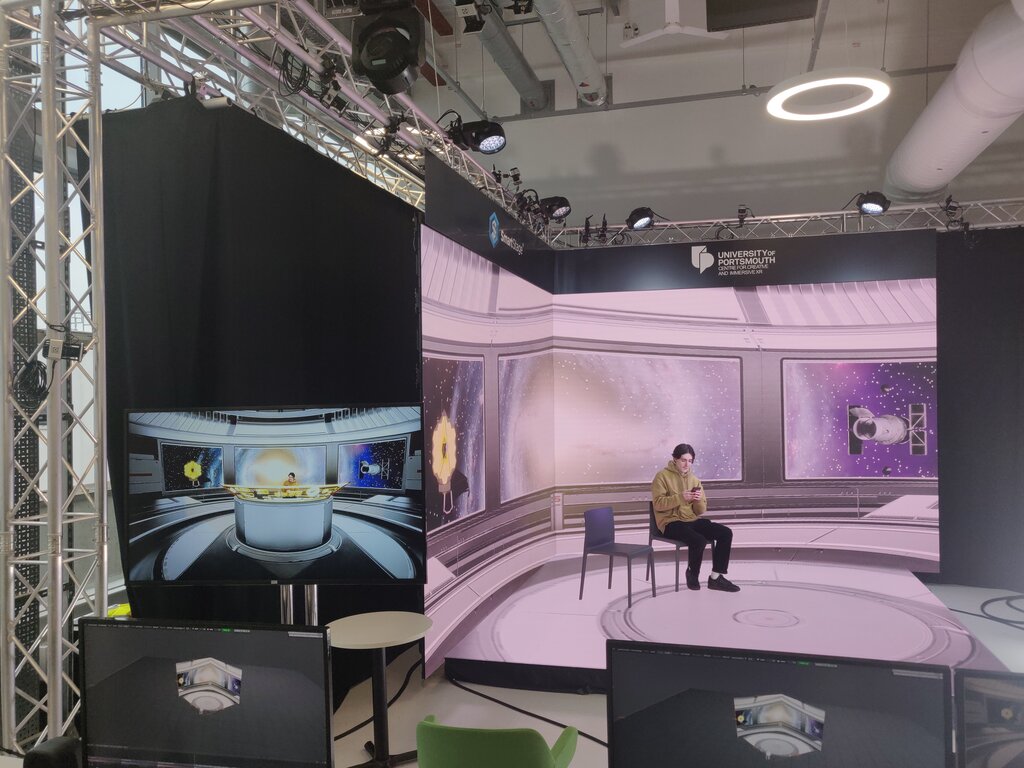
However, the technology presents challenges. The initial cost of building an LED volume and acquiring the necessary hardware is high. It also demands a new hybrid skillset, blending the expertise of traditional film crews with that of game developers and real-time 3D artists. The entire pipeline is technically complex and requires careful planning and collaboration from the very beginning of a project.
Mastering Unreal Engine opens up a world of possibilities, not just for game developers but for creators across various industries.
Unreal Engine has become a dominant force in this field because of its ability to produce stunning, photorealistic graphics in real-time. Its robust set of tools for world-building, lighting, and creating digital humans (Metahumans) makes it an ideal platform for building the complex virtual worlds needed for film and television.
Let's check your understanding of these core concepts.
What is the key feature of modern virtual production that distinguishes it from older techniques like rear projection?
In a virtual production workflow, the massive set of high-resolution LED screens that displays the virtual environment is often called 'the ______.'
Virtual production represents a fundamental shift in how visual media is created, blurring the lines between the real and the virtual to tell stories in new and exciting ways.