Unpacking the Attention Is All You Need Transformer
Introduction to Transformer Architecture
Breaking the Sequence
For a long time, models that worked with language, like Recurrent Neural Networks (RNNs) and their more advanced cousins, LSTMs, processed text one word at a time. It's like reading a long sentence by revealing one word at a time on a narrow slip of paper. This sequential process created two major problems.
First, it was slow. Because the model had to process the first word before moving to the second, and so on, it couldn't take advantage of modern parallel computing. It was a bottleneck by design.
Second, it struggled with long-term memory. By the time the model reached the end of a long paragraph, it often forgot the details from the beginning. Important context was lost, just like you might forget a character's name mentioned ten chapters ago in a book.
Older models were forced to process information sequentially, making them slow and forgetful when dealing with long pieces of text.
A New Way of Seeing Words
The Transformer architecture, introduced in a 2017 paper titled 'Attention Is All You Need', offered a radical solution. Instead of processing words in a sequence, it looks at the entire sentence at once. The key innovation that makes this possible is called the self-attention mechanism.
Think about how you understand the sentence: "The dog chased the cat until it got tired." You instantly know that "it" refers to the dog, not the cat. Self-attention allows a model to do the same thing. It weighs the importance of every word in a sentence relative to every other word. For the word "it", the model would learn to pay more "attention" to "dog" than to "cat" to understand the meaning.
This ability to see the whole context at once solves both of the old problems. The model can process all words in parallel, which is much faster. And since it's not limited by sequential memory, it can easily connect words and ideas across very long distances in the text.
This powerful self-attention mechanism is the core engine, but it's housed within a larger, two-part structure.
The Encoder-Decoder Duo
The standard Transformer model is built with two main components: an encoder and a decoder. You can think of them as two specialists working together on a task like language translation.
-
The Encoder: Its job is to read and understand the input sentence. It takes the original text, like an English sentence, and uses self-attention to build a rich, numerical representation of its meaning. This representation captures not just the words but their relationships and context.
-
The Decoder: Its job is to take that numerical representation from the encoder and generate the output, like the same sentence in French. It also uses a self-attention mechanism, but it works slightly differently. As it generates each new word, it looks back at the words it has already produced and the encoder's understanding of the original sentence to decide what to write next.
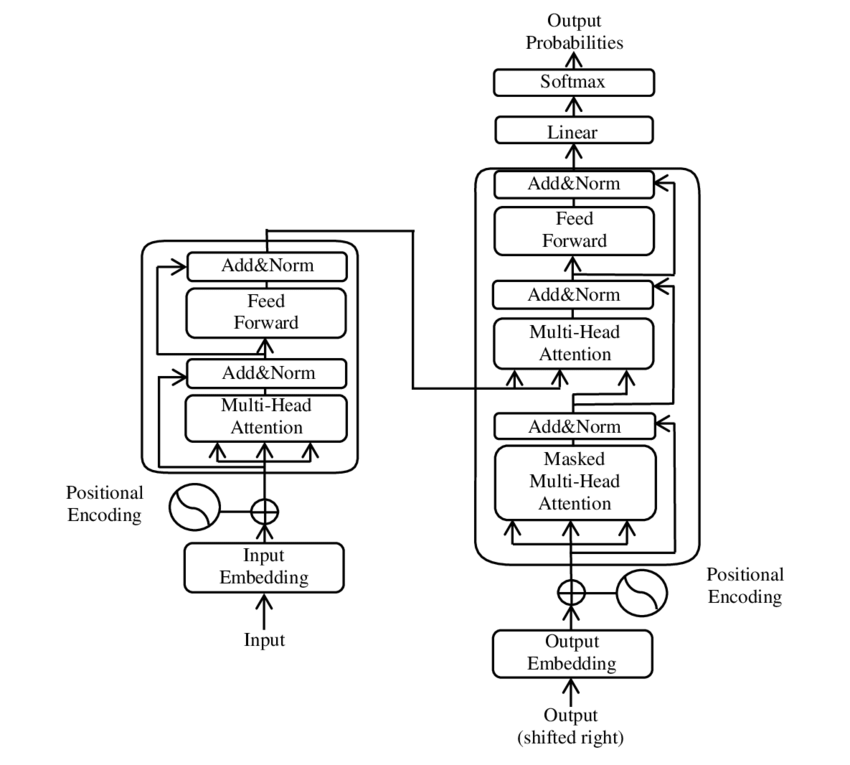
Within both the encoder and decoder, after the attention mechanism has done its work, the information is passed through another component: a simple feedforward neural network. This network acts as a processing step, helping the model to further analyze the information it gathered from the attention layers before passing it along. Each word's representation is processed by this network independently, which helps maintain the parallel processing advantage.
By combining self-attention with this encoder-decoder framework, the Transformer was able to achieve state-of-the-art results while being significantly more efficient to train than its predecessors.
What were the two primary problems with sequential models like RNNs and LSTMs that the Transformer architecture aimed to solve?
What is the key mechanism introduced in the Transformer architecture that allows it to process an entire text input at once, rather than word-by-word?