UNO Rules and Strategy
Deck Composition
The Anatomy of an UNO Deck
An UNO deck consists of 108 cards, a carefully balanced ecosystem of numbers and actions. Unlike a standard 52-card deck, UNO is built on a foundation of four colors: Red, Yellow, Blue, and Green. The cards fall into three distinct categories: Number cards, Action cards, and Wild cards. Understanding their distribution is the first step toward strategic play.
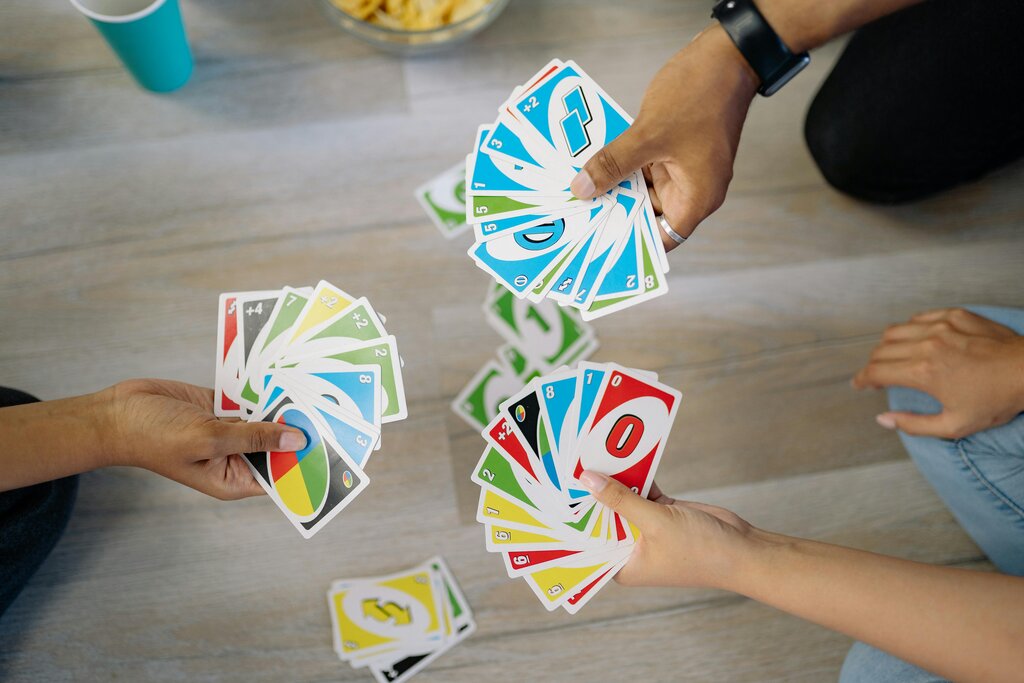
The Numbered Core
The bulk of the deck is made up of 76 number cards. These cards provide the primary mechanism for shedding your hand. For each of the four colors, there is one '0' card and two of every card from '1' through '9'. This uneven distribution is intentional.
| Card Value | Quantity per Color | Total in Deck |
|---|---|---|
| 0 | 1 | 4 |
| 1-9 | 2 (each) | 72 |
The scarcity of '0' cards (only four in the entire deck) makes them slightly more valuable for completing a color change when you're out of other options. Conversely, with 72 cards numbered 1-9, these are the workhorses of the game. The probability of any given card in the draw pile being a numbered card is high, roughly 70% at the start of a game. This statistical backbone is what makes basic plays possible.
Action and Disruption
Next are the 24 color-specific Action cards, designed to disrupt the flow of play. There are three types of Action cards, with two of each in every color: Skip, Reverse, and Draw Two. These cards follow the same color-matching rules as number cards but introduce a layer of direct player interaction and strategic interference.
| Action Card | Function | Quantity per Color | Total in Deck |
|---|---|---|---|
| Skip | Skips the next player's turn | 2 | 8 |
| Reverse | Reverses the direction of play | 2 | 8 |
| Draw Two | Forces the next player to draw two cards and forfeit their turn | 2 | 8 |
While a hand full of numbers is safe, a hand with a few well-timed Action cards is powerful. They are your primary tools for putting opponents on the defensive. Holding a Draw Two can deter the player before you from leaving you with a single card, while a Skip can give you a crucial back-to-back turn to empty your hand.
The Wild Cards
Finally, we have the eight Wild cards, the most powerful and flexible assets in the deck. These cards are not color-specific and can be played on top of any card. There are two types.
- Wild cards (4 total): Allow the player to change the active color to anything they choose.
- Wild Draw Four cards (4 total): Allow the player to change the color and force the next player to draw four cards.
The Wild Draw Four is the undisputed king of the deck, but it comes with a condition: you are only supposed to play it if you have no other cards in your hand that match the color of the discard pile. If you are challenged by the player who has to draw and you played it illegally, you must draw the four cards yourself. If you played it legally, the challenger must draw six cards instead (the four from the card plus a two-card penalty). This risk-reward mechanic makes the a high-stakes play.
These eight Wild cards represent your best chance to escape a bad hand or seize control of the game. With only an 8 in 108 chance (about 7.4%) of drawing one, they are a resource to be managed carefully.
How many total cards are in a standard UNO deck?
Which of the following statements about the distribution of Number cards in an UNO deck is true?
Understanding this composition is fundamental. It's not just about what you have in your hand, but also about what's likely left in the deck.