Unlocking Your Subconscious Mind
Understanding the Subconscious Mind
Your Mind's Autopilot
Think about the last time you drove a car. You were consciously focused on the traffic, the signs, and your destination. But who was handling your breathing? Who made sure you blinked? Who managed the complex muscle movements of steering and braking that you've done a thousand times?
That was your subconscious mind at work. It's the powerful, silent partner to your conscious awareness, handling countless tasks in the background so you can focus on what's right in front of you. While your conscious mind is the part of you that thinks, reasons, and makes deliberate choices, your subconscious is the vast, automatic system operating below the surface.
subconscious
adjective
The part of the mind that operates below the level of conscious awareness, influencing feelings, thoughts, and actions without being the focus of attention.
Your conscious mind is what you use to learn a new skill, like playing the guitar. You have to think about every chord and every strum. But after enough practice, the subconscious takes over. Your fingers find the frets automatically. The conscious mind plans what to do, but the subconscious knows how to do it.
This division of labor is incredibly efficient. Your conscious mind has limited processing power, like the RAM in a computer. Your subconscious, on the other hand, is like a massive hard drive, storing your memories, habits, beliefs, and learned skills.
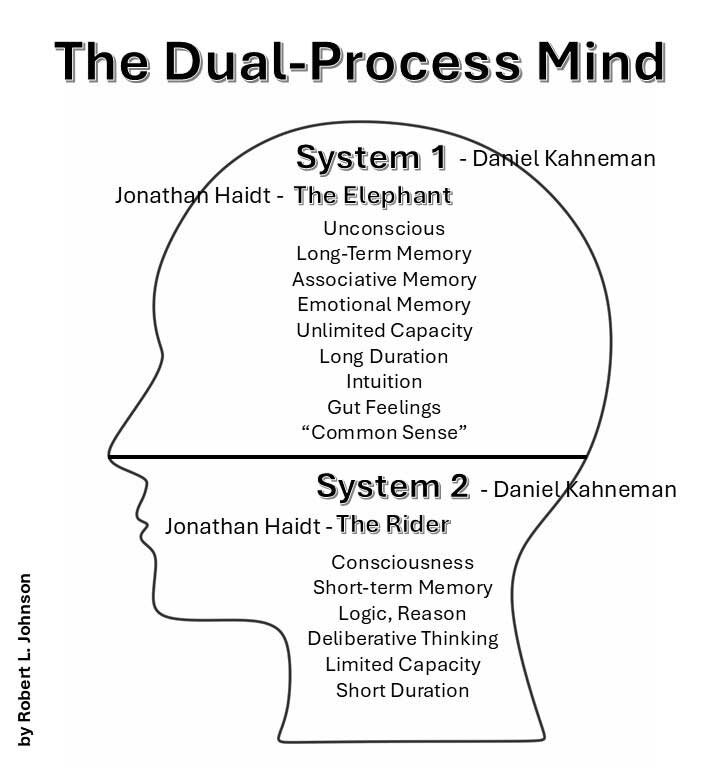
This image perfectly captures the relationship. The Rider represents your conscious, logical mind. It can see the path ahead and hold the reins. The Elephant is your subconscious—your emotions, instincts, and habits. It's immensely powerful.
The Rider can try to steer, but if the Elephant gets spooked or strongly desires to go in a different direction, the Rider has little chance of stopping it. This is why we sometimes act on emotion or find it so hard to break a bad habit, even when we consciously know we should.
Everyday Influences
The subconscious doesn't just handle physical skills. It constantly shapes your perceptions, decisions, and reactions. Have you ever gotten a sudden "gut feeling" about a situation? That's often your subconscious piecing together subtle cues—body language, tone of voice, past experiences—that your conscious mind missed. It delivers the conclusion as an intuition.
Other examples are all around us:
- Automatic responses: Flinching when a ball is thrown your way.
- Habitual actions: Driving your daily commute and not remembering parts of the journey.
- Emotional triggers: Feeling a sudden wave of happiness when a certain song plays, linking back to a forgotten memory.
These aren't random glitches. They are the product of a well-oiled machine that has learned from your entire life's experience. It creates shortcuts to help you navigate the world without having to consciously analyze every single piece of information.
Your subconscious mind is like a vast library of everything you've ever experienced. Your conscious mind only checks out one book at a time.
This means that deep-seated beliefs and values stored in your subconscious have a huge impact on your daily life. If you grew up believing that money is hard to come by, you might subconsciously avoid financial risks, even if a great opportunity presents itself. Your conscious mind might see the logic, but the Elephant is afraid to move.
Understanding this dynamic is the first step in recognizing why we act the way we do. It’s not about a hidden, mysterious force, but a practical, efficient system that runs the show behind the scenes.
According to the Rider and the Elephant analogy, what does the Elephant represent?
Which of the following is the best example of your subconscious mind at work?